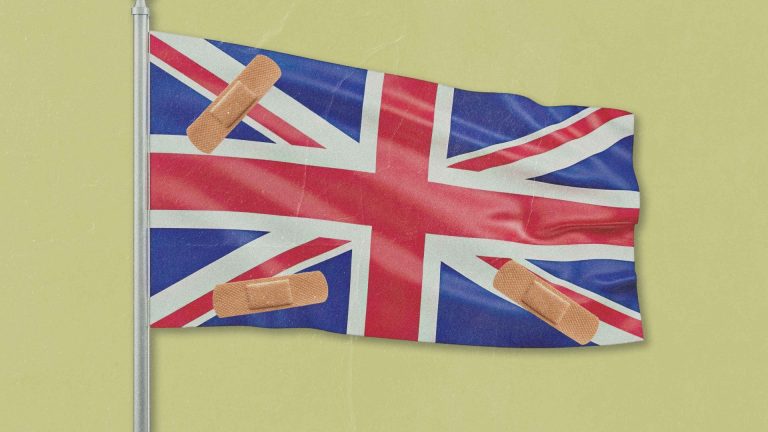
Here in Britain, most of us view the looming 10-year anniversary of the Brexit referendum with deep regret. What has happened to this country following that epochal decision is a story of decline and difficulty, no matter what Brexit’s proponents may claim. Less attention has been afforded, however, to what’s happened to the European Union since.
It is hard to argue convincingly that Britain is in a better place now than it would be inside the EU. Growth has been sluggish; promised trade deals have been underwhelming; trade-offs and cooperation with international partners have been harder fought as a sole voice than inside a large bloc.
That doesn’t mean that the EU is thriving. If Brexit’s 10th birthday is an opportunity to reopen the question of rejoining the bloc, we should first acknowledge the EU’s current condition.
Yet these problems are not an argument against Britain’s return. They are precisely why Britain belongs inside the room. The Europe Britain left in 2016 no longer exists. The question is whether we want a voice in shaping what comes next.
Since 2016, the bloc has suffered myriad crises, from Covid-19 to Ukraine. These prompted a rise in nationalism that has left Brussels with an ever-harder task of balancing European priorities against the national interest of 27 countries.
“National leaders are never rewarded for doing something that makes Europe stronger, but are cheered when they attack Brussels as some kind of blob, responsible for all their troubles,” says Sophie in’t Veld, a former Dutch MEP.
“The obsession with national sovereignty at a time of war, pandemics, climate change, digital revolution. What on earth does sovereignty even mean when your challenges cannot be contained by borders?” she adds.
The most pressing issue is the rebuilding of Europe’s security in the face of Russian aggression. Feasible policies to achieve this range from hugging Ukraine close, to replacing American capabilities with equipment and troops that originate from Europe.
In the crudest sense, that means huge investment in factories, recruitment, raw materials, new technologies and more. That sets up arguments not only over who pays for what, but what is made where, which country gets the jobs boost, and how much responsibility each member state would take on for the common good. Which, in an age of populism and naked national interest, is tough to navigate.
Europe’s economy is also struggling. We live in an age where an uptick of 0.3% in GDP is considered “solid”. Of course, these are unprecedented economic times, with the war in Ukraine, conflict in the Middle East and tariff-driven protectionism squeezing everyone.
Still, Europe has fared worse than the US and China – the two economies it sees as its biggest rivals. One of the major EU objectives from 2017 has been “Strategic Autonomy”, a plan to end over-reliance on other great powers, meaning Europe should be able to act in its own interest when the shit hits the fan – say, if a major war breaks out on the continent causing a global energy shortage.
Building a European economy that can grow autonomously would require large, specific investment in key areas: cutting-edge technology, manufacturing, energy supplies, to name a few. However, that’s hard to do when the economy isn’t growing fast and there is already a bun fight over how funds are allocated.
Complicating matters further, there is no common agreement among the EU27 as to how independent of America or China Europe should be. For every country that shares the French position of total European sovereignty, from defence to capital markets and from green energy to artificial intelligence, there are countries that are happy to rely on third parties if it means a cheaper deal.
To take one example, European officials from the so-called “frugal” states believe that despite the best efforts of Brussels to build a domestic green industry, cheap Chinese electric vehicles and solar panels will ultimately be too alluring. Or to use another example, frontier states close to the Russian border are reluctant to pivot away from American security architecture for fear that it cannot be replaced effectively by Europeans.
There is also a big question mark hanging over Europe’s enlargement project. Growing the bloc would provide a boost (some might say an artificial boost) to the economy. Bringing in new members also means acquiring their expertise: say, in the case of Ukraine, a defence manufacturing base that every other European country envies.
That’s the upside. The downside, as many member states see it, is that you also risk increasing a wave of migration – a hot-button issue across the EU – and more economic competition. Case in point: Poland, arguably Kyiv’s biggest EU ally, has blocked cheap Ukrainian grain entering the single market for fear it would undercut grain sold by Polish farmers. This dynamic can be almost copy and pasted for virtually every candidate state, only varying on what their domestic economic strength might be.
There are no quick fixes to Europe’s current problems. However, there is a loose acknowledgement that pivoting away from US dependency in some form is a good place to start – critically in defence. Exactly how far Europe should go varies depending on who you ask. But something most agree on is that the US focus has already shifted from Europe and is unlikely to return.
“If I were an American politician, I wouldn’t be looking at Europe as a priority,” says Gérard Araud, a French career diplomat who served as ambassador to the US. “Whatever hopes we have of a Democrat returning to the White House, I would argue they are not more likely to rebuild that transatlantic partnership than the next Republican.”
Araud sees this dynamic playing across everything from security to economics. “Europe is not where you find the great technological advances that will define the next decade. It is a huge consumer market and that’s it.”
As mentioned above, part of the reason that some countries – particularly in the east – have been reluctant to pivot away from the US is because they didn’t believe the EU could replace the exceptionally good deal on defence they’ve enjoyed for decades. Nato’s Article Five provided guarantees from the alliance’s superpower that, should Russia or any other adversary launch an armed attack, they’d come to our rescue.
Hindsight is a wonderful thing. That guarantee bred a complacency that stopped serious investment in European defence infrastructure, along with the equipment and personnel required to protect us. When Trump arrived on the scene in 2017, the American guarantee was revealed as a myth, and Europe’s true vulnerability was suddenly exposed.
Nearly 10 years on, it seems that Europe has finally realised the error of its ways. That pivot away from the US is slowly happening. Not only has spending increased, but joined-up thinking through the EU institutions, and bodies like the coalition of the willing, have forced a political dialogue that is genuinely constructive and has led to joint procurement projects and European-led deployments that may previously have waited for American sign-off or participation.
The pivot will have to be slow; even with Europe’s renewed energy, American capabilities still cannot be replaced overnight. But after years of talk at a European level, it is now possible to see a future where an erratic US president threatening to withdraw from Nato isn’t as terrifying a prospect as it has been for so long.
Unfortunately, the unity and progress made on security – still in its relative infancy – has only come about through necessity.
That urgency has not carried over to other policy areas that are just as critical to the EU. A recent and notable example is the watering-down of environmental rules to boost competitiveness and growth. It is only the latest rollback of EU climate goals, following last year’s agreement among member states to weaken the bloc’s carbon-reduction plan.
Prioritising current economic concerns over the future of the planet has mostly been driven by the right, but has only been possible because of a deal reached between the far right and the centre right, led by Ursula von der Leyen’s powerful European People’s Party.
Transactional politics has become commonplace in Brussels and is a far cry from the levels of unity we saw among member states as they repeatedly stared Britain down during Brexit negotiations.
Suggested Reading
The unBrexited Britain that could have led Europe
These transactions have increasingly moved away from debates in the European Parliament and are now defined by horse trading in the European Council – the body representing the national leaders of the EU27. This grubby “you scratch my back, I’ll scratch yours” dealmaking has had many negative consequences for the EU as a whole, but the most consequential might be how Hungary’s former prime minister, Viktor Orbán, used it to legitimise his assaults on the rule of law.
In 2021, the EU27 agreed its long-term, six-year budget and an additional package in response to the Covid pandemic. Orbán used his veto to hold up the entire fund in exchange for watering down language on the rule of law, which would have restricted Hungary’s access to cash. He was protected by his populist pal, former Polish PM Mateusz Morawiecki. This set a precedent for delinquent member states to coordinate abuse of their voting powers at a European level.
The dynamic of populists using Europe as both a punchbag and cash machine is not sustainable. Fortunately, there is some hope on the horizon. Despite the problems facing the EU, other countries are still trying to join. The expansion of the bloc could be an opportunity to reform how the EU works, especially if it is to welcome Ukraine into the fold. It might also be the moment British Europhiles have been waiting for.
“Something is stirring across Europe that few have fully registered. A referendum in Iceland. A renewed debate in Norway. A loud, insistent knock from Ukraine and Moldova. Each, in its own way, is weighing the case for joining the European Union,” says Gabrielius Landsbergis, former foreign minister of Lithuania.
“It is a moment with greater potential than the big-bang enlargement of the 2000s: a chance for Europe to rethink how it works internally and what kind of power it intends to be in the world. It is also the moment to prepare for the ‘Br-Enter’ – the day the UK’s return, in some form, moves from the unthinkable to the negotiable.”
The domestic arguments for Britain rejoining the EU are well-established. Less commonly heard is the European case. Sure, the reality remains that Europe has an intrinsic distrust of Britain after the Brexit negotiations. But a sincere, mandate-driven application from Britain to join the bloc, which coincided with wider expansion – specifically alongside Ukraine, whose accession is seen as a priority – would be too tempting for many in Brussels to shoot down.
Ironically, Britain’s return would bring with it a strong culture of democracy and respect for rules that has been missed in Brussels post-Brexit. “The UK always had a culture of respecting parliamentary democracy. They always provided excellent commissioners and civil servants, something we have missed since their departure,” says Sophie in’t Veld.
Conversations about Britain’s return or EU reform to accommodate Ukraine are not happening in public. They are being held by officials and policy experts in Brussels who see it as a once-in-a-generation opportunity to make the EU fit for the modern world.
This is the context in which pro-Europeans in the UK must see the Rejoin debate. It is not about returning to what we once had, rebates, opt-outs and ways to work around a system we don’t like, but a chance to re-enter the bloc alongside our great friends in Ukraine and make Europe better for ourselves and everyone else.
The old arguments about Brexit are staid and largely irrelevant. The experiment has failed and the institution we voted to leave has changed. So too has the rest of the world – into a place far less accommodating than Europe ever was.
Europe’s challenges are our challenges, whether we are in the EU or not. We simply cannot change our geography. Campaigning to rejoin the EU today would not be an admission of failure or an act of submission, but a positive project that puts us at the heart of our own geography and destiny. It is time for our political leaders to admit that and start making the case to the public.
Luke McGee is an award-winning journalist specialising in European politics, security and diplomacy