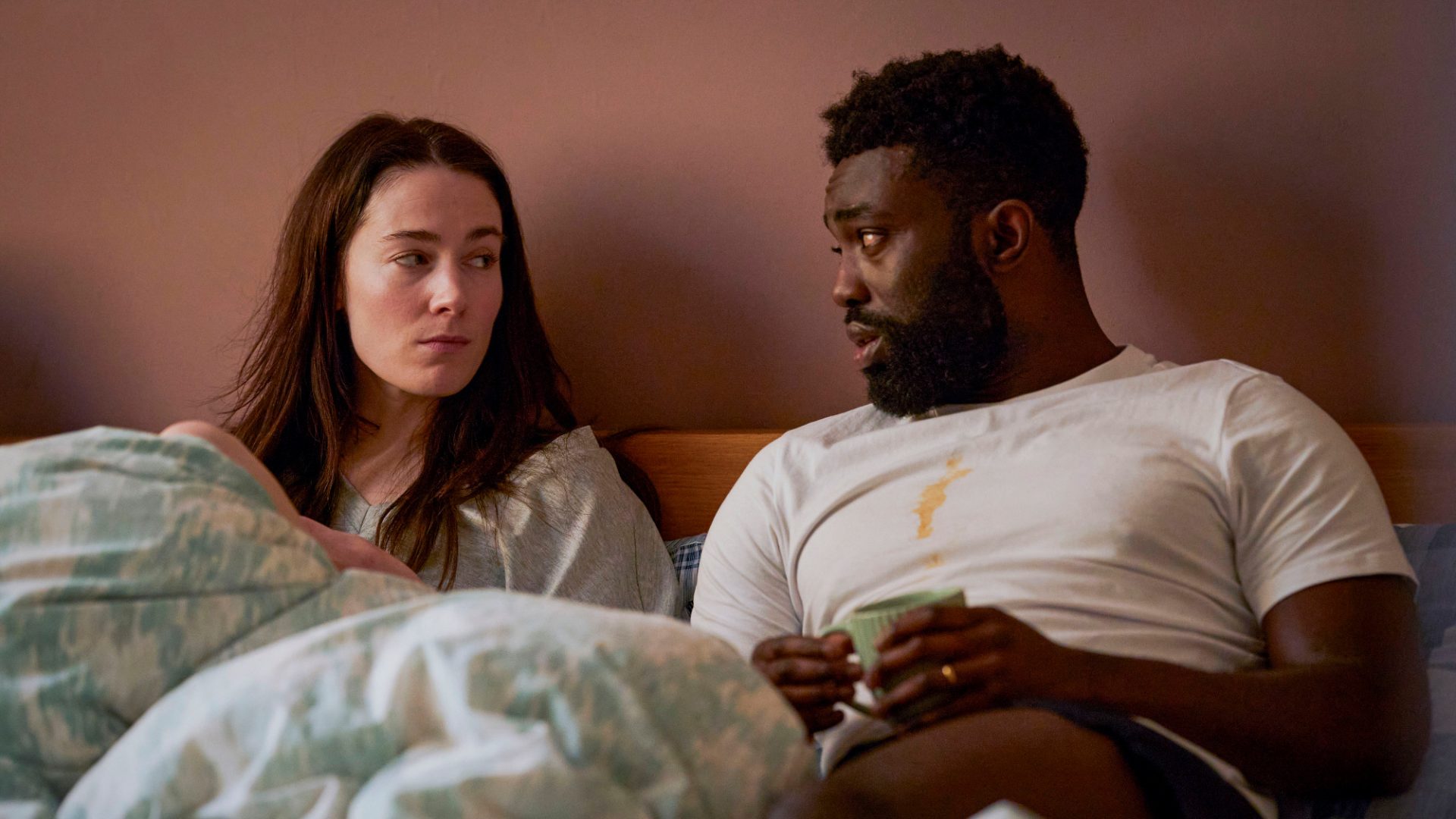
Lisa and Stephen have read online that they can be referred to a recurrent miscarriage specialist after it happens twice. Unfortunately, they’re wrong. “That’s after three,” the doctor tells them, not looking up from his typing.
Played by the equally exceptional Siobhán Cullen and Paapa Essiedu, the couple are the focal characters in Stefan Golaszewski’s Babies, a six-episode drama about life after baby loss. Created, written and directed by Golaszewski, it explores how to communicate what you need from your partner, loved ones and medical professionals during struggles to conceive, and what happens when you can’t. It’s honest, empathetic and breaks your heart. It’s a gift of a watch.
Back in the surgery, the GP eventually abandons his keyboard long enough to make eye contact with Lisa and Stephen before delivering his verdict. “We don’t get in a flurry when a 34-year-old has a couple of miscarriages,” he shrugs. When they have had three, then they can explore matters further and, he presses, Lisa may have another… and another… and another…
He advises that they get some sleep, stay positive and keep breathing. In fact, he’s got a leaflet on the latter if he can find it among his other office clutter. In the car park, the pair try their best to laugh off his sanitised attitude to their questions, but their humour is surface-level. A plaster covering the wound that both of them are reluctant to discuss runs throughout the series; even among those meant to be on their side, even with loved ones, the pair feel alone.
The couple’s struggle to conceive continues with each episode and as it does, their interactions with those around them become increasingly strained. Lisa’s parents coo and swoon over her ideas for her career as a distraction; her girlfriends help in their own way, occasionally becoming more fixated on their own fertility journeys, while Stephen’s mother attempts to bond with Lisa over each miscarriage. Stephen’s father, meanwhile, wants to “remain positive” and avoid, at all costs, any real conversation about what his son and his wife are going through.
Then there is Stephen’s best friend, Dave – a stereotype of toxic masculinity – and his new girlfriend, Amanda. The two men communicate through beer orders and one-liners and, in fact, it’s very unclear why they’re friends. Amanda, on the other hand, is extremely unlikeable and, as a minor criticism, seems to have been written for this sole purpose.
Like Golaszewski’s Marriage, the plot of Babies is non-linear. Scenes leap months ahead, at times we join encounters without all of the appropriate context, and flashbacks are scattered throughout most of its episodes. And yet, this doesn’t detract from what Golaszewski is trying to achieve. Babies isn’t meant to make you think, or offer a grand societal commentary – it’s supposed to make you feel, and here it succeeds.
It is by no means an equal comparison, but the way doctors brushed off Lisa and Stephen’s concerns felt familiar. When I was diagnosed with polycystic ovary syndrome (PCOS), the consultant concluded our appointment with a brief commentary on how this meant I “will likely struggle” to get pregnant.
I was 26 and, in all honesty, having children could not have been further from my mind, but I still felt like I’d been hit by a bus. Like Lisa and Stephen, I was then presented with a leaflet. The relief the doctor then expressed when I mentioned I was in a long-term relationship was almost comical. Almost.
Suggested Reading
The unbreakable Gisèle Pelicot
More recently, the topic reared its head in a contraceptive appointment. I was booked in for an IUD removal, where the doctor enquired if there was any possibility I could be pregnant. Without going into specifics, I told her no.
She sucked her teeth before suggesting that we just do a test anyway. I agreed, and was then asked whether if I was pregnant I would be proceeding or requiring a termination. I didn’t respond and was ushered to the bathroom to complete the test.
“That’s all fine,” she said five minutes later when she swanned back into the room. “All fine”, I found out after pressing her, translated to “negative”.
I know three women who have experienced baby loss, but the statistical reality is that I know more. Golaszewski’s show endeavours to hear them and put human connection and communication back at the centre of fertility journeys.
It may not sound like a show for those who have experienced baby loss to watch, but it is for them. The writing will break your heart wide open. But it may also, slowly, piece it back together again.
Eleanor Longman-Rood is digital editor of The New World