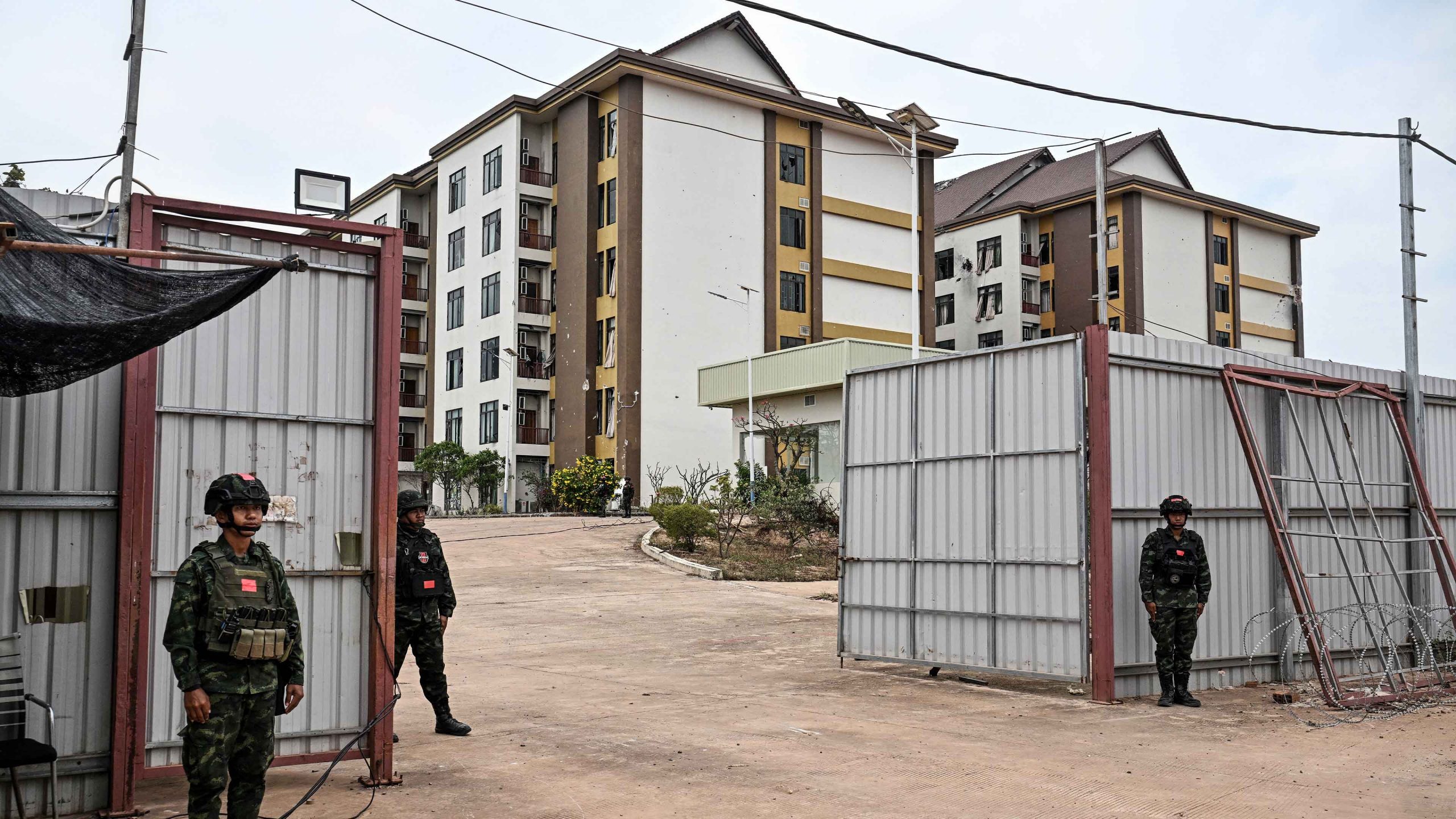
The 37 buildings that make up the abandoned scam compound on the Cambodia-Vietnam border appear to have been ransacked. Stripped metal bunk-beds lie askew in tiny dormitories, where local authorities say seven to eight thousand people were housed, eight to a room, most of them trafficked into Cambodia and held against their will.
In the central courtyard, the basketball court is empty, and grimy fish tanks are piled up outside a line of shuttered restaurants. A closed currency exchange advertises US dollars, Indian rupees, Vietnamese đồng, Indonesian rupiah, Chinese yuan, and the cryptocurrency Tether.
Chinese-language posters promote illegal gambling sites, tattoo shops and a “massage” parlour inside the compound – a glimpse into how bosses here spent the money they forced captives to steal from victims around the world. In what feels like a grim joke, an overturned employee “suggestion box” lies rusting on the ground.
This is the Golden Fortune Science and Technology Park, part of the Prince Holding Group. The UK and US governments sanctioned the Prince group in October 2025, describing it as a transnational organised crime outfit that had conned millions of dollars out of their citizens through online investment scams.
In the wake of these sanctions, the US seized over $15bn of the Prince group’s assets and the UK government froze £125m in UK-based assets, as well as a £12m London townhouse in September.
This scam empire is just one piece of a gargantuan criminal industry that poses a growing threat to the UK. By the time Cambodia launched its long overdue crackdown on the scam industry late last year, 300,000 foreign nationals had been recruited or sold to work in 600 compounds and other scam sites.
Suggested Reading

Trump, Putin and the ‘peacemakers’ who make war more likely
Research by the National Democratic Institute in Washington DC and the analytics firm Inca Digital estimated that scam revenues at these sites may have exceeded $37bn per year. Meanwhile, in England and Wales, an estimated £14.4bn is lost to fraud and scams each year.
Addressing a conference in Phnom Penh on combating online scams, the Home Office minister, David Hanson, said fraud now constitutes almost 50% of all crime in the UK. To help tackle this, on September 23 the UK and Cambodia signed a new cooperation agreement.
A year ago, Prince seemed untouchable. This was Cambodia’s pre-eminent real estate company, churning out multibillion-dollar real estate projects all over the country, even though reports emerged claiming that many were scam compounds that enslaved and tortured workers. The company’s Chinese-born founder, Chen Zhi, was a naturalised Cambodian citizen and personal adviser to the prime minister who at one stage co-owned a casino-hotel complex with the current interior minister – the same minister who this month signed the cooperation agreement with the UK.
We last gained access to the guarded and operational Golden Fortune compound nine days after sanctions were announced. Workers were crammed into locked dormitories. But we had to run, pursued by guards and Chinese managers who appeared to alert police to block the road to try to stop us leaving.
Since then, international pressure has led to Chen Zhi being deported to China. Major compounds shut down. The countryside is littered with ghost towns that were only built to serve criminal interests. But questions remain over how thoroughly this criminal industry is being investigated.

Authorities are failing to screen survivors of human trafficking or interview them as witnesses. Thousands of trafficking victims have remained stranded in Cambodia, with many – including children – held in immigration or criminal detention. At Golden Fortune, police admitted they did not raid the building, probably losing vital evidence while bosses could flee without arrest.
“The old online fraud model depended on large, visible compounds. What I call ‘Scam Version 2.0’ is much more portable. A small team with phones, internet access and a way to receive and launder money can set up almost anywhere,” said Martin Purbrick, a former Royal Hong Kong Police detective and now consultant on organised crime.
“Cambodia is an important part of the picture, but the online fraud economy is no longer confined to any one country,” he said.
“The measure of success is whether authorities dismantle the networks behind the scams, not simply how many premises they raid.”