It’s 36 degrees in Paris and, post-lunch, we’re Lime-biking back over the Seine towards our hotel, searching for the perfect jambon-beurre along the way. Despite having eaten steak de veau for lunch, we now need a sandwich after the inevitable vodka martinis at Bar Nouveau and the margaritas at Candelaria, a dimly lit cocktail bar hidden behind a busy taquería in Le Marais.
The jambon-beurre is feted, even cultish because it’s the perfect combination of historic, affordable, and delicious – much the same as a slice of pizza in New York, a bowl of pad Thai in Bangkok or tacos in Mexico City.
The French are collectively mad for their most famous sandwich. It is one of simple design: a crusty baguette, freshly baked; slices of quality bone-in ham and a lot of creamy butter. No cornichons, traditionally, despite what Pret might have you thinking. The chef Michel Roux might be the biggest name in the anti-cornichon lobby in Britain.
In this sandwich, there is nowhere to hide. It’s sophisticated in its simplicity, and harks back to a time (some say the jambon-beurre originated in Paris, around Les Halles, in the mid-1900s) when workers would toil for hours each morning before sitting down with their reward. It makes the lack of interference even more revered: don’t spoil a worker’s lunch, be it a jambon-beurre, a Cornish pasty, Brazilian feijoada or a bento box in Japan.
In normal times, the sandwich is all over Paris come lunchtime. The problem is that my visit is in late summer, when half (more, probably) of the city has shut up shop and headed to the provinces to eat galette.
Places like Bouillon Pigalle and Chartier are open, but some of the lesser-known locations prized by locals and charted only by word-of-mouth are closed or at least operating at reduced hours. So it is that we end up at the shop round the corner from our suite in the Park Hyatt. It’s a cafe on a road leading from Place Vendôme.
This is an expensive area, not usually one associated with everyday baguettes and any semblance of buzz. But we find a queue, and there’s promise beyond it: most in it appear to be, or sound, French. Locals are sitting down to dainty glasses of nondescript wine and eating baguettes filled with bone-in-ham and, in some cases, a semi-hard or soft cheese.
Vendôme, grandly positioned inside the moneyed 1st arrondissement of Paris, is mostly surrounded by luxury designer shops and high-end cafes. The Ritz is here, and does its own jambon-beurre, so too La Pâtisserie du Meurice par Cédric Grolet, a truly mesmeric shrine to pastry. If you have 18 euros to spend on sculptured confectionery – namely Grolet’s hyper-real fruit sculptures, made from lacquered chocolate shells filled with layers of cream, ganache and poached fruits – I cannot recommend doing so enough.
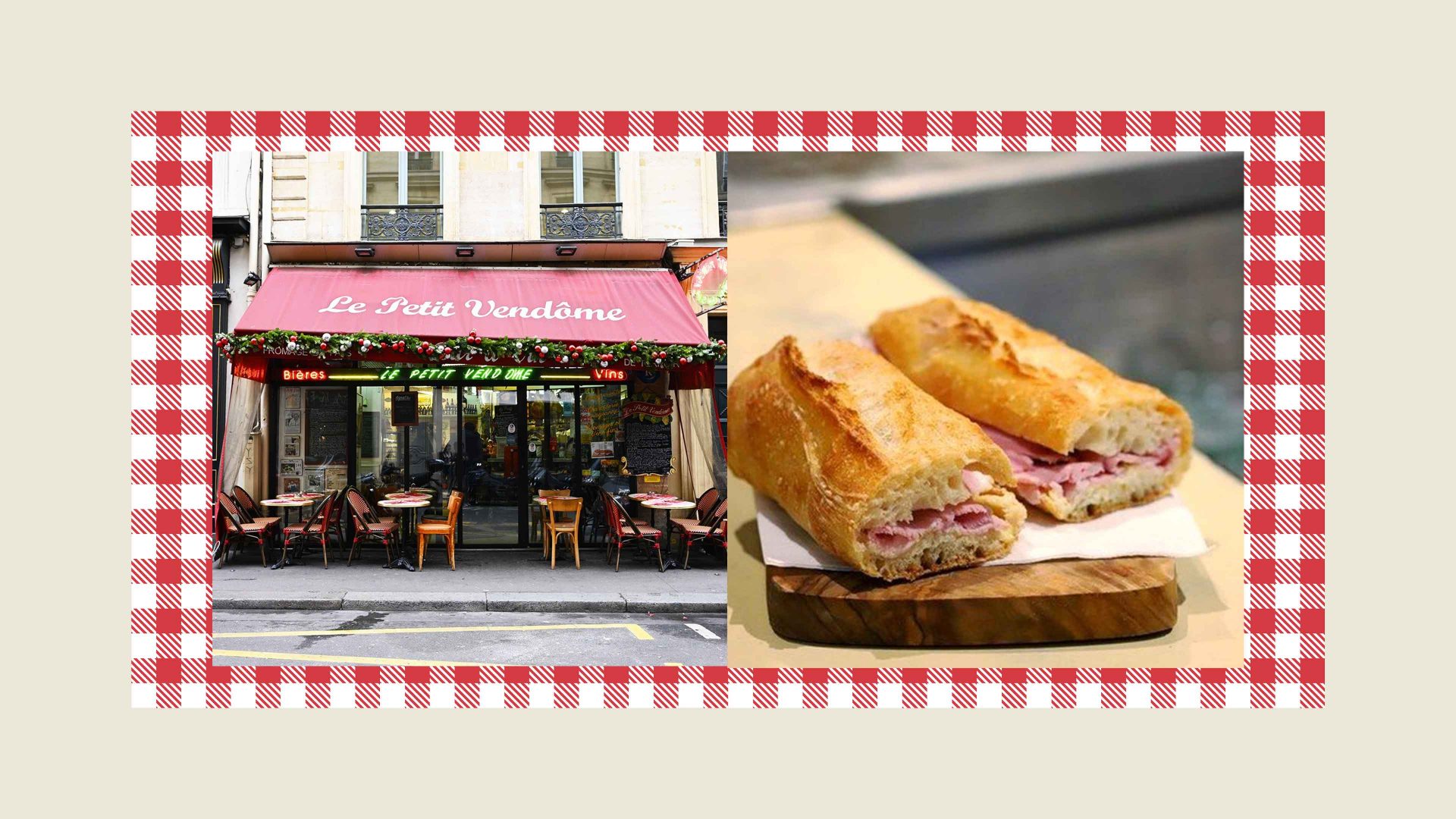
But Le Petit Vendôme is an exception in that it’s roundly affordable, chaotic and casual. It’s a microcosm in a grandiose locale: red gingham, disordered buttering, floppy cheeses melting on shelves, embellished mirrors and posters, old telephones and wires and stickers on windows. One of the stickers recognises the Association pour la Sauvegarde de l’Oeuf Mayonnaise, a designation founded by the French journalist Claude Lebey to promote proper mayo.
There is much clattering here, staff whirling about carrying budget vins blancs et rouges. There are a great number of chalkboard menus, French flags around them, which seem largely unnecessary considering pretty much everyone comes here for one thing. Or, if not a jambon-beurre, a variation thereof.
Seasoned jambon-beurre eaters might add cantal, a milky and quite sweet cheese from the Auvergne region. It marries the pork emphatically. Or – and how I wish I’d ordered one of these for us to share too – a sandwich named Le Patron, or The Boss, which is from Burgundy and sees the ham cooked with garlic, parsley, and cheap white wine.
Instead, we each have a classic jambon-beurre at €6.50 apiece. Which is of tremendous value: each baguette is long, flavourful and chewy – I think a proper jambon-beurre should take at least 15 minutes to eat – and buttered well, the fat a mattress for sheets of meat. The sandwich here has won a multitude of awards, so too the bread.
Is this the best jambon-beurre in Paris? In Europe, even the world? Time Out magazine said it was in 2025. Various other titles have showered their sandwich with praise. It is undoubtedly glorious, though I think what is known as the Provençal Rosé Paradox is at play here: the romance of this Parisian deli pulls you in, and it might not taste as good elsewhere.
Suggested Reading


The dishes that made Anthony Bourdain
What, in Britain, is the equivalent of the lunchtime jambon-beurre? We have wondrous breakfast sandwiches – bacon and egg being the optimal example – but come midday, the country’s integrity begins to wane.
Places like Mondo in London, Fat Pats in Manchester and Sandwich Sandwich in Bristol are beginning to nail the event sandwich, but with their complex fillings and higher prices, these aren’t everyday lunches. It’s more likely a British office worker will visit a branch of M&S and make do with a ham and mayo on granary, the bread day-old, the plastic window providing only marginal insight into the terrible notion within.
If you live or work in a big city, the answer is to find a good mid-range deli. Or to save up for the Eurostar and a jambon-beurre at Le Petit Vendôme.