It is a cold day in Tbilisi. Nodar Vardiashvili speaks no English and only nods his head as I approach the counter. I point to the old sausage boiler (made in the old USSR, I suspect) and to the beer pump and say “please” in English, then attempt to do the same in Georgian.
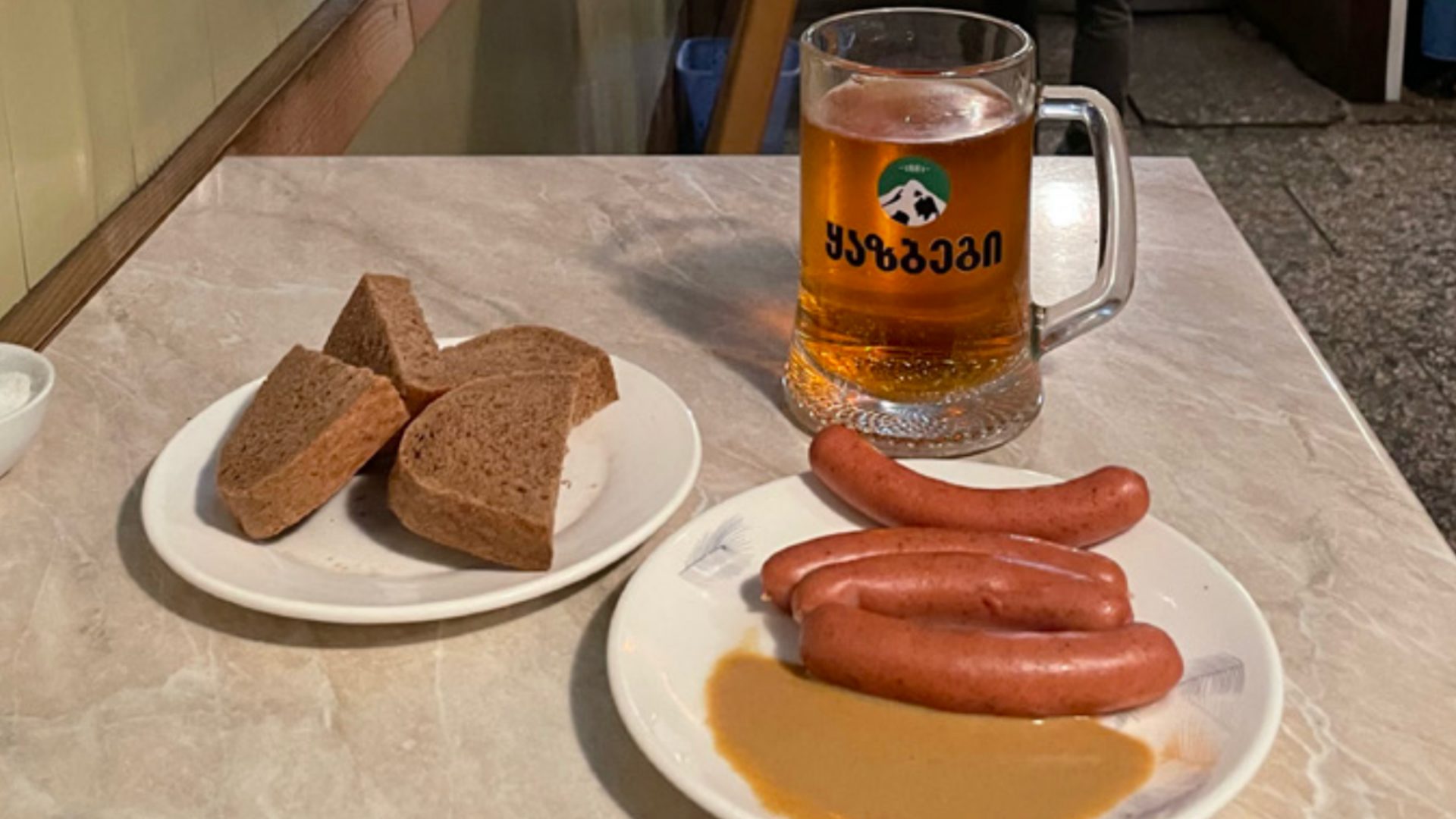
He acknowledges, asks whether I’d like “one” or “two”, and soon four smooth sausages appear on a little patterned plate together with a large dollop of mustard, another plate of rye bread, and a crisp, cold mountain beer.
Tbilisi is changing, fast. You might have seen contestants running across the bow-shaped, steel-and-glass Bridge of Peace on the sixth series of Race Across the World, with John Hannah huskily explaining how a modernisation drive means “onion-domed churches and Soviet tower blocks stand shoulder to shoulder with ultra-modern new buildings”.
Tourism has boomed too – in 2025, the country welcomed 7.8 million international visitors, 6% up on 2024, and UK visitors increased by 25%. Few will have come specifically because of places like Nodar’s, but more should.
There are only two other diners there when I visit. One is portly and gregarious, in circular sunglasses, and requires a second round of mustard halfway through eating; the other quietly dispatches his late lunch with such pace as to be moderately alarming.
They are quite small and gently curved, the sausages, and the closest comparison I can draw for British readers is the frankfurter: cheap cylinders of salty pork, here a relic of Soviet-era Georgia and epochal as much as sustaining. I’m told later that a serving of four is an amateur move – most people have eight.
As for the bread, I’m served two thick slices cut into quarters. It’s coarse and malty and looks a little dry, but isn’t at all. It punctuates the meat while tempering the hot mustard, a large dollop of which makes my eyes water. It’s hangover-curing food, especially with the Kazbegi, a classic and refreshing European-style lager that diligently balances bitter and sweet with its hoppy aroma and caramel notes.
All this, incidentally, for 10 lari, or under £3. I remember that a single hotdog at an Odeon cinema is about a tenner… without the bread and beer.
You might be wondering why I’ve not yet told you this shop’s name. Well, it doesn’t have one, despite existing in Tbilisi since 1964, riding out wars, political turmoil and economic strife. It hardly has a presence online – no website, phone number or Instagram account. One wily visitor listed it on Google as “Sausages and beer” some years ago, but it’s yet to go viral.
Suggested Reading

The bus station Chinese that’s one of the best restaurants in Britain
The story of its owner, Vardiashvili, is Diportian. That is to say, it’s similar to the ones told about Diporto, an Instagram-famous basement taverna in Athens that has become a mecca in recent years. Like Nodar, its chef-owner, Mitsos, started as a waiter, wears a white food coat and doesn’t tend to say very much. Both he and Vardiashvili also happen to sport suave flocks of grey hair and even greyer moustaches.
Vardiashvili also began as a young apprentice (he was 22) before inheriting it from the previous owners in the 1990s. He’s 77 now, having dedicated his working life to affordable lunches. He still walks to his little kitchen every day, a journey almost an hour-and-a-half long.
For 15 minutes or so as I eat, I see Vardiashvili turn sausages punctiliously with metal tongs, occasionally sighing among the billowing steam that emanates from their hot bath. Out front, there’s only room for 20 diners, all of whom are invited to stand and perch at old plastic tables.
In place of napkins are small sheets of rough paper; the lighting is dim and the cladded walls bear no artwork. Two fans are positioned at each end of the room, though neither turn in winter.
Through the small hatch to the kitchen, religious paraphernalia hangs at the rear, a pair of abacuses on one side, the wood worn to near-splintered, and washed glasses rest beneath the beer spout ready to be filled. There’s a small second room where crockery is washed behind a blue curtain.
Until recently, this canteen in the working-class neighbourhood of Nadzaladevi looked more like a bunker than anything: a long, thin, metal-clad structure painted a leafy green and surrounded by other low-rise buildings and concrete walls. Today, it’s covered in faux brickwork and features a neon sign next to the kitchen window, the only one low enough to see into.
But its facelift doesn’t hide the fact that there’s construction work happening on all three sides, tall new flats that dwarf this diminutive canteen. Its entrance on the right-hand side is now adjacent to wood-chip boards and hoardings, the corrugated rooftop drowned by girders and beams.
All around are signs of Georgia’s change, one that is being frustrated by war in Iran. Unless something changes soon, there will be fewer visitors from the Middle East this year – worrying, since they account for only 10% of all tourists but 20% of all tourist spend.
Those who make it, though, can find their way to a cafe with no name and reflect that in unpredictable times, two things we can always rely on are sausage and beer.
Josh Barrie is a food and drink writer living in London