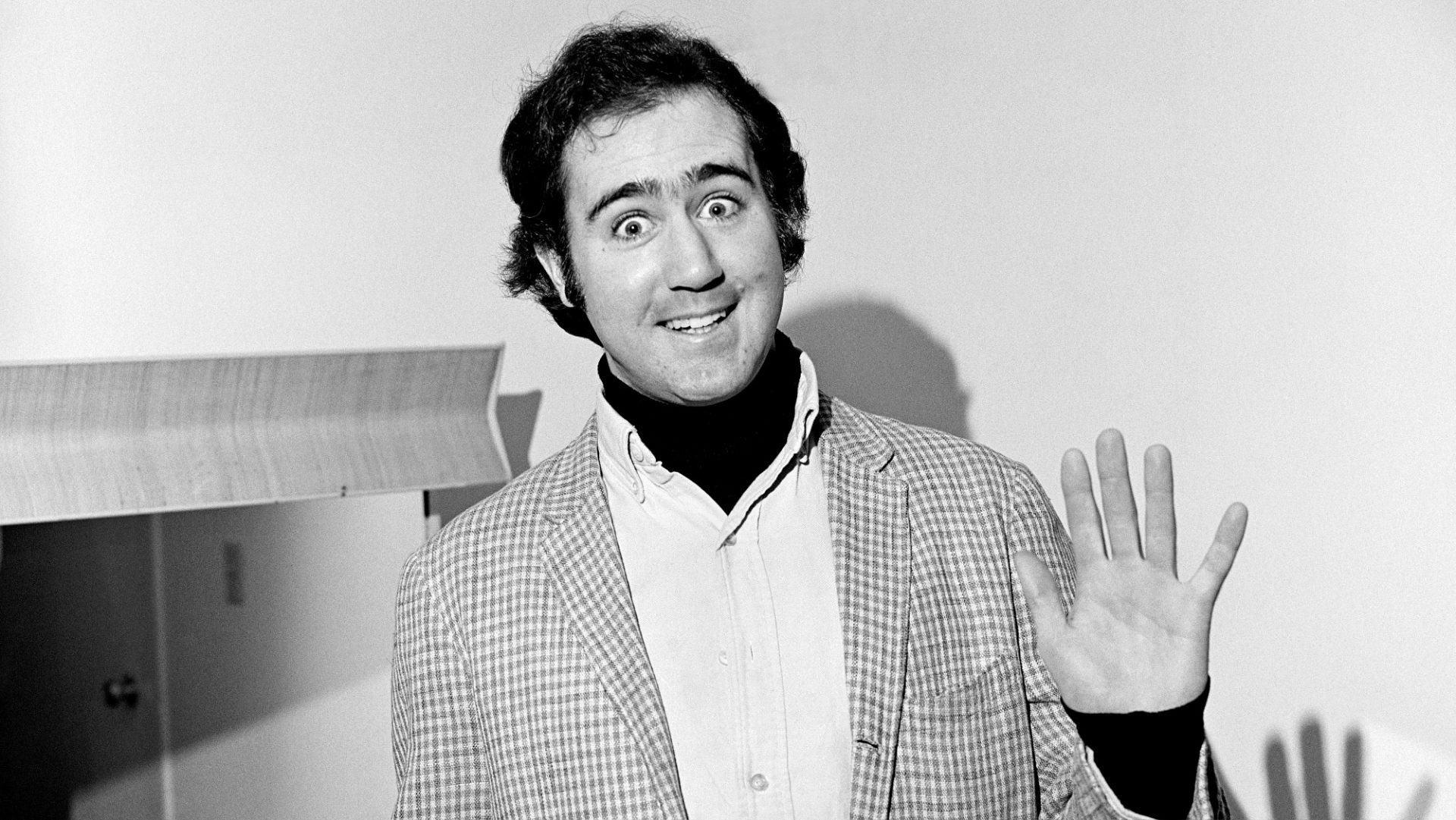
January 17, 1949 – May 16, 1984
“When I was starting in show business, my grandma used to say, ‘Why are you wasting your time?’” Andy Kaufman tells the packed audience at New York City’s most prestigious venue. “I told her that one day I would be performing at Carnegie Hall. I said ‘when that time comes, I’m going to give you the best seat in the house.’ So here she is, my grandma!”
From an armchair at the side of the stage, an old woman in a red dress waves proudly. “After the show, if everyone is good, we’re all going to go out for milk and cookies,” Kaufman continues. “Everyone say ‘milk and cookies’.”
“Milk and cookies!” the joyous crowd repeats. It’s not what they were expecting from a performer whose reputation is for delighting in an audience’s discomfort and confusion.
Clearly, Carnegie Hall is bringing out the best in Kaufman; this is the show of his life and he is storming it.
At the end of the night, he thanks the bands and singers who made special appearances. “And thanks to my grandma, played by… Robin Williams!” Standing up from the armchair where he has silently spent the entire evening, the audience gasps at the deception as Williams waves, removing his (pre-Mrs Doubtfire) makeup and costume.
“That was the first half of my act,” Kaufman tells them, provoking huge laughter. But he is not kidding. “There are 20 buses waiting for you outside. Please everyone follow me,” he says, jumping down from the stage and walking up the aisle to the front of the theatre. Dubiously at first, audience members follow him outside, where a row of buses does indeed await. The convoy takes them to New York School of Printing, which Kaufman has hired and where more acts are waiting, with performances into the early hours… as well as the promised milk and cookies.
Andy Kaufman was born in Great Neck, Long Island and as a child he hosted imaginary television and radio shows alone in his bedroom, performing magic shows and singalongs with puppets, entirely for his own entertainment.
His big break came in 1975 with a performance on the first-ever Saturday Night Live. Kaufman’s act that night consisted of him standing awkwardly by a record player as it blared out the theme tune from 1950s cartoon Mighty Mouse, before lip-synching with absolute confidence the line “Here I come to save the day”. It was an act honed as a regular at The Improv in New York, where he worked alongside Jay Leno and Billy Crystal.
Suggested Reading
Tenzing Norgay and the Everest question that wouldn’t go away
Kaufman was a source of confusion to all from the moment he first stepped on stage. A provocateur, the anti-comedian’s anti-comedian, he was playing with the idea of what performance meant.
“He wasn’t a comedian, he was a behavioural scientist,” his friend and collaborator Bob Zmuda claimed about this love of causing chaos. This was never more evident than when Kaufman performed as the intentionally loathsome Tony Clifton, getting lost in the character for days and upsetting everyone around him.
In 1978, Kaufman joined the cast of Taxi. The show was an instant hit, winning an Emmy in its first season, but Kaufman hated it, dismissing sitcoms as the lowest form of comedy. But he persevered, aware that the show’s success would help to build his audience.
Kaufman’s chat-show appearances were not the usual mix of well-worn funny anecdote and timely plug. On David Letterman in 1980, Kaufman used the coveted stand-up slot to talk about his (fictional) wife leaving him.
“Would rather you don’t laugh because I’m not trying to be funny right now,” he asked of an obliging audience, who though now familiar with the Kaufman shtick could be forgiven for starting to wonder if this time he was being sincere.
Was this a cry for help from a broken man sharing his vulnerabilities? It was not.
On another appearance, Kaufman provoked wrestler Jerry Lawler so much that he was slapped in the face and knocked off his chair in what appeared to be one of the most shocking moments in chat-show history.
“He was always a gentleman to me,” Letterman remembered later about one of his all-time favourite guests. “He would always let me know ‘I’m going to do a, b and c and don’t get upset when the wrestler hits me.’”
Kaufman once confided in Zmuda that he planned to fake his own death, determined that his reappearance years later would be the ultimate pull-back and reveal. He never had the chance to put the plan into action, dying of lung cancer at the age of 35. He was given a star on the Hollywood Walk of Fame and immortalised in a biopic starring Jim Carrey.
Man on the Moon didn’t include Act 3 of the Carnegie Hall show. At 2am in the New York School of Printing, one final announcement was made to a now weary and disorientated audience, a row of buses waiting to take them home. “Get a good night’s sleep, the show continues tomorrow morning … on the Staten Island ferry.”
Kaufman arrived at the dock the next morning to find 200 people waiting for the show to continue. Exhausted, he bought them all a ferry ticket and an ice cream before finally closing his performance. It was as he had said on one of the very few times he spoke publicly without hiding behind a character: “My only promise is that I will try to entertain you as best I can.”