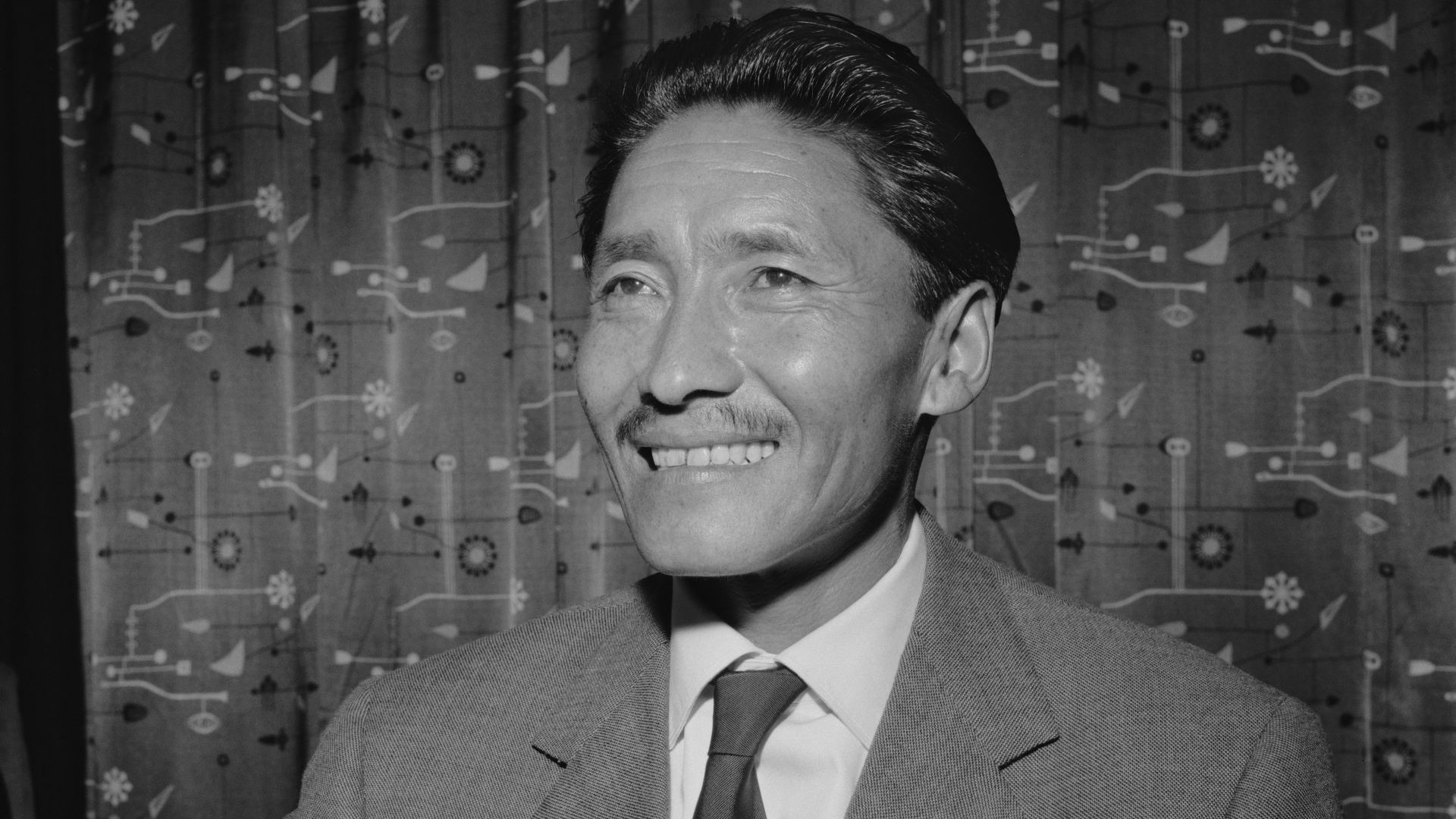
May 1914 – May 9, 1986
The Kiwi, tall and almost skeletal beneath his climbing gear, reaches out for a handshake. His companion, shorter but powerfully built, pulls him in for an embrace instead. In the late morning of May 29, 1953, Edmund Hillary and Tenzing Norgay are together in a moment of elation and relief, alone at the top of the world.
At the summit of Mount Everest, which Norgay’s Sherpa compatriots call Chomolungma, there is little time to contemplate the scale of their achievement. At 29,028 feet, the air is thin, and they are safe for only a quarter of an hour. So first, they look for signs that others may have been here before – it is not impossible that another climber, like the unfortunate George Mallory, may have reached the peak first but not been able to make the descent and report back.
Suggested Reading
The race that made Ayrton Senna
Satisfied that they have been where no one has set foot before, they begin to mark their achievement. They unfurl flags of Nepal, the United Nations, Great Britain and India, and take in the rarest of views.
Hillary brings out his camera and points it down at the slopes far below them, documentary evidence that they have really made it. Then he photographs Tenzing, who is beaming with pride, ice axe raised over his head, flags waving behind him.
When that is done and Hillary has refused a victory photo of his own, the man born 39 years earlier in the shadows of this mountain buries biscuits and chocolates in the snow to thank the mountain gods for a safe and successful climb. He puts his gloved hands together and says a quiet prayer of thanks. Next to the offering, he lays a small red-and-blue pencil given to him by his daughter. Then the pair pick up their ice axes, ready for the treacherous climb back down.
BBC radio broadcasts the news on June 2, 1953, the same day as the coronation of Queen Elizabeth II. One piece of information is missing: which of them had been first to step on Everest’s peak. The pair were determined to be thought of and remembered as equals.
Hillary did not take up serious mountaineering until his late teens, but Tenzing was born into it. As a young man, he found work as a porter in Darjeeling, starting point for most expeditions in the eastern Himalayas. When he returned home, he would prepare for climbs by filling a rucksack with stones and trekking back to Darjeeling, a distance of 434km.
Suggested Reading
The night that Purple Rain broke Prince
Developing a reputation for being an enthusiastic and skilful climber, particularly at altitude, he was chosen to be part of a 1936 team to climb Everest, an expedition that ended in abject failure. He made another five attempts, and in 1952, as part of a Swiss mission, he climbed to 28,210 feet, higher than anyone had ever reached before, before being forced to turn back.
Once he and Hillary had succeeded, Tenzing’s life changed dramatically. The expedition team arrived at Delhi airport to be greeted by a crowd of thousands. To many of them, Tenzing was a beacon of hope, someone who had risen from poverty to achieve greatness. To some, he was even more than that, considered an incarnation of Shiva, declared as a living god: “Even today, people put their forehead on the gates of our house, seeking blessing from him,” his son Jamling Norgay said.
Back home in Darjeeling, Tenzing used his experience to help and train aspiring mountaineers. He founded Tenzing Norgay Adventures, a trekking company which his son later took over, although he was not keen to see Jamling follow in his footsteps. “Since I was 18 years old I wanted to climb but my father said ‘no’,” he remembered. “He said, ‘Why do you want to climb? I already climbed it for you.’”
Suggested Reading

Lucie Aubrac, the pregnant spy who outwitted the Gestapo
Unable to read or write, Tenzing nevertheless authored several books by dictation, including Tiger of the Snows. A decade after his father’s death, Jamling took it with him when he climbed Everest himself.
In 1953, the newly crowned Elizabeth II gave Tenzing Norgay the George Medal – as a Nepalese citizen he was considered ineligible for a knighthood at the time. He was given the Order of the Star of Nepal by King Tribhuvan, and India awarded him the Padma Bhushan medal. Perhaps the biggest honour was that when he climbed Everest on that infamous expedition, he did it not as a porter or a climbing guide, but as a full member of the expedition, respected by the team around him, who sought his advice and knowledge.
A humble man, Tenzing relished replaying his journey of a lifetime, taking joy in the views and feelings still vivid in his mind. In his autobiography, he said: “The whole sweep of the greatest range on earth – even Kangchenjunga itself – seemed only like little bumps under the spreading sky. It was such a sight as I had never seen before and would never see again: wild, wonderful and terrible.”
It was Tenzing himself who eventually revealed the truth that people had debated for years: “We went on slowly, steadily. And then we were there. Hillary stepped on top first, and I stepped up after him.” The two remained friends throughout their lives.
Tenzing was happy to talk about the delight he felt on that special journey whenever asked. Jamling remembered: “I’ve listened to my father on many occasions talking about his feeling of being on the top… and all he says is ‘I felt happy,’ and that was it. He was happy.”