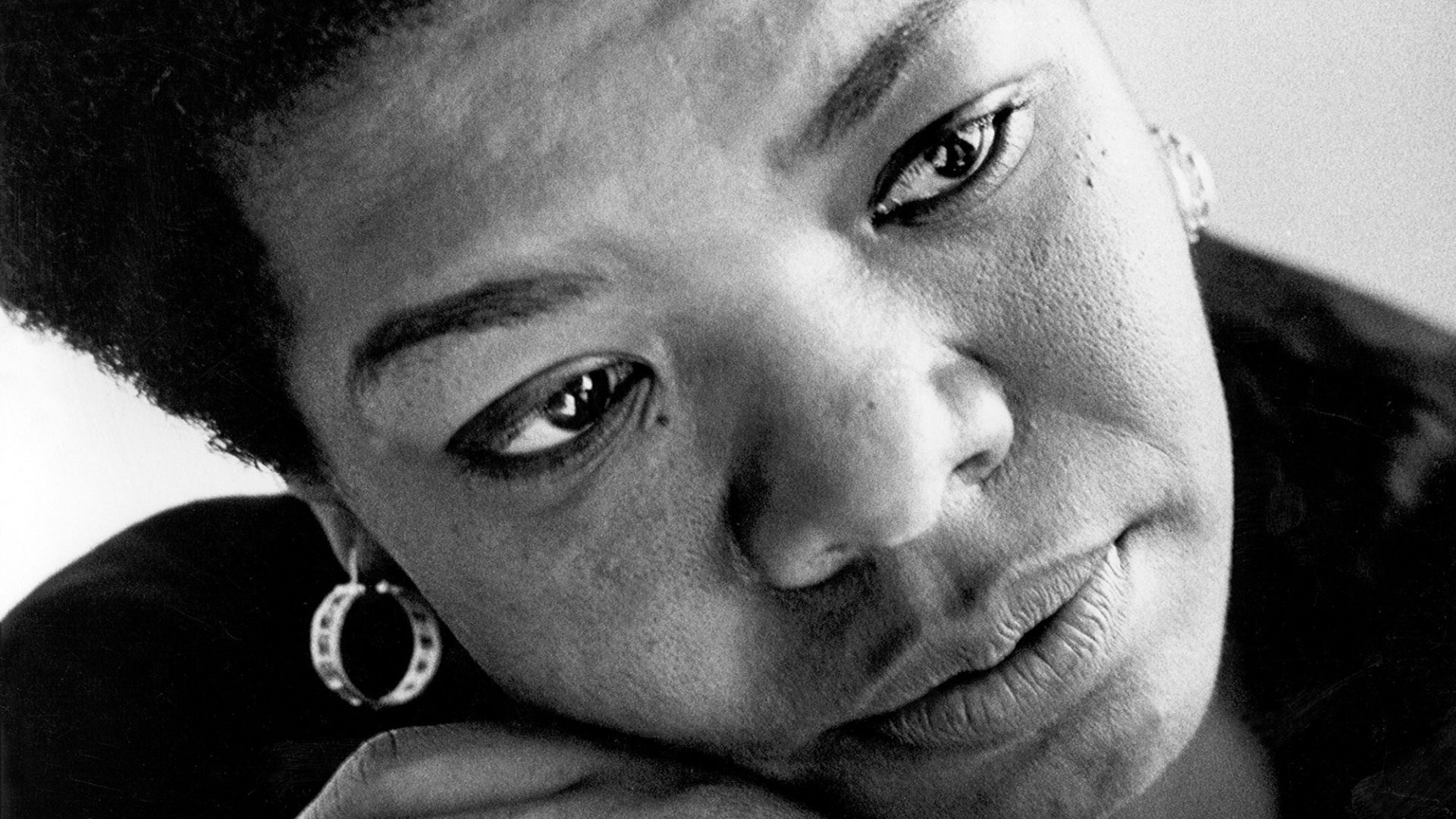
April 4, 1928 – May 28, 2014
“She has a voice that has spoken to millions,” says Barack Obama from behind the White House podium, “including my mother, which is why my sister is called Maya.” A few minutes later, he is placing the presidential medal of freedom around Maya Angelou’s neck as the writer bows her head, her face filling with tears behind her dark glasses.
At the start of his speech, Obama had reminded the crowd that “as a girl, Marguerite Annie Johnson endured trauma and abuse that actually led her to stop speaking.” This is detailed in her first autobiography, 1969’s I Know Why the Caged Bird Sings, one of the most important books in the history of American literature.
Angelou writes of her rape, aged seven, by her mother’s lover. She gave the attacker’s name to her family, and days after his release from jail, she overheard the police tell her grandmother he had been kicked to death.
Her reaction was to shut down completely: “I decided it was my voice that killed him… so I stopped speaking. For almost six years I refused to speak.” It was during these years that a favourite teacher introduced her to Shakespeare and Dickens, and also to the work of African-American pioneers like Georgia Douglas Johnson. Finally she challenged her to talk again, saying: “You do not love poetry, not until you speak it.”
You could argue that it was that period of her life that made Angelou the writer she was. As she developed her own literary voice, she discovered that “there is no greater agony than bearing an untold story inside you”.
She never shied away from taboo or trauma. Her close friend Dolly McPherson thought of her as “a blues autobiographer” for her willingness to share painful details from her life, including short spells working as a prostitute and as a madam, creating intimate connections with her readers.
Angelou always knew, from the days in which she stopped speaking, who she wanted to reach out to: “I write for the black voice, for any female voice, for the voice of the voiceless.”
Born in jazz age St Louis, then a destination for black families escaping the poverty and cruelty of the rural south, Angelou trained as a dancer and married a Greek electrician, Tosh Angelos, from whom she took her surname, altering it slightly at the savvy suggestion of her agent. “Maya” was a nickname given to her by her brother. She was a natural on stage and loved the adrenaline that theatre gave her.
Touring across Europe in the 1950s as a dancer in Porgy and Bess opened her eyes to the opportunities of a non-segregated world. After hearing Martin Luther King speak at a church in Harlem in 1960, she became involved in the civil rights movement, and with comedian Godfrey Cambridge she created the Cabaret for Freedom, a fundraising event showcasing black artists, writers and performers, and raising funds for King’s cause. She campaigned too for black feminism and against poverty and inequality.
She fell in love with South African anti-apartheid activist Vusumzi Make, moving with him to Cairo and embracing the political excitement of a newly independent Egypt. She was given a job as associate editor of the Arab Observer before moving to newly independent Ghana with her son, Guy, and teaming up with Malcolm X shortly before his assassination.
Suggested Reading
How Beyoncé inspired Tina Turner’s last stand
Three years after that killing, having returned to New York and begun working as a writer with guidance from James Baldwin, it was on her 40th birthday that she heard the news of Martin Luther King’s shooting in Memphis. She vowed never to celebrate her birthday again, although King’s widow talked her out of it.
She channelled the rage and sorrow into writing and narrating Blacks, Blues, Black!, a 10-part TV documentary on blues music and its creators. Its success led to the publication of the first of her seven volumes of autobiography, and that to the first of 10 volumes of collected poetry.
Her optimism and vibrancy can be seen even through the titles of her work: the third volume of her autobiography Singin’ and Swingin’ and Gettin’ Merry Like Christmas and a poetry collection Just Give Me a Cool Drink of Water ’fore I Diiie show a writer not afraid to showcase their soul.
She wrote films and their soundtracks, composed songs for the likes of Roberta Flack, and acted on stage and TV, including in 1977’s Roots. On the set of the 1993 film Poetic Justice, for which Angelou wrote two poems, she took Tupac Shakur to one side after seeing the young rapper full of anger.
She said: “I told him, ‘When was the last time anybody told you or reminded you that our people stood on auction blocks so that you could live today? Somebody in your background laid in the filthy hatches of slave ships to stay alive so that they would have some descendants. You’re more valuable than you can imagine.’ Later, when he wept, I wiped his face with my hands because I didn’t have a napkin.”
Angelou’s belief in mission and activism was never better expressed than in On the Pulse of Morning, a poem that she read at Bill Clinton’s 1993 inauguration and one quoted by Obama at her medal ceremony 18 years later. It speaks of lifting up your face to meet a bright morning, and how the wrenching pain of history must be met with courage.
“Lift up your eyes upon this day breaking for you,” it urges. “Give birth again to the dream.”