October 15, 1938 – August 2, 1997
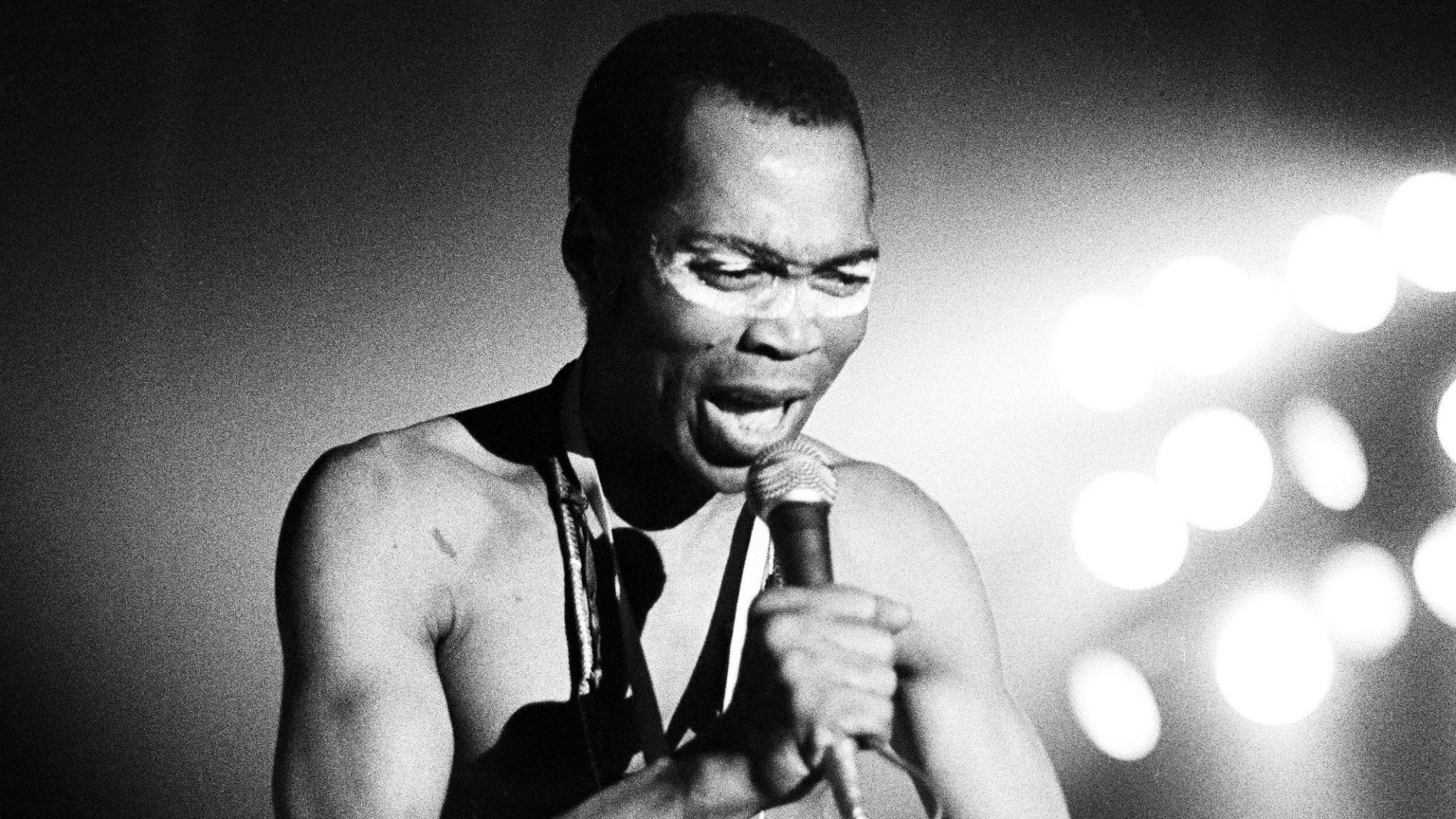
On an August night in 1969, a week before the Manson Family murders that will shake the city of Los Angeles, a highlife jazz act called Koola Lobitos takes the stage at the Ambassador Hotel on Wilshire Boulevard. They have been touring America for months, but with a combination of visa issues, small audiences and limited finances, their leader Fela Kuti is struggling. Nevertheless, as he always does with an audience in front of him, he gives his all.
In the crowd is Sandra Izsadore, an activist, part of the Black Panthers, who is transfixed by this man’s energy and soul. She thinks he is someone who will teach her all she needs to know. They both soon realise it is the other way round.
“Fela and I wanted positive change for the world,” Izsadore said of a man she recognised as having the exact skills needed to be part of a revolution. “I thought that change could come through music… Fela was that musician.”
Returning home to a Nigeria engulfed in civil war, having educated himself with the works of revolutionaries such as Malcolm X, Kuti writes Black Man’s Cry, a song in which he articulated the conversations he’d had with Izsadore, realising it was now time to embrace Black consciousness.
“To be a great man you have to have a great country behind you. I had no country, just a bunch of Africans running around in suits trying to be Englishmen,” he later says. He renames the band Nigeria ’70, then Africa ’70.
Kuti’s passion and energy is matched by musical skills that evolved while studying music at London’s Trinity College of Music (despite his parents having sent him to Britain to study medicine). He begins to incorporate strong political messages into his lyrics, while the music becomes funkier and more influenced by the percussive styles of music made by the West African Yoruba people.
He founds the Kalakuta Republic in Lagos, a communal home and recording base that he declares independent from the Nigerian government. Next, he creates his own performance space, the Afrika Shrine, where his 50-strong entourage perform four shows a week. The stage fills with dozens of dancers, backing singers, musicians with saxophones, trumpets and guitars, all held together by the innovative, peerless Tony Allen on drums.
This is the birth of Afrobeat, described not as a genre but as a weapon, music that makes you think as well as dance. Word quickly spreads that something special is happening, and people travel in their thousands to see these epic shows for themselves.
Friday’s late-night communal gatherings become particularly infamous, the audience given a chance to discuss political and philosophical ideas with Kuti. Throughout the next week, the band starts to put together a song based on the ideas that had been debated, with hundreds gathering just to watch them rehearse, seeing it build in front of their own eyes. As soon as a song is recorded, they never perform it again.
In 1976, Fela releases Zombie, a direct attack on the Nigerian military, which he accuses of being an institution of violence. Months after its release, the Kalakuta Republic is infiltrated by a thousand soldiers who brutally beat Kuti and burn the compound to the ground, destroying his recording studio and hundreds of instruments. His mother dies from injuries she sustains after falling from a second-floor window while the building burns.
Having established a new Afrika Shrine, Kuti’s pursuit of his own individual lifestyle and world vision reaches new heights when he marries 27 of his backing singers and dancers in a single ceremony, stating dubiously that he believes polygamy to be an African institution. He later divorces them all, amicably, having come to understand that “no man should own a woman’s body.”
He is arrested on a regular basis, but sentenced only once, in 1984, accused of attempting to unlawfully take money out of Nigeria. He serves 20 months of a five-year sentence in which he makes his prison cell his new shrine, where he can devote time to clarifying his thoughts and future plans. When released, he continues to tour and make deep, rhythmic music with real meaning. But in the 1990s, his output slows, and then, shockingly, it stops.
Suggested Reading
Phyo Zeya Thaw, the MC who faced down Myanmar’s generals
In August 1997, over a million people attend his funeral procession, one of Nigeria’s largest ever public gatherings. His brother Olikoye Ransome-Kuti, a former minister of health, reveals that Fela has died of Aids, about which the great bandleader had been dismissive until it was too late.
That comes as a shock, because throughout his life Fela Kuti was never scared to speak his mind, to confront what he thought was wrong and to unite people. By his own admission, he owed it all to that first meeting with Sandra Izsadore at the Ambassador Hotel, the moment “everything fell into place.”
Through her he understood the power one person can have if they believe in something and act on it, resulting in him becoming a hero to millions throughout Nigeria and beyond, able to articulate their frustrations, injustices and fears, while simultaneously allowing them to dance.