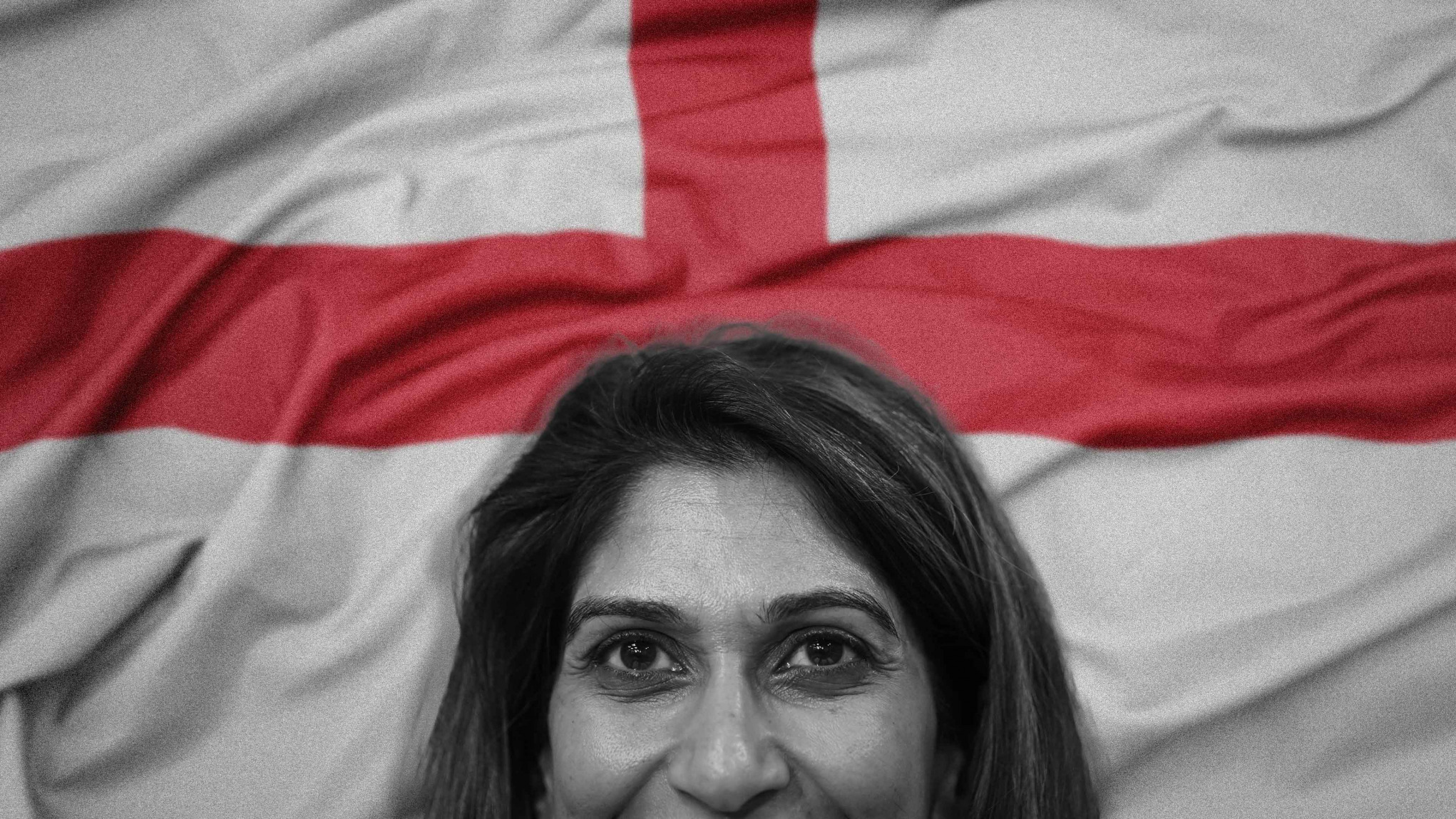
The former Conservative minister turned Reform politician Suella Braverman recently told a TV audience that she did not regard herself as English. “To say I’m English is to take a ‘laissez-faire, anything-goes’ attitude to ethnicity, citizenship and identity,” she said.
The suggestion that English is an “ethnicity” is highly contentious. It’s a divisive idea that’s regarded as insulting by many people whose families have lived in England for generations and who regard themselves as thoroughly English. But if you look at it from the point of view of language, the idea that “English” is an ethnicity is also completely nonsensical.
As chance would have it, I am not entirely English – only half. The other half is Welsh, and if you ask any Welsh person whether they are “ethnically English” they will give you a look as if there’s something wrong with you.
In terms of nationhood, Wales is not England. It has its own language, Welsh, which is part of the Brythonic Celtic language group. The difference between the Welsh and English languages is a mark of the different histories of the two nations.
The Welsh word for the homeland is Cymru – which in Welsh is pronounced “cum-ree”. That word enters the English language in the name of the county of Cumbria, whose inhabitants also once spoke a Brythonic Celtic language called Cumbric, now extinct. The relatedness of the two languages is clear: the Welsh call their language “Cymraeg”, a word almost identical to “Cumbric”.
It is here that Braverman’s idea of the English as a singular ethnic group begins to hit trouble. Because if you take the narrow view that a people are only defined by their “ethnic” origins, then the Cumbrians are not English at all, but are in fact Welsh.
The same “ethnic” conclusion also applies to Cornwall. The south-westerly tip of our islands also once had its own Brythonic language, Cornish, or “Kernewek”, which is now the subject of a small but determined revival.
Welsh and Cornish were, in fact, a single language, but the Saxon invasions pushed them further into the west, and at the Battle of Dyrham in 577, the two were forced back beyond the Bristol Channel, cutting the Cornish and Welsh off from one another. From then on, Welsh and Cornish developed independently.
So an “ethnic” appraisal of the current English population would immediately reveal that the English aren’t so English after all, especially the Cornish and the Cumbrians, who are in fact Welsh. That is presumably something that Suella Braverman would reject. But if she did, it’s hard then to see how she could avoid coming to the conclusion that, if the Cumbrians and the Cornish are “ethnically” English, then the same must go for the Welsh, too.
Suggested Reading

Why Trump got it badly wrong over Lake Ontario
There would also be problems waiting for her overseas. Braverman should keep in mind that large numbers of the Brythonic-speaking Cornish didn’t much like their new Saxon invaders and decided to make their escape in small boats.
They ended up in northern France, where they gave their name to the French region of Brittany. The 100,000 present-day Breton speakers are their descendants – their language is the direct descendant of Cornish. If the Cornish are “ethnically” English, then the same must go for the Bretons.
But that, presumably, is a conclusion that would send Braverman and her Reform colleagues into a spin, and which they would dismiss as absurd. But the absurdity is in viewing “English” as an ethnicity in the first place. It never was – and it isn’t now. The history of our island languages tells us so.
Peter Trudgill is away