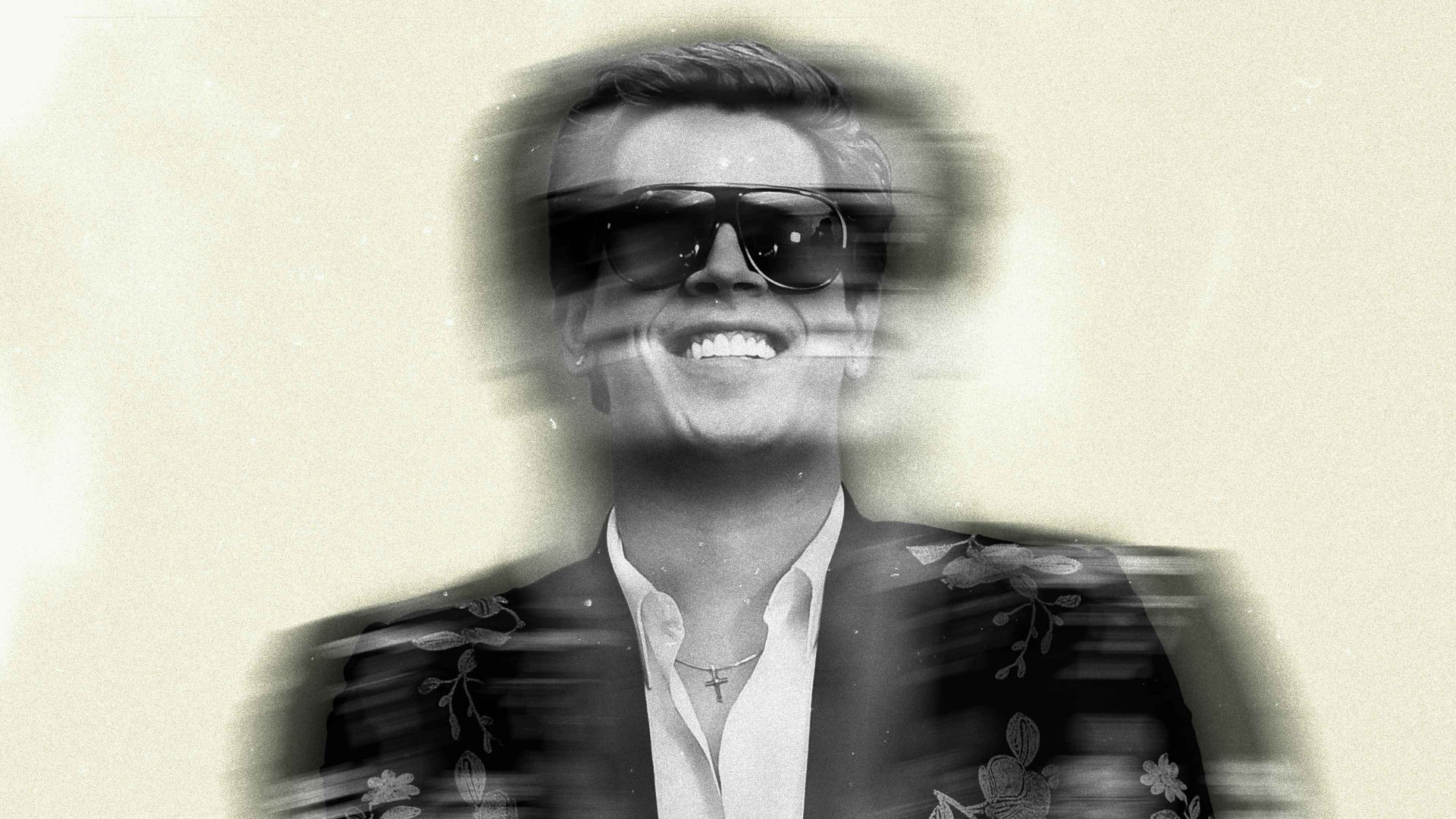
When the news that Milo Yiannopoulos had been detained by ICE broke on Friday, it lit up my phone like a firework display. People who hadn’t messaged for years – some of whom are owed money by him – asked if I’d seen the news. Several WhatsApp groups became a hive of activity. What would happen now?
Yiannopoulos’ detention and deportation to the UK was written up by almost every major US and UK outlet. The US Department of Homeland Security’s social media accounts posted about it, even as pro-Trump influencer Laura Loomer claimed credit. The New York Times thought the story worthy of two separate news alerts.
But most normal readers of any of those publications would, on seeing the news that Milo Yiannopoulos was being deported, have just one question: who?
ICE has detained more than 610,000 people in the first 18 months of Trump’s second term. Why is this one apparently so newsworthy? Much of the reason is that Yiannopoulos has been desperately bidding for America’s attention for more than a decade – first, as one of the few journalists to embrace the Gamergate movement that preceded the modern manosphere, then as an editor for the once-influential far-right ‘news’ site Breitbart, then as an early Trump booster.
More recently, Yiannopoulos briefly served as an intern for then-Republican congresswoman Marjorie Taylor Greene, before a stint as “political aide” to Kanye West, right as the controversial rapper was selling swastika shirts on his website and releasing “Heil Hitler” as a track.
Yiannopoulos never lasted long in any of these roles, but sticking with things has never been Yiannopoulos’ strong point. He has been mainstream and alternative. He has been Catholic, Jewish, and yet also posed for photographs wearing the Iron Cross when he was 22 – long before the modern far-right flirtation with Nazi aesthetics.
He has been a journalist, entrepreneur, public speaker, and Christian telesales evangelist. He has been gay and ‘straight’, British and ‘Greek’. Even “Milo Yiannopoulos” is only one of several names he has tried out.
Every time the act wears thin – and with him, it always happens quickly – he moves on to a new one. Except this time, it seems, a whole country has run out of patience.
I’ve spent a decade now as a reluctant occasional biographer of Yiannopoulos. Ten years ago, I was writing a book that became Post-Truth: How Bullshit Conquered the World. When I was looking for a chapter on the kind of new media chancer that embodied the era, there was no better candidate than Yiannopoulos, and no shortage of people willing to talk about him.
The chapter was eventually serialised by the US outlet The Daily Beast, under the headline “Milo Yiannopoulos is the walking embodiment of bullshit”. At the time, even I thought that might be a bit harsh – but it’s aged well. Long before Yiannopoulos was ever known in the US as a far-right agitator, he was well established in the UK. He was only in his early 30s, but he was already a washed-up grifter.
Yiannopoulos claimed to have been born in Greece in 1983, but in reality he was born as “Milo Hanrahan”, in 1984, in the British town of Chatham, where his father ran a company providing security to local bars and nightclubs – a service Yiannopoulos would use for his own ends in his early career: upsetting him could, people warned one another, lead to unpleasant visits.
Suggested Reading


Inside Natalie Harp’s bizarre devotion to Donald Trump
For his first attempts at fame, or notoriety, Yiannopoulos used the alias “Milo Andreas Wagner”, under which he wrote plagiarised poetry, briefly worked as an aide to Bianca Jagger, before serving as a book researcher to Damien Thompson, then the editor of Telegraph Blogs.
This got Yiannopoulos his foothold into the Telegraph, where he was hired as a technology blogger, and where he started using the “Milo Yiannopoulos” name – which, except for a failed attempt to adopt the mononym MILO, he has stuck with ever since.
Yiannopoulos was noted for his spiky, aggressive writing style, and little else. His arrangement with the Telegraph soon became a looser, freelance one, until a furious row over an awards ceremony – which left the Telegraph thousands of pounds out of pocket and suspicious of sponsorship arrangements – severed the relationship permanently.
What followed was Yiannopoulos’ best attempt at mainstream respectability, as he launched an independent technology publication called The Kernel, for which he said he’d secured financial backing from unspecified sources. Yiannopoulos hired a talented young team of journalists, put on parties, and for a time, the outlet published solid, noteworthy journalism.
Eventually, though, people noticed that their wages and their invoices weren’t being paid. Yiannopoulos had quite literally been writing cheques that he couldn’t cash. As people spoke to one another, they compared notes on the stories he’d been telling and found none of them stood up.
As quickly as it had appeared, The Kernel collapsed – leaving many struggling early-career professionals seriously out of pocket. To this day, Yiannopoulos has a string of unpaid County Court Judgments against him, with thousands of pounds of unpaid court-ordered debts to pay.
Thanks to his exhausting personal antics, ethical issues, and his mounting debts, Yiannopoulos’ credibility in the British media was already shot by 2014, but fate offered him a lifeline in the form of Gamergate.
What had started as a supposed row over “ethics in video game journalism” had mutated into a backlash against feminism and what later became known as wokeness in gaming as a whole.
Yiannopoulos, who had previously dismissed gamers as “tragic” and “unemployed saddos” decided he would now be their champion, appearing on TV to argue the Gamergate cause, and getting into endless online fights on their behalf. This was enough to leverage into a position as a technology commentator at the then-influential US far right outlet Breitbart.
Raheem Kassam, one-time editor-in-chief of the site, doesn’t recall that relationship fondly. “Back in 2014, Milo reached out and begged me for a job, right as we were starting up Breitbart London. I made the mistake of giving him a chance. That’s where his entire life on the right began,” Kassan said in a lengthy post on X. “But within WEEKS, he was emailing the U.S. bosses demanding MY job, and claiming he could do it better. He was rebuffed, of course.”
Suggested Reading

The choreography of fascism
Yiannopoulos’ characteristically chaotic and brief tenure at Breitbart, though, was enough to secure him the financial support of one of the site’s investors, Rebekah Mercer, who in the words of Kassan “shelled out MILLIONS” to fund Yiannopoulos to tour US campuses speaking about culture war issues, as an early Trump supporter.
This was easily the peak of Yiannopoulos’ powers: any time a campus announced he would be speaking at an event on site, students would mobilise to protest against it, and try to get the event cancelled. Yiannopoulos would then decry the attempted cancellations, fan up the flames for attention, and arrive on site with huge security details.
His star seemed to be rising until his longstanding desire to court controversy caught up with him in early 2017. Years before, Yiannopoulos had made comments appearing to defend priests sleeping with teenage boys as young as 13. At the time, this was enough to get him ostracised from the US conservative movement. The funding, speaking invitations, and entourage all disappeared.
Yiannopoulos, once one of the most outrageous and controversial public faces of the MAGA movement, has tried and failed to reinsert himself into the narrative ever since, but the reality is that his act is increasingly passé.
In 2017, few except him would flirt with Nazi imagery and ideas. In 2026, almost every Republican-supporting man over 30 does it on a daily basis. Yiannopoulos said he married a man, but then relegated him to housemate when he tried out being ex-gay for a while – presumably ditching Catholicism for a more US-friendly brand of evangelicalism for a time.
He spent a while as an aide to Marjorie Taylor Greene, then a MAGA darling, but soon fell out of favour there, too. His time with Kanye West – at the nadir of his controversies – ended in 2024. Yiannopoulos has not been short of second, third, fourth, or fifth acts, but none of them have ever managed to break through like he briefly managed in 2016, for all that he’s been left to chase that high.
With his arrest by ICE, Yiannopoulos seems to have finally pushed his luck too far. The Department of Homeland Security suggested Yiannopoulos had not shown up to his immigration hearing weeks earlier, leading to a final order of removal being issued. Despite this, he had still taken a domestic flight to Louisiana – a deeply silly thing for someone illegally overstaying their visa to do – where he was detained.
According to ICE, Yiannopoulos was deported back to the United Kingdom over the weekend, meaning he is our problem once again. With the US closed off to him, probably permanently, he is almost certain to court attention and controversy in the UK instead.
Yiannopoulos would surely like to be seen as a prophet, someone who heralded a new age. He certainly likes to be seen as dangerous: he was so delighted by that moniker that he used it as the branding for his campus tour.
In reality, though, he is more of a canary in the coal mine: he succumbed to a particular movement’s insanity first, before it worked its way through society as a whole. For a while, that made him stand out, but today… there are thousands of influencers putting on the same kind of show that he does, and many of them do it better.
Yiannopoulos might find that the UK has fewer people interested in his act than he’d like. What he will find, though, is people to whom he still owes money, and some of them still have court orders against him. Has the time finally come when Yiannopoulos will have to pay what’s due?
 Most popular
My truly deranged encounter with Trump apologist Kellyanne Conway
The moral depravity of Robert Jenrick

Is this the real reason Trump keeps falling asleep in public?

Suella Braverman’s book has sold only 106 copies. This is why