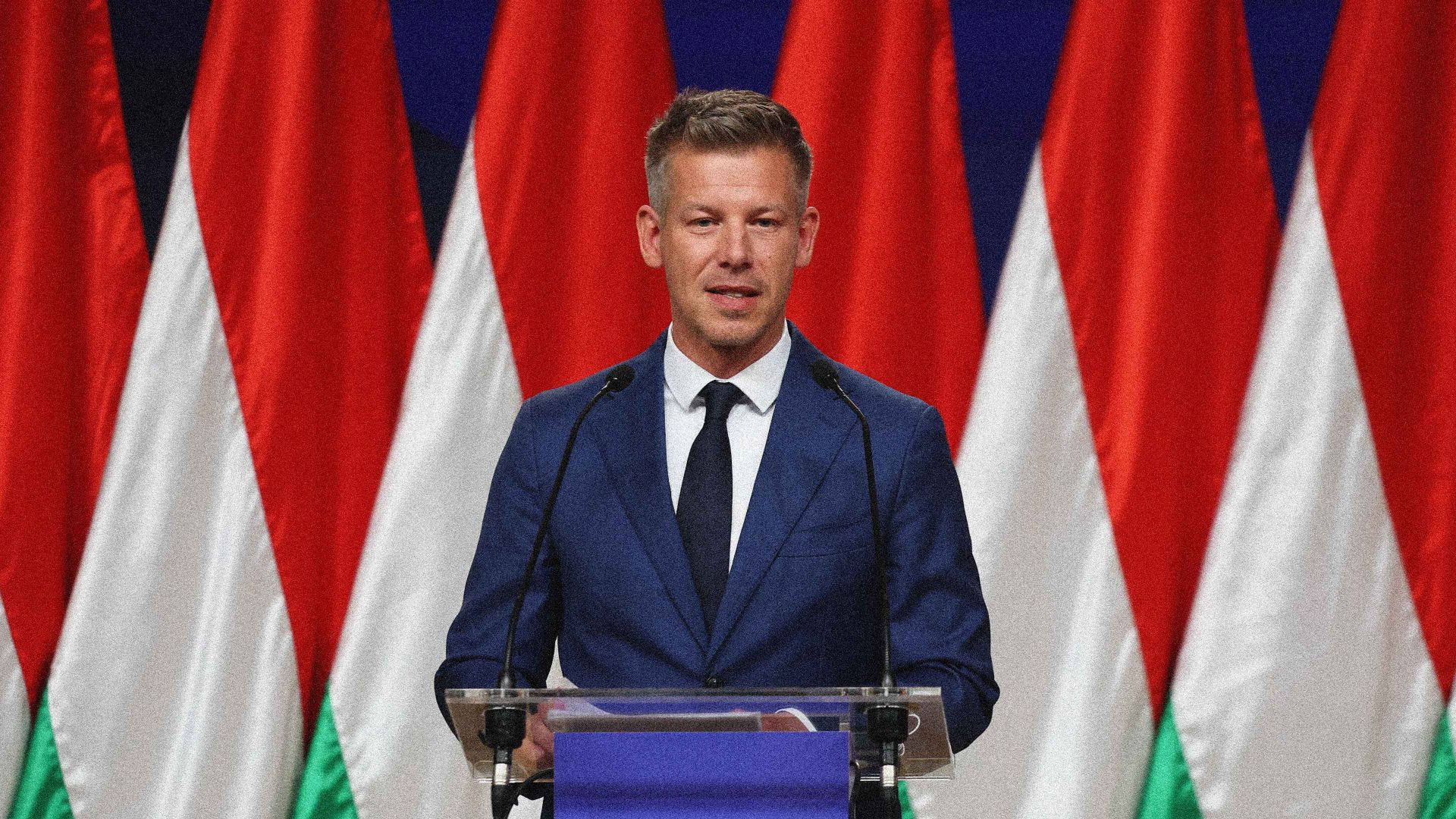
Once Viktor Orbán conceded in the Hungarian election, on April 12 hundreds of thousands of people came out to hear the words of the winner: Péter Magyar. Young people climbing on bridges, mothers and daughters hugging with tears in their eyes, lovers embracing as if it were their first kiss once again, and the Hungarian flag flying proudly in the night.
As I was carving through the crowd, I called my best friends. We are the generation who had only seen politics under the Orbán regime. I pulled together a patchy FaceTime call with my American girlfriend to show her what hard-fought freedom looked like (and certainly not to make her jealous about it).
I was heading to Castle Hill – not only to see this parade from above, but for a quick TV hit I promised the BBC once the results were in. “Are we going to see immediate change?”, the reporter asked, but before I could answer, a group of young people flooded into the shot and gave late-night viewers in Britain a firsthand account of how voters felt about the future.
To answer that question now: yes, we are. But no – the foreseeable future does not look as bright as it felt on the streets of Budapest on that Sunday night.
Magyar will be officially sworn in on May 9. Some of the things that he has to do now are as easy as they come: he’ll need to outperform Orbán at being a democratic leader. Hungary’s foreign relations have immediately become better than they’ve been at any time in the past decade – except, perhaps, with the US and Russia, which both tried and failed to keep Orbán in power but have pledged pragmatic co-operation.
Suggested Reading
From Orbán fan to Orbán foe: will Péter Magyar change Hungary?
The European Union celebrated his win as the country’s reintroduction to the European community. Magyar will soon visit Warsaw to restore Hungary’s historic friendship with Poland, as well as Austria to boost regional cooperation. And crucially, he has offered to meet Volodymyr Zelensky in June in Berehove, a Hungarian-majority town in south-western Ukraine
Magyar has lifted his predecessor’s veto on a 90bn euro (£78bn) loan to Ukraine and now is eager to boost slow growth by unlocking the equivalent of £13.8bn of EU funds for Hungary that were blocked because of corruption and Orbán’s restrictions on democracy. He also wants to access a similar sum in cheap EU defence loans.
The challenges have already begun. Magyar has faced criticism of his overly personalised leadership, which sits uncomfortably after Orbán’s legacy of strongman rule. He’ll need to prove that he can lead a technocratic government and delegate tasks accordingly.
Some of his early appointments look inspired. He recruited István Kapitány, a former Shell executive, to oversee energy policy. He picked Anita Orbán (no relation), a diplomat and Vodafone executive, to lead foreign policy.
But Magyar has been criticised for picking his brother-in-law Márton Melléthei-Barna as justice minister. It is not entirely surprising – he has been part of the Tisza movement from the start – but after years of perceived corruption under Orbán, it feels awkward. Even more so, Magyar’s sister, Anna Ilona, who is married to Melléthei-Barna, has had to step down as a judge “to avoid even the appearance of an intertwining of branches of power”.
The new government will face the thankless task of clearing the rubble after an aspiring totalitarian regime. The challenges include, but are not limited to: rebuilding Hungary’s economy; overhauling energy policy, healthcare, education, public infrastructure, academia, media and cultural life; and re-establishing democratic institutions, replacing Orbán loyalists and holding his cronies to account. And that’s only what we know now. The true scale of the devastation might only be revealed once Magyar takes the keys to his new office.
Suggested Reading


Orbán’s defeat: The beginning of the end of populism
This brings us to the final point, which is the depth of these issues. Hungary is in a perpetual state of economic crisis: as the poorest nation in the EU, Magyar not only has to revive a flatlining GDP, low investor trust and the Hungarian forint (which bounced back to pre-Ukraine war levels after the election). No wonder he is so keen to reclaim the frozen EU billions.
Hungary is also in a state of energy crisis: thanks to Orbán’s love for Putin, the nation almost exclusively runs on Russian energy – a great vulnerability, even without turmoil in the Middle East.
Finally, Hungary is also facing a political crisis: Magyar vowed to replace Orbán’s 2011 constitution and confirm the new one not by a parliamentary vote, but a referendum. Drafting and passing that, as well as breathing new life into the judiciary, will take months at best, if not years.
That does not mean that Magyar is not off to a flying start. But keeping this plane in the air will require lots of fuel – and the tank might run empty before he realises.
Iván L Nagy is a Hungarian political journalist and podcaster