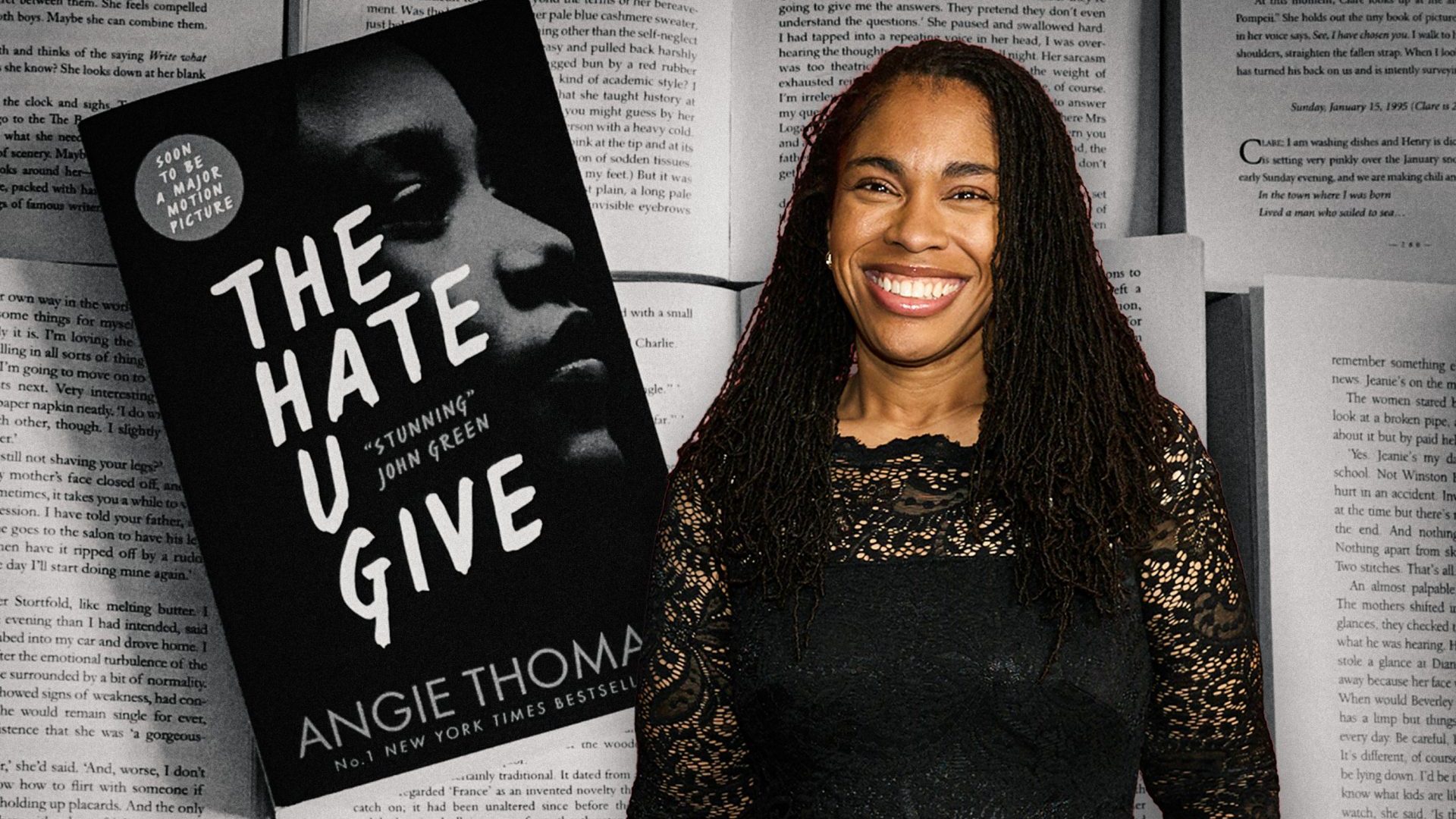
Earlier this spring, Angie Thomas was invited to speak to the pupils at a seat of learning founded in 1619. Entranced by the venerable surroundings of Alleyn’s School, in Dulwich, she found herself reflecting on the growing pains of the turbulent nation she calls home.
“America’s birth was 1776,” she tells me. “In comparison, America is a rebellious teenager right now. My country is going through an identity crisis as an adolescent. That’s what we’re seeing.”
It’s been almost 10 years since Thomas first held a mirror to the rampant acne and dental braces of the United States. Originally written as a senior project at Belhaven University, in her home town of Jackson, Mississippi, The Hate U Give emerged in 2017 as a period-defining novel about race and class in a divided nation.
At its outset, the author had no real idea if her story would ever be published. Today, the book has sold more than six million copies across 32 countries.
The Hate U Give tells the story of Starr, a teenager from the Black neighbourhood of Garden Heights – the city in which it resides is unnamed – who witnesses the killing of her friend Khalil by a white police officer. Khalil is a drug dealer who moves product to pay for healthcare for his gravely ill grandmother. Starr is a girl from the block who attends private school miles from her home. As tensions soar, this dual identity places her squarely on the juddering faultline of a country well versed in waging war on itself.
Suggested Reading


Matt Goodwin’s new book: The missing chapter
The portrayal of Garden Heights as a home both to people who are moved to violence and mom-and-pop stores in which owners and customers are on first-name terms owes a debt to the author’s formative years. Angie Thomas was raised in Georgetown, an ethnically diverse neighbourhood in the Jackson metropolitan area in which the average household income is just $31,000. Of the many issues raised in The Hate U Give, perhaps the most enduring is the idea that communities can flourish on streets with cracked sidewalks.
“My neighbourhood… was the kind of [place] where, yeah, I heard gunshots at night,” she tells me. “But, also, my neighbours were like family to me. There’s this phrase, it takes a village to raise a child, and I lived in a dysfunctional village. But it was still a village.”
Bearing a smile capable of blinding anyone within a two-mile radius, Angie Thomas is interviewed on a sunny spring morning at the south London offices of her publisher Walker Books (full disclosure, my wife works there). Speaking at a speed roughly equivalent to a tobacco auctioneer with a fondness for amphetamines, it takes her just 50 minutes to deposit almost 5,000 words into my recording device. It’s quality stuff, too. Were space not an issue, I’d happily report them all.
Seated at a table in the room next door, we find the person who changed her life. In 1994, the decision by the friendly yet quietly formidable Julia Thomas to take her then six-year-old daughter to a library in the wake of a neighbourhood shootout between rival gangs was an occasion of pivotal importance. Discovering that (as she recalled to the Guardian) “there was more to life than what I saw [on the streets of Georgetown],” at a stroke, a love affair with the printed word was born.
There is, though, a but. “I wasn’t seeing a lot of books about people in communities like mine, specifically books aimed towards young people,” Thomas tells me. “In America, we had a diversity problem in children’s literature. We still do. What people in the [publishing] industry aren’t considering is that kids in certain communities… get written off as non-readers. I don’t believe there’s such a thing as a non-reader. There’s just a kid who hasn’t found the right book.”
Suggested Reading

What Ken Burns’s new documentary tells us about America
Or else the right book has been spirited from view. With its themes of police violence, civil unrest, teenage sex and drug use, The Hate U Give is just one of many titles in the crosshairs of the kind of agitators who embody America’s consistently underexamined fondness for (at best) puritanism. Today, the novel’s removal from schools in Florida, Pennsylvania, South Carolina, Texas and more amounts to nothing less than an assault on the long-established truth that libraries are portals to worlds unknown.
With depressing efficiency, the censors wreak havoc without consent. In a sign that the virus is airborne, last October, Thomas’s book was banished from the Year 10 reading list at Budmouth Academy, in Dorset, following a complaint from just one parent. Despite admitting to reading only “about half” of the novel’s 438 pages, James Farquharson, a former – no, really – Conservative councillor, believed himself qualified to judge that The Hate U Give depicted white people “as the baddies”.
“I’ve heard that [my novel] makes white kids feel bad,” Thomas tells me. “I’ve yet to have a white child tell me that. It makes maybe the adults feel bad. But I get white kids, when they’re reading it, say that they see parts of themselves in Starr.
“They find ways to connect with the character. They’re finding the path to empathy that their parents aren’t.” Asked how many children have complained about her book, the answer comes, “None”.
Defending their author, in a public statement, Walker Books noted that The Hate U Give “has repeatedly been placed on banned books lists by those who would shield young people from uncomfortable truths rather than equip them to interrogate the world around them”.
Burrowing down to the bones of the matter, the publisher also quoted a survey from the writers’ advocacy group PEN America noting that of the more than 10,000 titles facing bans in the US, 44% contain characters of colour while 39% feature protagonists who are either gay or transgender.
Her voice ascending with incredulity, Thomas asks, “Of all the issues we’re facing right now, why is diversity a problem? Why is equity a problem? Why is inclusion a problem? Why has this become a thing?”
In further unsurprising news, a peek beneath the bonnet reveals that those who seek to expel books from syllabuses and school libraries are both organised and well-funded.
Suggested Reading
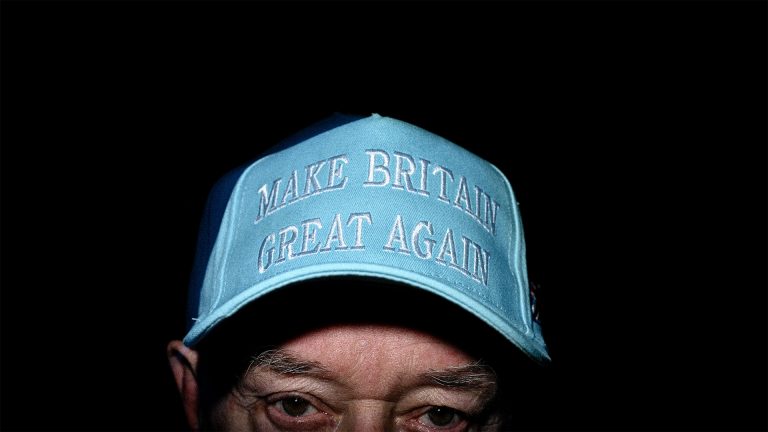

Keeping Trumpism out of Britain
In accepting $50,000 from the far right organisation Stop the Steal, for example, the US pressure group Moms for Liberty was able to wage a campaign that is both sinister and peculiar. Alongside “divisive” titles about Dr Martin Luther King, MFL sought to ban a children’s nature book for its depiction of “mating seahorses with pictures of positions and discussion of the male carrying the eggs”.
In Texas, meanwhile, 20 out of 40 school librarians in the town of Keller were either fired or resigned their positions after the cell phone company Patriot Mobile threw $650,000 into a successful bid to seat pro-censorship candidates on school boards in the wider Fort Worth area. In this corner of the Lone Star State, freedom of expression was suppressed by the election of just 11 people.
Once more, turbulence in England robs me of my inalienable right to cock a snook at our excitable American cousins. In March, Index on Censorship published a story about “Emily” – not her real name – an autistic librarian who resigned under “severe stress” after being asked to pull almost 200 books and graphic novels from the shelves of a Greater Manchester school.
“I ended up removing biographies of second world war airmen, literally less than a week after Remembrance Day, because they weren’t children’s books,” she recalled. Books by Dan Brown, Zadie Smith, Terry Pratchett and Michelle Obama were also forced into exile.
“When you’re banning books… you’re only thinking about one group of kids,” Thomas says. “What about the kids who see themselves in [the banished texts]? Nobody’s thinking about them. You’re trying to make decisions for other people’s children, and that’s just not OK.” Her hope is that the parents and children in the UK will say, “we don’t want that happening here”.
Beneath the insidious pretence of protecting children, the aims of the expurgators are of course obvious. With its complex ideas and clear-eyed language, The Hate U Give affords its reader a detailed panoramic view of a community whose citizens are too often represented only in headlines. In the eyes of powerful forces who live in fear of the corrective power of fiction, clearly, this will not do.
“Dehumanisation and othering are how these people maintain their power,” Thomas says. “And when you talk about book bans, that’s part of it. They want to dehumanise, they want to other; they don’t want empathy, they don’t want nuance, they don’t want these things. But ask yourself why?… Why, why, why? It’s because it maintains their power structures. That’s what we’re seeing.”
In other words, America has committed the unpardonable sin of lying to its children. Each morning, in schools across the country, many millions of pupils are required by law to recite a patriotic verse, the words of which our 37-year-old interviewee can recall even now.
Speaking quietly, she begins to soliloquise. “I pledge allegiance to the Flag of the United States of America, and to the Republic for which it stands, indivisible, with liberty and justice for all…”
Recognising a work of fiction when she sees one, Thomas smiles. “America is still an idea,” she says. “That’s the problem. They haven’t made it what they said it was going to be.”
The Hate U Give by Angie Thomas is published by Walker Books
Ian Winwood is the bestselling author of Bodies: Life and Death in Music