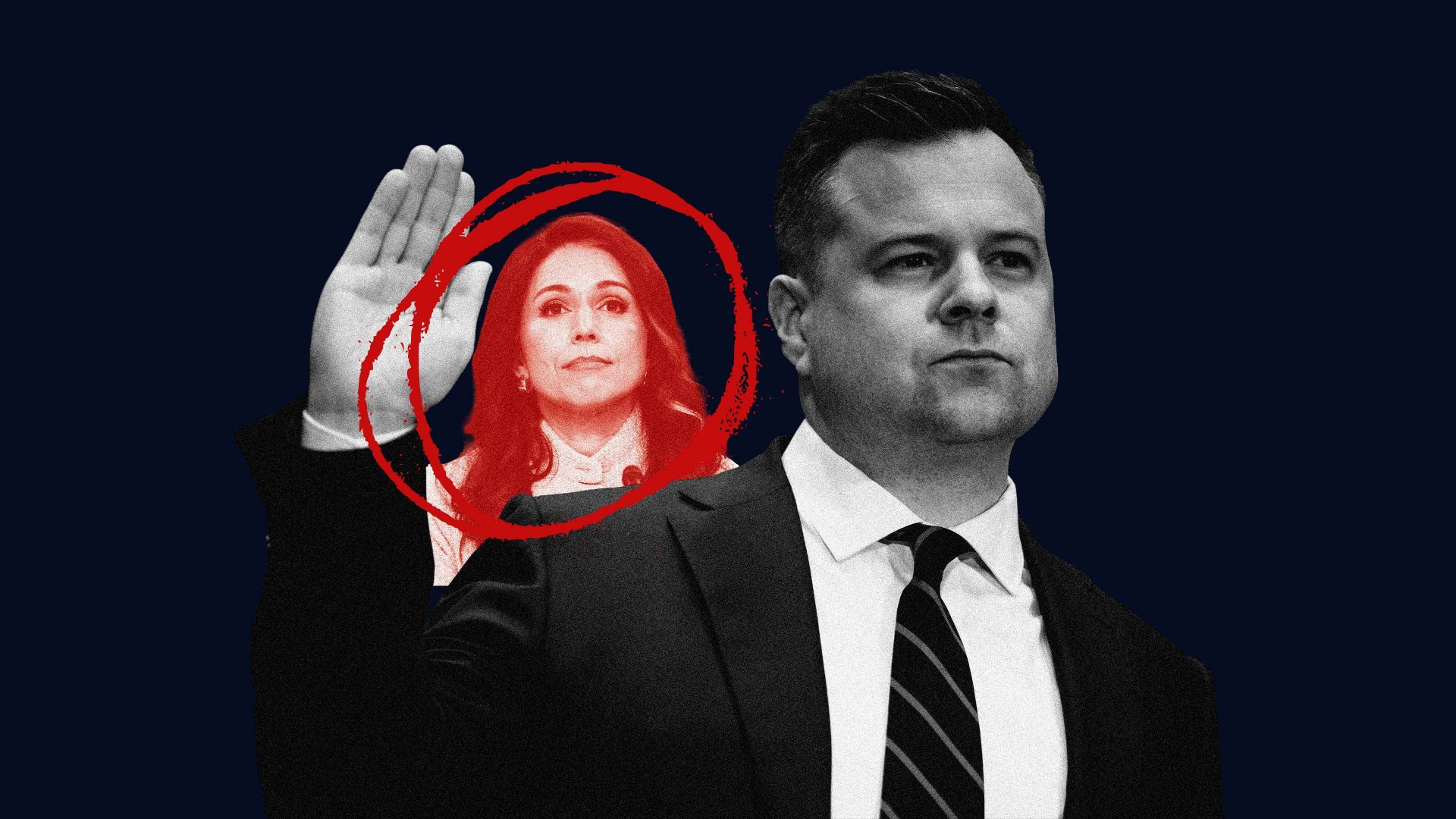
Tulsi Gabbard’s curious tenure as Director of National Intelligence has just ended. She was a bad choice. But her replacement will be much worse.
A controversial appointment from the start, in the early 2000s Gabbard served in the Hawaii National Guard and did a tour in Iraq with a medical unit. She ran as a candidate for the Democrats in Hawaii, and won a seat in the House of Representatives. There then followed a brief campaign as a Democratic presidential nominee, but she dropped out of the race to endorse Joe Biden.
She left the Democrats in 2022 and endorsed Trump in 2024 and the following year, she was confirmed as Director of National Intelligence. Gabbard had scant experience either of intelligence work, or of managing large organisations.
Her critics also noted her 2017 meeting with the Syrian leader Bashar al-Assad, her long-standing skepticism of the intelligence community, especially its 2017 report on Russian meddling in the 2016 US election. This was no doubt part of her appeal to president Trump.
On the positive side, on several occasions, she held true to the intelligence agencies’ assessments. In congressional testimony relating to the 2025 Annual Threat assessment, she stated: “The Intelligence Community continues to assess that Iran is not building a nuclear weapon.” That statement became a political firestorm in June when Trump argued that Iran was approaching a nuclear weapons capability and publicly said Gabbard was “wrong.”
Still, the next year she testified that, after the attacks on Iran by the US and Israel in June 2025: “Iran had made ‘no efforts’ to rebuild its nuclear-enrichment program”. In Trump’s eyes, this was no doubt the beginning of the end of her tenure.
Suggested Reading
Can the US hold together as a country?
During the administration’s first 100 days, Gabbard redirected intelligence resources into identifying individuals with terrorist connections entering through the southern US border and supporting broader homeland-security initiatives. At the same time, her campaign against the “politicisation” of the intelligence agencies included not only internal reviews but also personnel and budget reductions in the office of the DNI.
She also revoked security clearances, including of my successors as acting chair and vice chair of the NIC, both distinguished CIA officers, as well as of the officer who had been her intelligence briefer in Trump’s first term and an NSA analyst who had served with me at the NIC as national intelligence officer for cyber, an individual who was recruited by NSA when he was seventeen. These were naked efforts to settle Trump’s imagined political scores.
Perhaps the most unusual episode involved her participation in a January 2026 FBI search of election facilities in Fulton County, Georgia. Gabbard argued that she was present under her election security authority, which permitted her to monitor possible foreign interference. But not only was it way outside her intelligence lane and involved interfering in domestic political matters, but it smacked of transparent grandstanding to curry favor with the president’s claim that the 2020 election had been stolen.
In any case, it didn’t work. By 2026, reports indicated that Gabbard had become increasingly isolated from major national-security decision-making, including discussions on operations involving Venezuela and Iran – critical matters in which previous DNIs would have been valued participants.
From my perspective, the most worrisome aspect of her tenure, one too little noticed, was her effort to make the Office of the Director of National Intelligence the lead entity for national counterintelligence.
After the creation of the DNI, counterintelligence authority was divided: the FBI was the operational lead for counterintelligence inside the US – investigating spies, foreign influence operations, penetrations of government agencies, and insider threats.
The DNI, through the National Counterintelligence and Security Center (NCSC), had a coordinating and policy role. In 2025, Gabbard’s office sought a major reorganisation to reduce the FBI’s autonomy. Again, the argument was intensely political and was based on the claim that the FBI Counterintelligence Division could not be trusted to act neutrally in matters involving Trump and his allies.
Not surprisingly, the Bureau viewed the proposal as an attack on one of its core missions.
Counterintelligence involves analysis but also criminal investigations, surveillance under the Federal Intelligence Surveillance Act, recruiting sources, arresting and prosecuting – activities for which Gabbard, as DNI, lacked both legal authorities and operational infrastructure. Moreover, transferring those capabilities to Gabbard would have blurred intelligence and law-enforcement, created confusion about accountability and politicised counterintelligence by placing it closer to the White House. Gabbard’s official last day in post was set for June 30, giving a total tenure of one year and three months.
Welcome as Gabbard’s departure is for those of us who have served in intelligence and know its value to the nation’s security, her successor is even worse. Bill Pulte is 38, and comes from a property development dynasty. He first came to Trump’s attention on Twitter back in 2019, when he promised to give away two cars to two veterans if Trump retweeted him. Trump duly obliged. Pulte has a degree in broadcast studies, and has worked for PulteGroup, the family business.
His first government role was as director of the Federal Housing Finance Agency. Pulte carried out a wave of sackings across the federal housing entities he now oversaw. One of his early innovations was to allow cryptocurrency to be considered as an asset during mortgage applications.
The housing finance position would not appear a natural career stepping-stone into the US’s intelligence world, but crucially it gave Pulte extensive access to huge amounts of information about the mortgage borrowing history of US citizens.
Suggested Reading
US spy chief: Trump is repeating the mistakes of Vietnam and Iraq
Making use of this access, Pulte has referred Federal Reserve governor Lisa Cook and New York attorney general Letitia James for criminal prosecution. The allegation is that they made mistakes on their mortgage documents. James, the attorney general of New York, led a successful civil suit against Trump. It seems that Cook’s mistake was to have been nominated to the Federal Reserve board by Joe Biden. Both women also happen to be Black.
When the James allegation came to light, Trump took to social media to call her a “crook”. Pulte alleged that she had “falsified records”. But the truth is that the mortgage paperwork errors of which both are accused are so commonplace that they also happened to have been made by Trump’s treasury secretary Scott Bessent.
Pulte also attacked the former chair of the Federal Reserve, Jay Powell, alleging that he lied to Congress, and also that the California congressman Adam Schiff had committed mortgage fraud. According to the Axios news site, it was Pulte who first presented Trump with the AI image of him depicted as Jesus Christ.
This is the man who is now set to become the Director of National Intelligence for the US. He will have a profound degree of access to the most sensitive kinds of information about US security and US individuals – far more sensitive than anything he oversaw during his housing role.
If Tulsi Gabbard was bad, Pulte will be much, much worse.
Greg F. Treverton was Chair of the US National Intelligence Council until January 2017. He is now Professor Emeritus of the Practice at Dornsife College, University of Southern California, and Chair, Global TechnoPolitics Forum
 Most popular

I went looking for Trump’s America – this is what I found

18 things that will absolutely, definitely happen if Trump gets whopped in the midterms

Emily Maitlis’s diary: Why are we turning away the people who could make Britain richer?

‘The deep state stole my mini-budget’: An exclusive extract from Liz Truss’s new book