Until now, the strange and idiosyncratic Konrad Mägi has been overlooked in Britain. Even as a career-spanning retrospective at Dulwich Picture Gallery remedies this at last, at least one critic considers his previous obscurity a good thing.
The painter (1878-1925) is a much-celebrated modernist in his native Estonia, praised for his use of colour, and for wild, vibrant landscapes that propose Mother Nature as the path to human and spiritual communion. But a Guardian review of the Dulwich show was vitriolic – echoing the time Mägi himself went to Paris for an exhibition that included Cézanne, Matisse and Rodin and found “all the hideousness and repulsiveness… boring to walk through.”
The new exhibition brings Mägi to the UK for the first time: 59 paintings and two drawings are on loan from Estonian collections, and many of them have never previously left the country. It is an occasion momentous enough that both the president of Estonia and the culture minister attended the exhibition’s opening reception, along with contemporary artist Kristina Õllek, whose installation, specially commissioned for the gallery’s mausoleum, complements and emphasises Mägi’s continuing artistic legacy.
Mägi didn’t just bring Estonia into the orbit of the avant-garde. The modernist lexicon offered new ways to elevate and honour the country’s landscape and folklore, a significant step in Estonia’s evolving national identity in the 19th century, which led to its self-determination and eventual, if temporary, independence from Russia between 1918 and 1940.
Mägi’s political convictions were more dearly held than his artistic ones: he described himself as an anarchist, sympathetic to left wing causes. His paintings, organised here thematically and in broadly chronological order, present a bewildering array of familiar styles, from cubism to the dots and dashes of pointillism.
But unlike Matisse’s famously restless summer of 1905, when he and André Derain diligently and methodically worked themselves out of pointillism, into a more loosely painted and sensuous colourism, Mägi is straightforwardly chaotic.
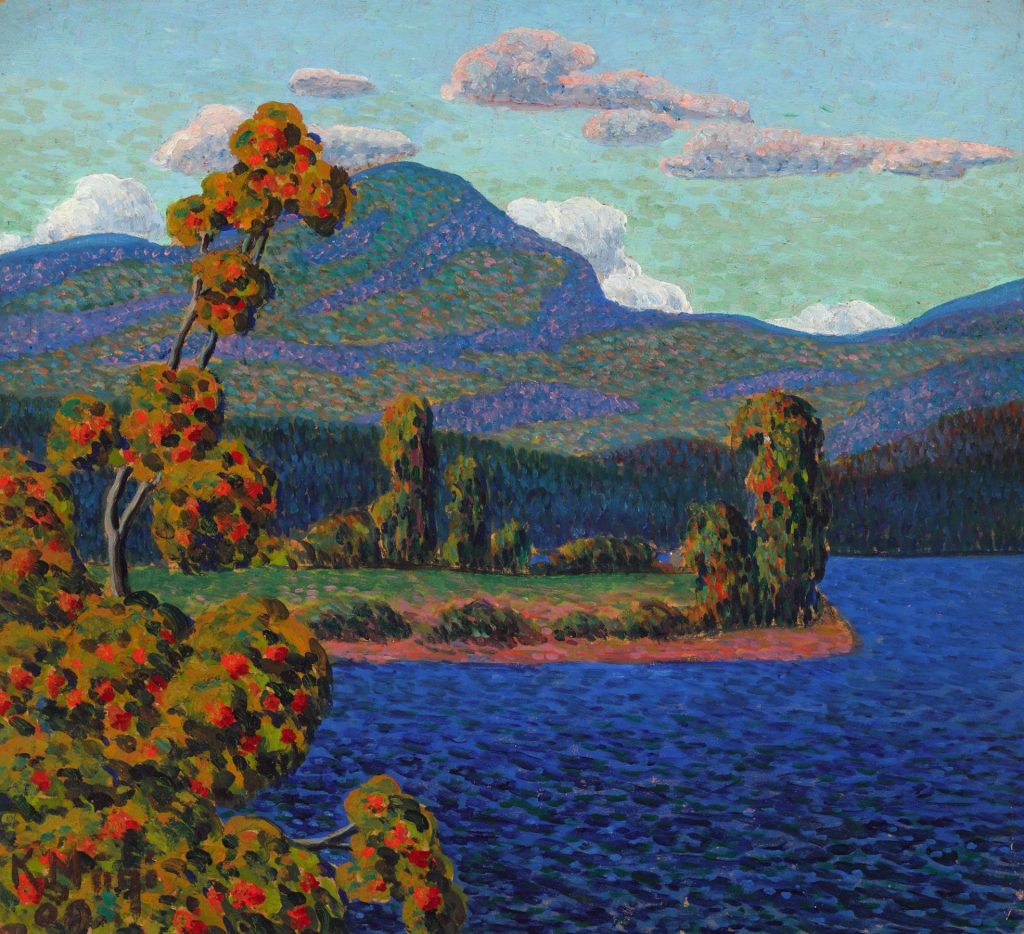
His earliest known paintings were made in Norway between 1908 and 1910, and in this period alone he seesaws between neo-impressionistic landscapes, and a decorative, symbolist style that is a bit like Klimt. He also made a pair of winter landscapes that miraculously capture the effects of the dying sun on the snow, to demonstrate his sophisticated facility with colour. He seems never to have painted anything quite like it again.
The impression of an artist flitting wildly between styles without really interrogating any of them may be the result of gaps in the records – works have certainly been lost over the years, some seem to have been destroyed by Mägi, who later in life seems to have been in the grip of syphilis, which drove him to violence, mainly against himself.
Paintings will also have been lost in the mass exodus that, according to Estonia’s Ministry of Foreign Affairs, saw 70-80,000 people flee the advancing Red Army in 1944, in addition to the 10,000 Estonians who were deported to Siberia in 1941.
For all that, it is also the case that Mägi’s output was sporadic, and that his reputation is founded on an extremely short career – and not just because he died at the age of 46. He only took up painting aged 28, on a trip to Norway with friends including the painter Nikolai Triik. The pair had met in St Petersburg, where Mägi had enrolled on a short-lived wood-carving course at the Stieglitz art school.
The closure of the wood-carving department gave Mägi time to visit the museums and galleries of St Petersburg, and he became increasingly interested in Symbolist painters such as Mikhail Vrubel, who unlocked Mägi’s interest in the esoteric, and metaphysical, which remained an important element of his work. The Russian Revolution of 1905 started that year, and though Mägi was briefly involved, he and Triik left for the Norwegian islands of Åland that same year. It was only then, and it seems with the encouragement of Triik, that he made his first paintings, of which only one now survives.
Triik seems to have provided Mägi with much-needed motivation, even after he had arrived in Paris, the undisputed centre of the art world. Perpetually short of money, Mägi finally got to Paris in September 1907, where he lived in the artists’ colony La Ruche (The Beehive), alongside Marc Chagall, Amedeo Modigliani, Fernand Léger, Diego Rivera, and others.
But rather than an artistic heaven on earth, Paris was for Mägi a wretched disappointment: “He had a terrible time in Paris,” says curator Kathleen Soriano. “He had no money, he wasn’t buying any food, he complained about the quality of the tobacco, the paper that he had to buy was too expensive.”
Though he took drawing classes, he seems not to have made any new paintings, until his old friend Triik arrived: “As far as we know, he didn’t really make any art there on his first trip”, says Soriano. “It was only when Estonian artist Nikolai Triik came to visit him that he was encouraged to make good new work.”
Mägi arrived in Paris at what, in hindsight, was an unimaginably exciting moment: 1907 was the year that Picasso’s friends were invited to his studio to see his latest painting, Les Demoiselles d’Avignon. The Salon d’Automne that year doubled as a tribute to Cézanne who had died in 1906, and also included contributions from Matisse and Derain, Rodin and André Lhote, Raoul Dufy and Fernand Léger.
Mägi was not impressed, and wrote to his friend August Vesanto that “I do not particularly like contemporary French art (there are exceptions). After looking at old portraits, it is especially painful to look at all this sloppy rubbish.”
Triik had arrived in Paris from Norway, a particularly fashionable place at a time when artists and intellectuals, fatigued with modernity and the industrialised world, were searching out ways to reconnect with nature. “The wild North”, writes art historian Eero Epner, seemed to offer exactly this possibility, and Mägi took the bait.
Norway did nothing to improve Mägi’s unrelentingly gloomy outlook, which was certainly exacerbated by extreme and chronic ill health, later diagnosed as a combination of ulcers, gastritis, rheumatoid arthritis, radiculitis and early-stage tuberculosis. But it did provide him with his first exhibition, which he followed in 1912 with three paintings at the Salon des Indépendants in Paris. Still, despondent once again, he returned to Estonia, where he produced a significant number of portraits.
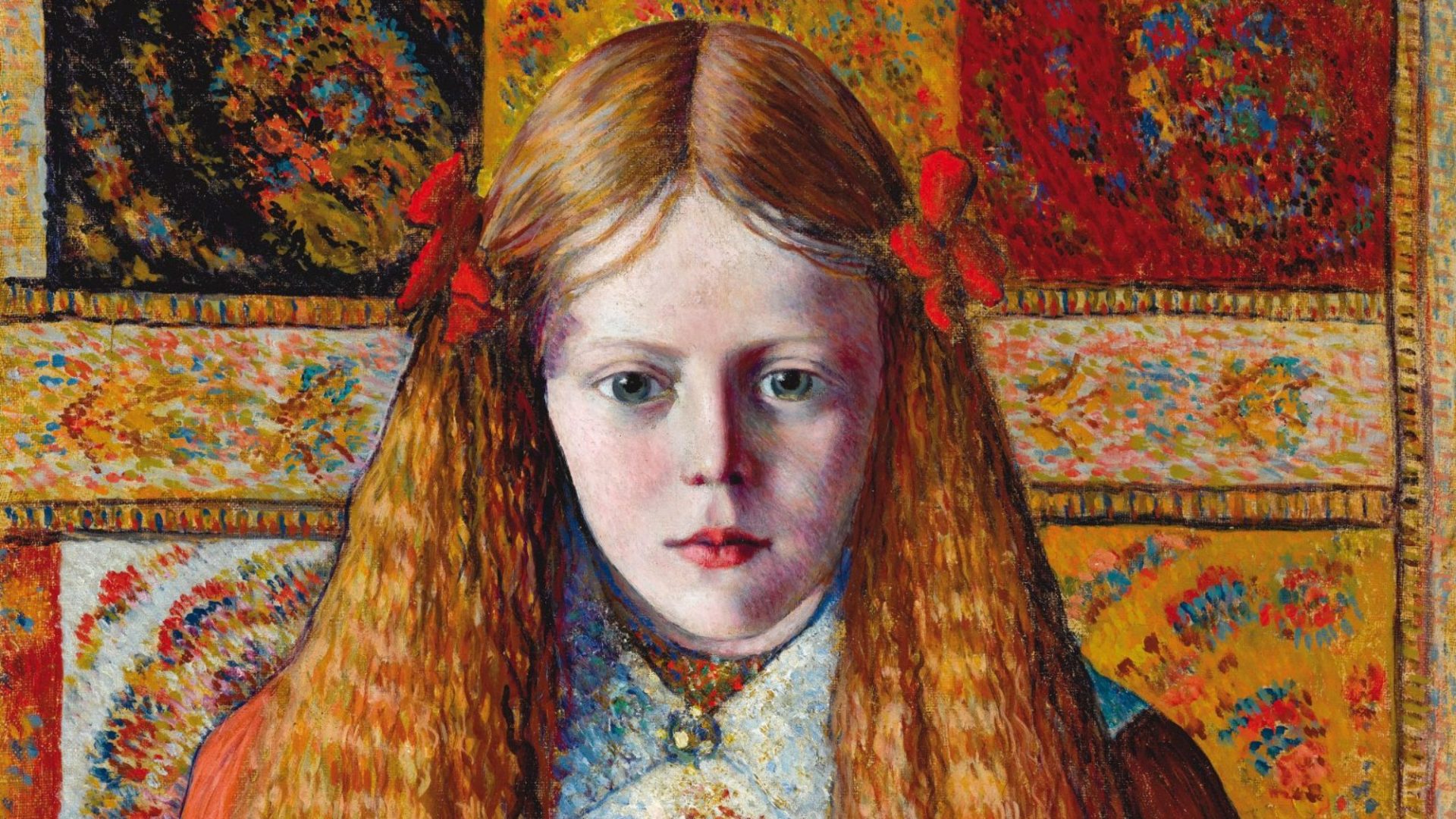
These have tended to receive less attention over the years, but their hints of cubism, interesting backdrops and expansive colour show him consulting precedents from Degas and Manet, Picasso and – yes – Cézanne, and most of all Edvard Munch, to do justice to his subjects. Similarly, the mixture of commissioned works, and paintings from models, some of whom, though not all, were his friends, suggests a surprisingly sociable character.
If the earlier rooms suggest an artist overwhelmed by various modernist idioms, his series of paintings of Estonian islands from 1913-14 show him developing a more stable, distinct style, his repetition of motifs, such as the Vilsandi lighthouse, indicating a more thoughtful and considered approach, in which vestigial pointillist dots are harnessed as concentrations of light in almost psychedelic landscapes.
Suggested Reading

The very strange genius of Stanley Spencer
Despite his terrible health, Mägi travelled a lot in his final years, but also taught at the Pallas Art School in Tartu. He spent his last months in a clinic for internal diseases, where he died aged 46. Interestingly, though Mägi’s work was suppressed by the Soviet authorities, the rules were relaxed by the end of the 1950s, and by the 1970s he was fully rehabilitated.
Now, a century after his death, Mägi’s strange and idiosyncratic paintings can be seen by British audiences for the first time. The Guardian’s review described the exhibition as “plodding” and “banal”, “pointless” and “vacuous” – statements with which Konrad Mägi might not have agreed – but you get the feeling he would have appreciated the candour.
Konrad Mägi is at Dulwich Picture Gallery until July 12