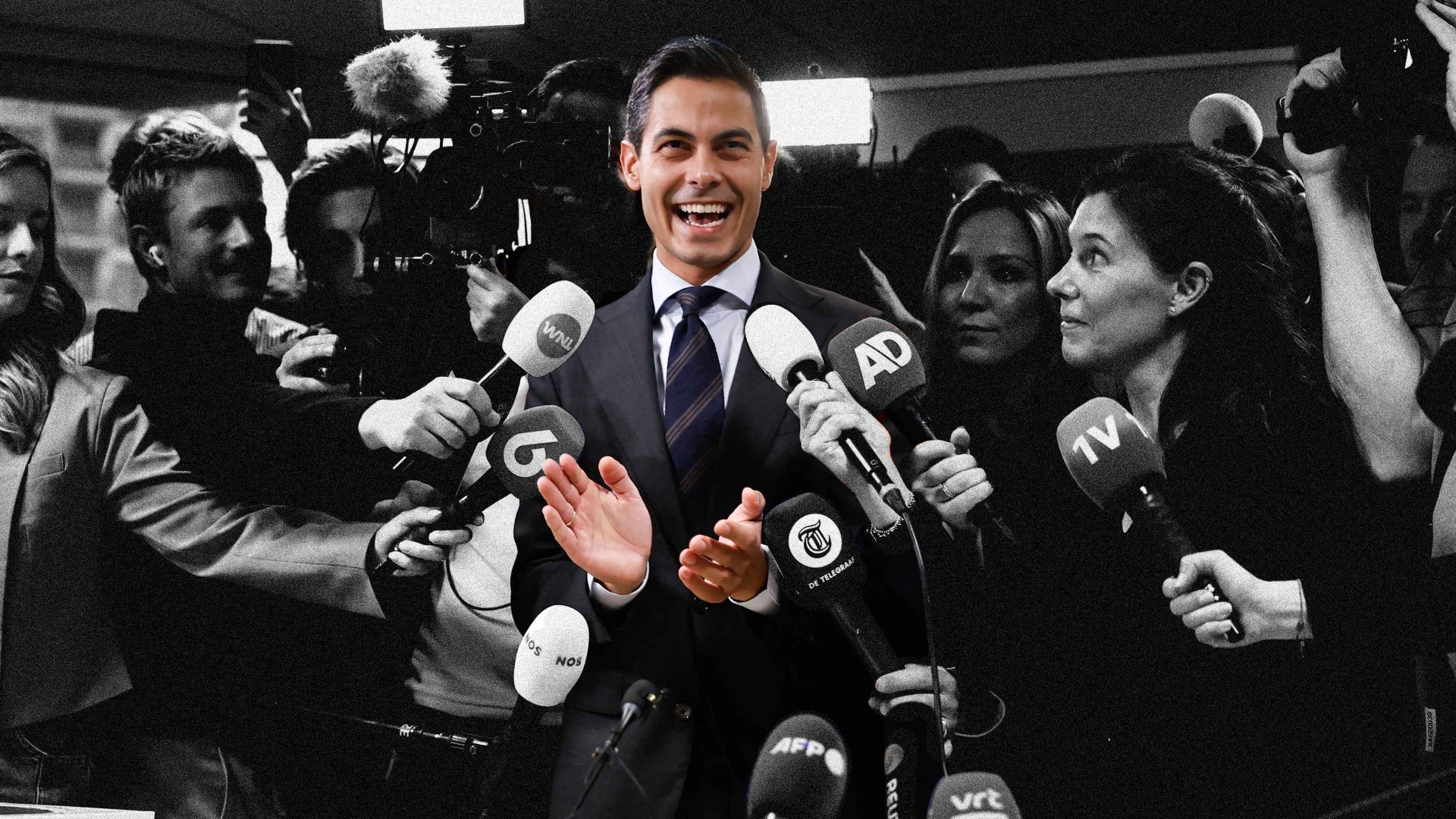
The first month-and-a-bit of the new Dutch government under liberal prime minister Rob Jetten has not been an easy one. Not only was the country shaken by attacks against Jewish buildings in Amsterdam and Rotterdam, there’s the war in Iran, rising gas prices, and the small matter of the coalition government not having a majority.
During the first debates in parliament, Jetten promised several times to “look into” or “look again” at several of the harsh economic measures that his government has proposed. Above all, he said, his minority coalition was not going to run around “like a headless chicken”.
It’s not easy to characterise Jetten’s government. It’s not exactly hard right, but almost. It doesn’t have a majority in parliament, but almost. And while he’s prime minister, it’s not entirely his coalition, but almost. In fact, this is the Netherlands’ second “almost government” in a row.
It follows the ramshackle and ill-fated coalition fronted by technocrat former spymaster Dick Schoof, who stood in for the real winner at the time, the far right’s Geert Wilders. That “almost Wilders” government predictably fell apart after less than a year, not just because of infighting, but also because it could never deliver the unconstitutional migration curbs that Wilders, its puppet-master, demanded.
Having almost plagiarised Barack Obama’s “Yes We Can” slogan, Jetten is presenting himself as a breath of fresh air. Helped by being the youngest ever Dutch PM, and the first openly gay one, he projects change. Yet, despite his young age, he is a veteran of both parliament and government. In the last couple of years he has started drifting to the right.
There’s a lot more “almost” about Jetten and his new government. First of all, while widely lauded in mainstream circles across Europe for beating Wilders and his Party for Freedom, PVV, he almost didn’t. Until the PVV suffered a dramatic defection earlier this year, Jetten’s D66 was level with it in parliament. He had eked out the narrowest of wins in the popular vote.
Suggested Reading
The Netherlands’ lessons from the UK – and England
While Jetten and D66 are often described as progressive centrists, that label doesn’t fit any more. During the election campaign he made it clear that he was willing to ditch his former objections to a hardline migration policy, in the interest of coalition building. Jetten has now committed to implementing much of the previous government’s tough migration package.
Even on the environment, his and his party’s longtime signature cause, he has toned down previous policies. This is possibly why Jetten, a former outspoken environment minister, had to endure a boisterous Extinction Rebellion protest outside the gates of the royal palace during his swearing-in ceremony.
Gone is the promise to cut huge Dutch livestock numbers by half. This was previously seen not only as necessary to address pollution, but also to free up the “nitrogen budget” to be able to build badly needed new housing. The progressive side of D66 has clearly been subsumed by its laissez-faire liberal side. The big winner of the coalition talks has been the other laissez-faire liberal party, VVD.
The VVD’s new leader, defence minister and vice-PM in the new government, is the hard right Dilan Yeşilgöz-Zegerius. She has led her party twice to electoral defeat, shedding a total of 12 seats; but nobody would know from the way she dictated terms to Jetten. Most of the great offices of state are distributed among her VVD and the centre right conservative Christian Democrat CDA.
Maybe Jetten thinks he might appease his party’s often progressive-leaning voters with some high-profile give-aways in the areas of culture or education. But that will hardly provide a cover for his migration and environment compromises, nor for the harsh economic measures that are going to drive up individual healthcare costs and the retirement age.
He will have very little choice but to tack out towards the political extremes. The only parties likely to give him the kind of sustainable majority he needs are located on the far right of the political spectrum. These include the break-away faction from Wilders’s PVV.
And so despite almost forming a successful government, they will continue to be hugely influenced by the far right.
Ferry Biedermann is based in Amsterdam and writes on Europe, the Netherlands and Brexit