“They fuel the chaos. We will restore order. With Marine, the rule of the thugs is over!”
Le Pen and her sullen understudy Jordan Bardella have only to repeat their party’s talking points about restoring security and making vandals and their parents pay, to protect what they label “the silent majority, honest France, working France, against those who destroy.”
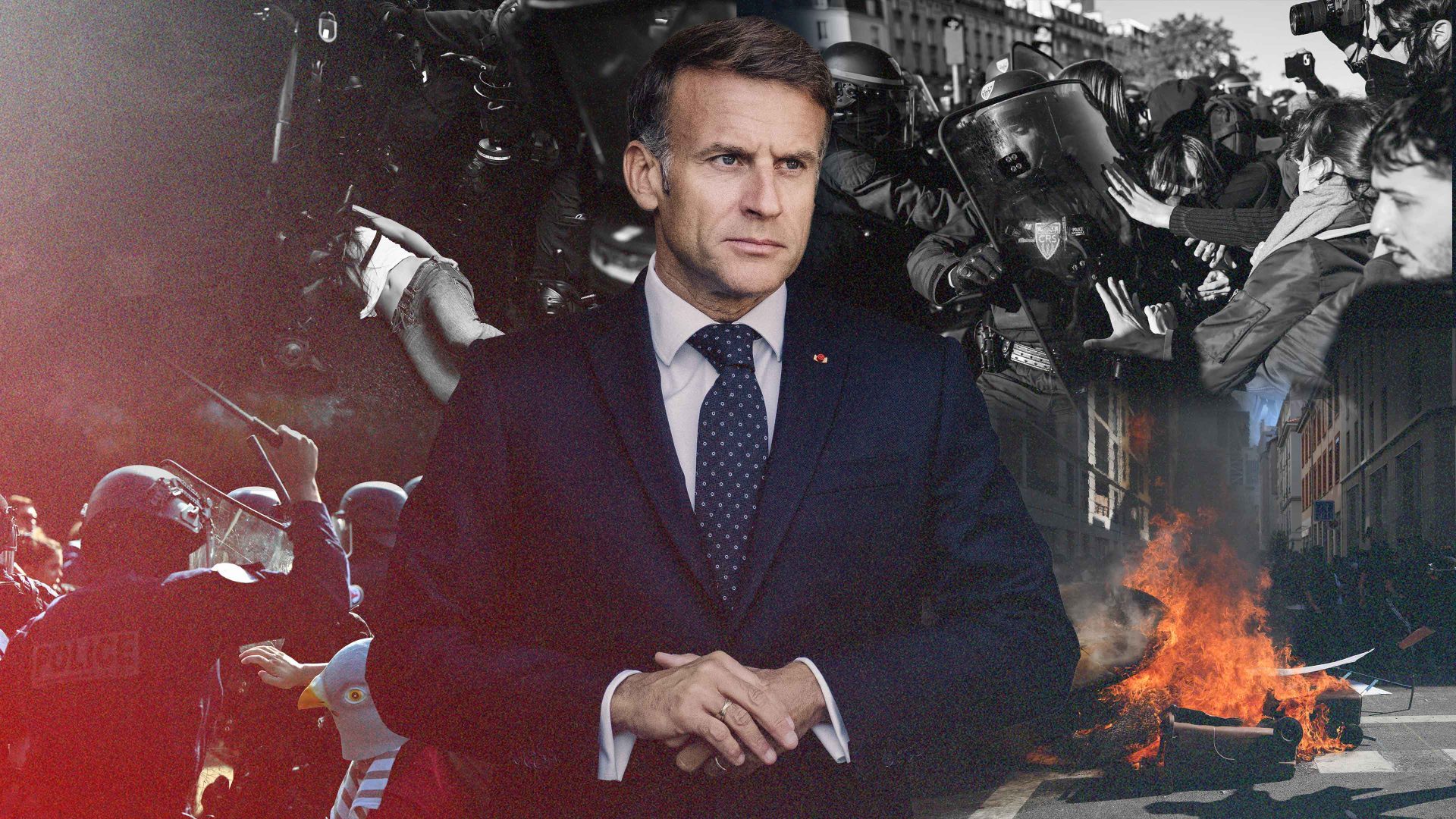
The clips do the rest: masked teenagers in black, smashing up schools, setting fires and pillaging, attacking police, a Marseille principal beaten senseless, a teacher doused in petrol, a country sliding into another bout of Gallic chaos. The images also send their confrères in the international extreme right into paroxysms of France-bashing, splashed with racist Great Replacement bunkum about France being “invaded” by a non-existent Muslim and Black horde.
Nevermind the shocking videos of police dragging teenagers by the neck and seeming to kneel on very young rioters, although this seems simply to thrill the far-right. More than 6,000 have been arrested, many of them minors, since the unrest began in late September, breaking the single-day arrest record set during the Gilets Jaunes riots.
But the question is bigger than the riots. With street revolt, gridlock over a budget whose failure to pass has alarmed bond markets, and growing demands that he resign, can Emmanuel Macron still do what Charles de Gaulle did in moments of national crisis? Can he take hold of the country? Or has he already lost it to Le Pen’s National Rally, which is still tipped to win next spring’s presidential election?
France has faced these moments of crisis before. The most acute was in 1958, when the French Fourth Republic collapsed over Algeria. In May of that year, French-Algerian ultras and far-right nationalists from milieus in which a young Jean-Marie Le Pen was already prominent, seized control in Algiers.
They demanded the return of Charles de Gaulle, the wartime hero, who had entered self-imposed exile after the war. They believed de Gaulle alone could preserve Algérie française.
Paratroopers took Corsica, while Operation Resurrection envisaged airborne forces seizing strategic points around Paris. They were planning a textbook coup d’état. Amid the threat of a fascistic military takeover, de Gaulle was called back to office, formed a government and drew up a new constitution, which was approved overwhelmingly by referendum. The coup plotters backed off, the Fourth Republic was toast and the Fifth was born.
Suggested Reading

British teens need to copy the French and get out on strike
But it soon became apparent that de Gaulle was willing to let Algeria go. In 1961, four generals launched a putsch. After it failed, the organisation armée secrète (OAS), born from the radical Algérie française movement, waged a terrorist campaign to stop Algerian independence and repeatedly tried to assassinate de Gaulle. In a wave of bombings and assassinations, committed across both Algeria and the French homeland, the OAS killed around 2,000 people.
France, in other words, is no stranger to crisis. But de Gaulle’s doctrine and response to national upheaval was not simply to respond with imposing law and order. His politics was grounded in authority, national sovereignty and perhaps most strikingly in the concept of an intergenerational pact. Even in 1968 he understood that a revolt of the young could not simply be driven off the streets by men in uniform. As de Gaulle remarked at the time: “Youth can only live in hope, and hope requires knowing where one is going.”
The trouble is that Macron has already tried his de Gaulle moment – it didn’t work. In 1968, de Gaulle famously dissolved his government, forced an election and emerged with a massive majority. Macron tried this ruse in 2024 but came out shell-shocked and saddled with a hung parliament, where his agenda has been stifled by the extreme right and left. The deep paralysis he is currently unable to solve is all of his own making. He is, it turns out, no de Gaulle.
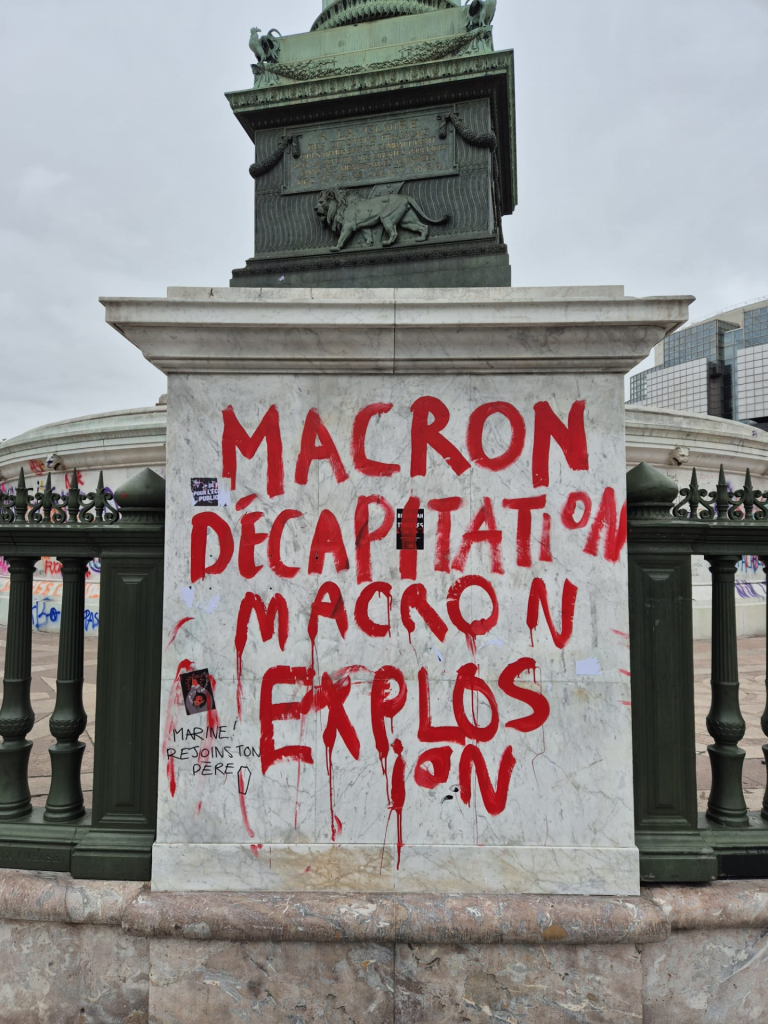
While parliamentarians gesticulate inside the assembly, masked young criminals vandalised a school in Lormont near Bordeaux, ransacking classrooms, setting fires and stealing computers. At the Place de la Bastille, casseurs attacked police while others threw heavy objects from apartment buildings.
In the face of this, the Le Penists want to restore order. But what sort of order, and for whom?
Bardella, exposed in online messages as a raging conspiracy-peddling anti-Semite barely a decade ago, no longer bothers hiding his xenophobia. “I will always fight so that ‘wallah’ and ‘wesh’ are not the cultural horizon we have to offer to the youth,” he told TF1, insisting France must wage “a cultural battle, a battle to transmit France, our literature, our art of living, our greatness!”
This is pretty rich, coming from a 31-year-old YouTuber who failed geography and dropped out of the Sorbonne. Extreme-right hate merchant and convicted denier of crimes against humanity Éric Zemmour is even more explicit, as usual: “always the same people” riot and smash things up, “the France of the banlieues, the largely Arab-Muslim France.”
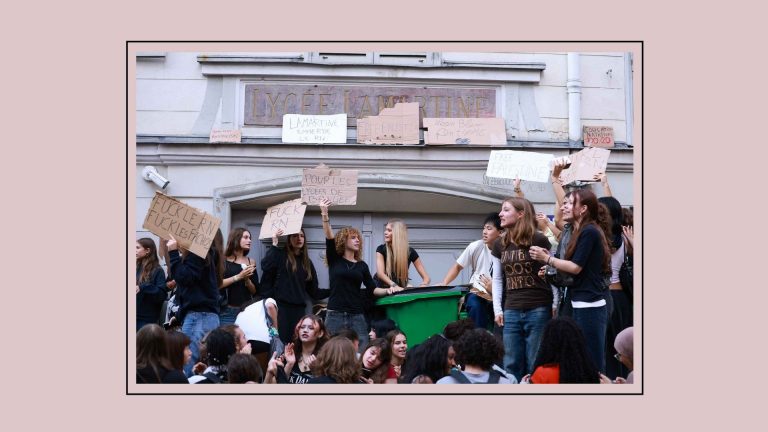
Except this movement is not confined to the banlieues, though it started there. But now plenty of white bourgeois kids are expressing solidarity with their peers in the immigrant-populated suburbs of Paris or Marseille. The demonstrations have spread to the Latin Quarter, where May 1968 began, elite lycées and even to the private schools and universities such as the Institut Catholique.
The global far-right’s online loudmouths do not see this. Trump declared the disturbances were not about schools but “out of control” migration and Islam wanting to take over. Texas senator Ted Cruz duly followed his master’s voice with a repost oozing White Genocide tropes: “France is burning,” Europe “opened its borders and failed to confront radical Islamism,” and “Europe is the warning,” a lesson that he then tried to turn against AOC, Mamdani and other Democrats. “Another day of France-as-content,” came the acid reply from the French foreign ministry’s English-language account.
Suggested Reading
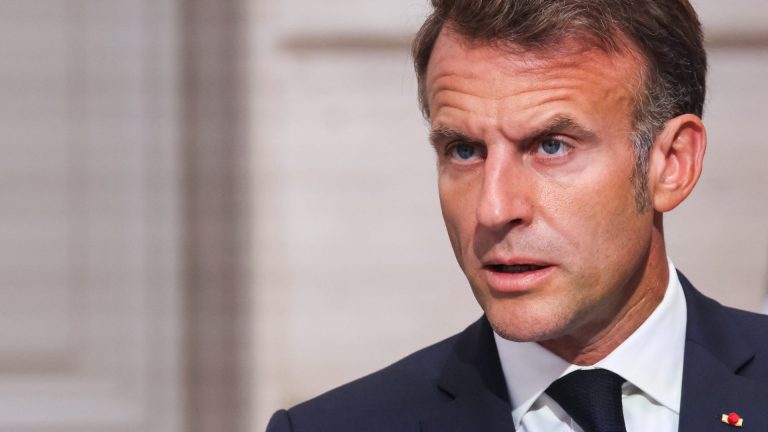
Crisis in France: it’s all Macron’s fault
The former Trotskyist Jean-Luc Mélenchon, who at 75 polls above 40% among 18-to-24-year-olds, and is accused of encouraging and even legitimising violence, calls this the biggest mobilisation since May ’68. It isn’t. Not yet. The soixante-huitards were joined by workers in their millions. A general strike that paralysed France is not what we are seeing, although let’s see what happens with next Tuesday’s “Act V”.
The actor Vincent Lindon, who plays Jean Valjean in a new adaptation of Les Misérables, grasps the distinction better than the opportunistic politicians making facile comparisons. “In May ’68, it was a rejection of consumer society. Today, it’s a crisis against scarcity,” he told France Inter. The teenagers of 2026 are fighting back because their schools lack teachers, heating and cooling and, sometimes, even toilets.
That shortage has an origin, and it is not one much of the left is willing to name. “If money is plentiful, why isn’t it visible in classrooms?” asks Benjamin Sire in Les Électrons Libres. A clue can be found in the education ministry’s €89.1bn budget for 2027, which includes no less than €25bn for retired staff pensions. That figure is set to surge.
Paul Krugman, a Nobel laureate of the liberal left, notes that France’s retirement age is the earliest in Western Europe at 64. He wrote on his Substack: “You don’t have to be a conservative to see the problem.” Pension costs have meant cutbacks elsewhere, notably in education. Older people, he said, are subsidised “at the expense of everyone else”, adding that “mass national student demonstrations should come as no surprise.”
Le Pen has pledged to reduce the retirement age back to 62, which he calls “extremely expensive”. The extreme left would go back to 60.
The political extremists are busy exploiting the situation in every way they can. After a 15-year-old lost his hand in Lens, interior minister Laurent Nuñez suspended the use of grenades during the lycée protests pending investigation. On far-right CNews, and among Le Pen allies, this became evidence of a campaign to “disarm” the police.
Suggested Reading
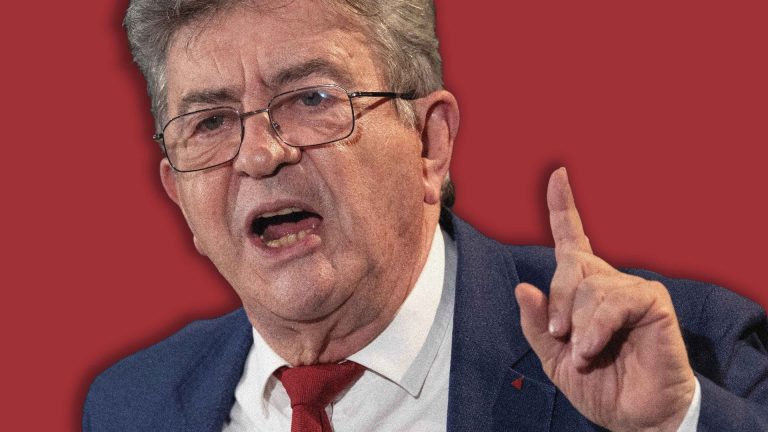

France’s Corbyn is helping Le Pen win the presidency
Julien Rousset, writing in Sud-Ouest, concedes Macron bears heavy responsibility for the tinderbox situation, but warns that “any unpopular president, and all become unpopular sooner or later, would face extreme pressure to leave,” creating “a kind of institutionalisation of instability.”
Macron is hardly hiding in the Élysée. He is still doing the presidential rounds, leaving his interior and education ministers and prime minister to manage, amid unsourced reports of his fury at the police’s excessive tactics. He has also made his understandable fury known over France 2’s decision to broadcast a teenage marcher’s placard insulting his wife Brigitte: “Macron, screw your own teacher, not ours.”
None of this adds up to taking command the way de Gaulle did. France’s president has to offer more than the condemnation of violence, and talk of the importance of optimism.
Macron has already tried the great presidential gamble of dissolving parliament and calling an election. It weakened him. Another dissolution could simply produce another hung parliament, or a Le Pen majority. Despite his deep unpopularity, he could address the nation, further rein in police excesses and keep offering concrete responses like the 3,000 new replacement teachers suddenly found by his education minister.
That may be the Gaullist strategy Macron has not tried – giving a justifiably angry generation some idea of where they and France are going, while restoring enough political authority to get a budget through and the country functioning again. Or he could simply hope the marches and riots die a natural death come the October holidays. The petering out option and getting the budget passed, however, are both far from assured.
Le Pen and Bardella present themselves as the reassuring candidates of law and order while cynically benefiting from the panic they promise to end. The Le Pen party doesn’t need to declare overtly that French streets are being taken over by a foreign and Muslim rabble. The online hate-mongers are doing it for them in France, the US – everywhere.
The political structures that kept France democratic through the shock of losing Algeria and the protests of 1968 held, but nothing about that was inevitable. No one knows what France would have become had the generals or the OAS won. If Le Pen wins, we may yet find out.
 Most popular
I was at Eton with Charles Spencer – this is how it explains his battle with the royals

Emily Maitlis’s diary: My deep dive into Jeffrey Epstein’s hidden empire – and the network that let him get away with it


The linguistic logic behind dropped syllables
Putin’s wartime economy is heading for catastrophe