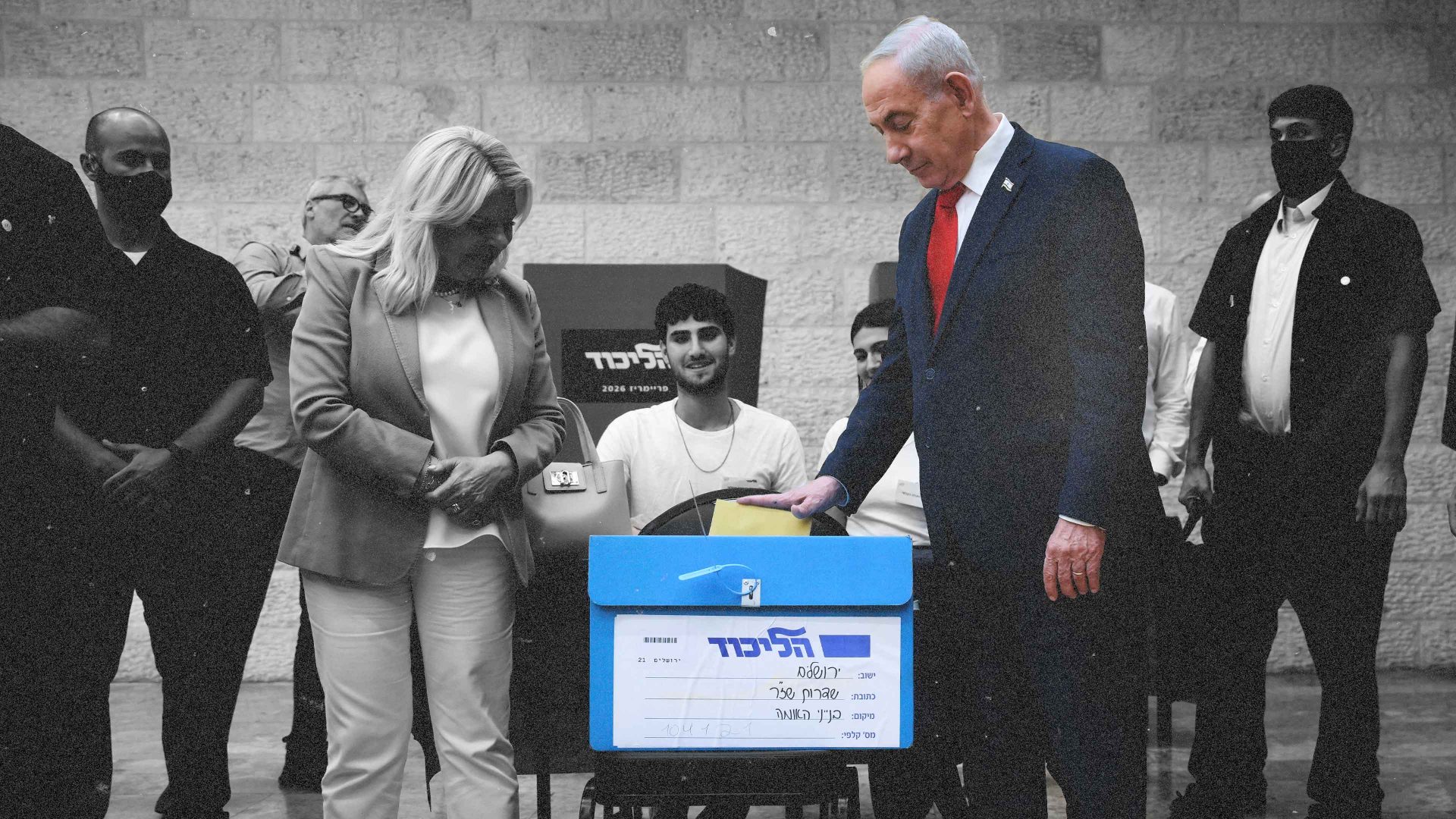
To understand how Benjamin Netanyahu’s camp are handling easily the most crucial election of his long career, it helps to consider the recent interview the prime minister’s wife, Sara, gave to Channel 14, the far right, fanatically pro-Netanyahu station that makes Fox News look non-partisan by comparison.
In her sights was Yair Golan, the former Israel Defence Forces deputy chief of staff, who now heads the centre left Democrats. On the morning of October 7, 2023, the day of the Hamas-led massacre of 1,200 Israelis, Golan drove south and risked his life to bring multiple young people to safety. They were fleeing the Supernova dance festival after it turned into a killing field.
Sara Netanyahu’s take on this widely acknowledged act of heroism was that it was nothing of the sort. How come, she asked, Golan had left home in his general’s uniform before even the prime minister knew about it? This was factual nonsense, designed to promote the conspiracy theory – already believed by 40% of all voters according to a recent poll – that Israel’s security elite withheld intelligence from Netanyahu in order to damage him.
Suggested Reading
What the next PM must do on Israel-Palestine
The purpose was clear – to distract from far more fundamental accusations about October 7 still hurting her husband. One is that, by allowing regular cash from Qatar into Gaza, he sustained Hamas in order not to have to negotiate with a divided Palestinian leadership. Another is that he ignored persistent defence establishment warnings during 2023 that the divisions in Israeli society generated by his dictatorial efforts to neuter the judicial system were fatally jeopardising the country’s security. (Not to mention a remarkable report in the Israeli daily Haaretz on Tuesday that he did nothing with a warning ten days before October 7 from Mohammed Bin Zayed, the United Arab Emirates leader, that Hamas were planning a serious act of war.)
These accusations are having an effect. Netanyahu’s main rival is the more centrist ex-IDF chief of staff Gadi Eisenkot, who lost a son, killed fighting in the Gaza war. Polls now show Eisenkot has a lead of around 10 points over Netanyahu.
Unfortunately for Netanyahu’s opponents, that is not the end of the story. Because Israel’s proportional voting system makes it virtually impossible for one party to win the 61 seats needed to form a majority, the task of constructing a coalition with smaller parties is crucial. And since no party is too extreme for Netanyahu to recruit to his bloc, he still has everything to fight for.
Many foreign governments are fervently hoping that he will fail. But they should also note what is missing in the current election debate. On Sunday night a Rest is Politics live event at London’s Festival Hall featured two close friends. One was Maoz Inon, an Israeli whose parents were both murdered on October 7, and the other, Palestinian Aziz Abu Sarah, whose brother died from internal injuries inflicted in an Israeli prison. The pair were promoting their inspirational book The Future is Peace.
What struck me, having returned from the region the night before that compelling event, was that Netanyahu’s long period in power has successfully delegitimised as treacherous leftists any politician who openly talks Inon’s and Abu Sarah’s wholly persuasive language. Indeed most opposition parties hardly talk about the 59-year-old occupation at all, apart from those representing the 20% of Israeli citizens who are Palestinian.
The subject is ignored, even though a just end to the occupation is an existential imperative, not just for the five million Palestinians suffering under its yoke, but for Israel itself. It is the country’s only hope of a future as a secure liberal democracy rather than as a regionally threatened and, in the long term, internationally shunned apartheid state.
And this matters. For Netanyahu and his coalition allies are doing anything but ignoring the issue. The supremacist interior minister Itamar Ben Gvir’s pursuit of votes includes a chilling video with fascistic overtones, revelling in the savage conditions he has imposed on Palestinian detainees.
Meanwhile his ideological soulmate, the finance minister Bezalel Smotrich, has suggested that mass “emigration” of Palestinians both from Gaza and the West Bank is the “only solution”. Netanyhau will no doubt happily appoint both ministers again if he wins on October 27.
But this is not just a matter of the overtly racist rhetoric deployed by members of his coalition, which is the most extreme in Israeli history. In all too concrete terms, they are also enabling, by ensuring its complete impunity, the lethal and rapidly mounting settler violence designed to accelerate de facto annexation of the occupied West Bank and the formation of a single Israeli state stretching from the Jordan to the Mediterranean.
An Eisenkot victory, though welcome compared with the alternative, is not magically going to overturn this. The Israeli settlers living in the West Bank and their political champions are now on such a roll that it will be hard to restrain their worst excesses, assuming Eisenkot wants to. He is a centrist in Israeli terms – which means pretty right wing in others – and he has ruled out the idea of a Palestinian state if he wins as “delusional”.
Suggested Reading

Israel’s new weapon of war: archaeology
There has been one positive development in the otherwise bleak election run-up: an unexpected decision by a far-sighted Jewish politician and former police chief named Yoav Segalovitz. A former minister who has been attentive to the needs of Arab voters, he has joined one of the four Arab parties as a Knesset candidate, second only to its leader, Mansour Abbas.
This is unlikely to bring in more anti-Netanyahu voters. But it might just mean that the opposition would be willing to include Abbas’s party in a coalition, thus giving Eisenkot the numbers to form a government.
On Tuesday Foreign Secretary Ed Miliband marked his decisive and welcome reset of government policy on Israel by leading a clutch of other countries in imposing significant sanctions against those trading in goods and services with the settlements.
If Eisenkot wins, the worst outcome would be if foreign governments dropped sanctions aimed at a just solution for the Palestinians, just because Netanyahu has gone. Those in a potential Eisenkot coalition who believe in such a solution, including Mansour Abbas and perhaps also Yair Golan – will need all the international support they can get. I think Inon and Abu Sarah would agree with that.