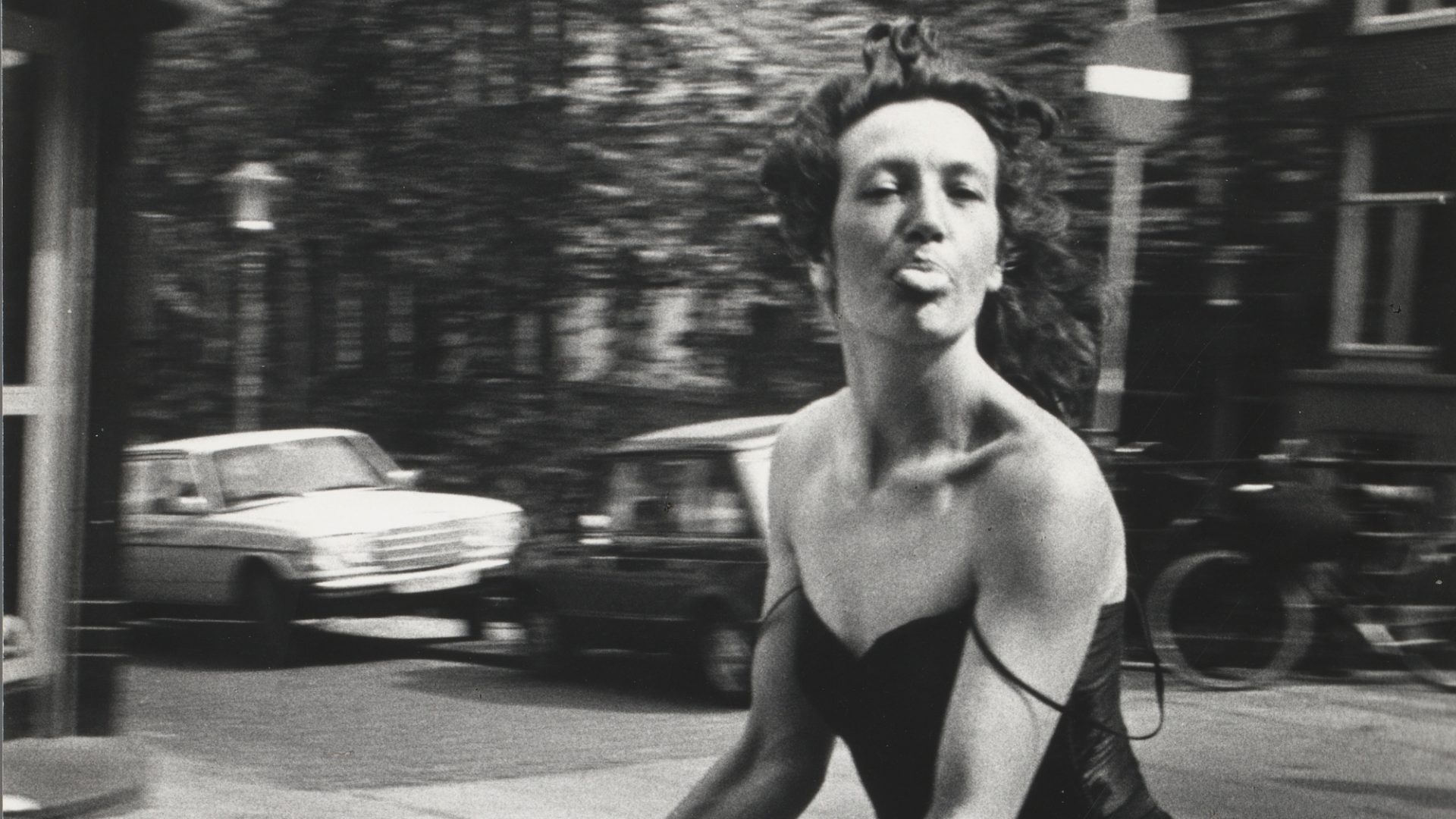
A summer’s day in Amsterdam in 1983. Cycling along the canals, a young woman pedals past a man with a camera. Provocatively, she pokes her tongue out at him and whizzes on by. Ed van der Elsken gets the picture, the tongue mid-poke.
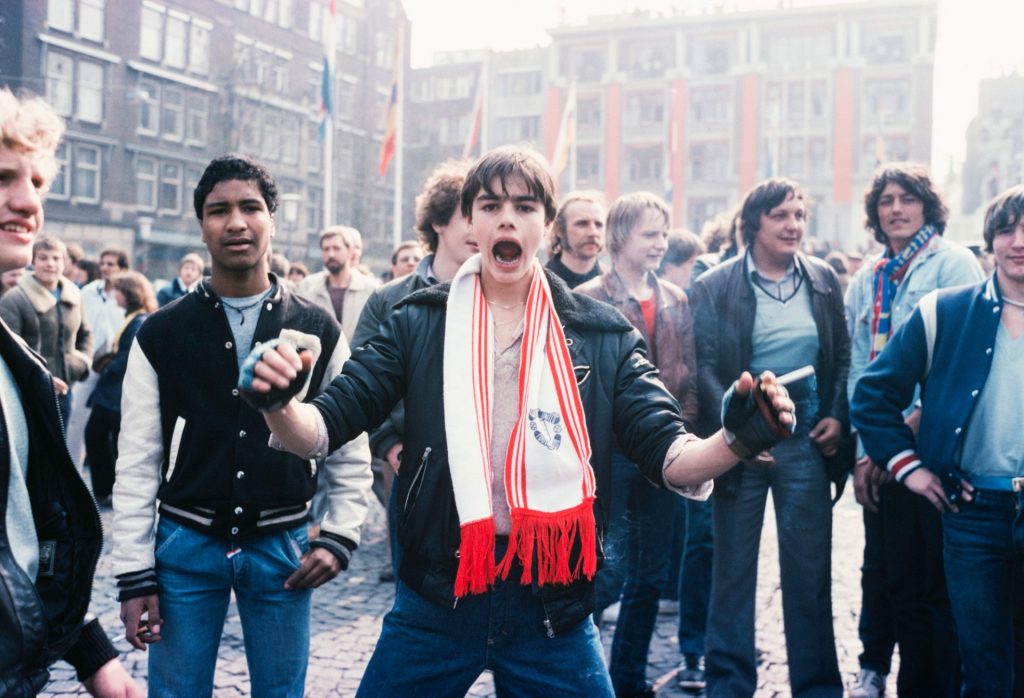
In 1966, a man hurls a rock at the riot police lined up on Damrak, Amsterdam’s main thoroughfare. Again, van der Elsken snaps: the rock is caught, forever in mid-flight.
One city, two moments, the sweet and the bitter. This is the streetwise alchemy that made van der Elsken the photographic maestro of Amsterdam noir.
In Ed van der Elsken. Up Close, a new exhibition at the Rijksmuseum in Amsterdam, he emerges as a gonzo storyteller. He worked from the late 1940s through to his death in 1990, producing a varied body of work – photojournalism, semi-fictional picture stories, autobiographical series – all anchored to his humanist interests and his willingness to get involved in the story at hand.
He shot political riots and jumping jazz bars, sex workers, drunks, street performers, hippies and junkies. He even photographed the birth of his son, in biological detail. “I couldn’t express myself in an expressionistic or abstract way,” he noted. “I’ve always needed reality in order to say something meaningful.”
Born in Amsterdam in 1925, van der Elsken initially wanted to be a sculptor but turned to photography at the end of the second world war, inspired by the work of Bill Brandt and Bert Hardy in issues of Picture Post. He started taking street photographs, with a fondness for seedy scenes – rubbish bins and crates of fish, the clientele of Amsterdam’s red-light district – which led to freelance work.
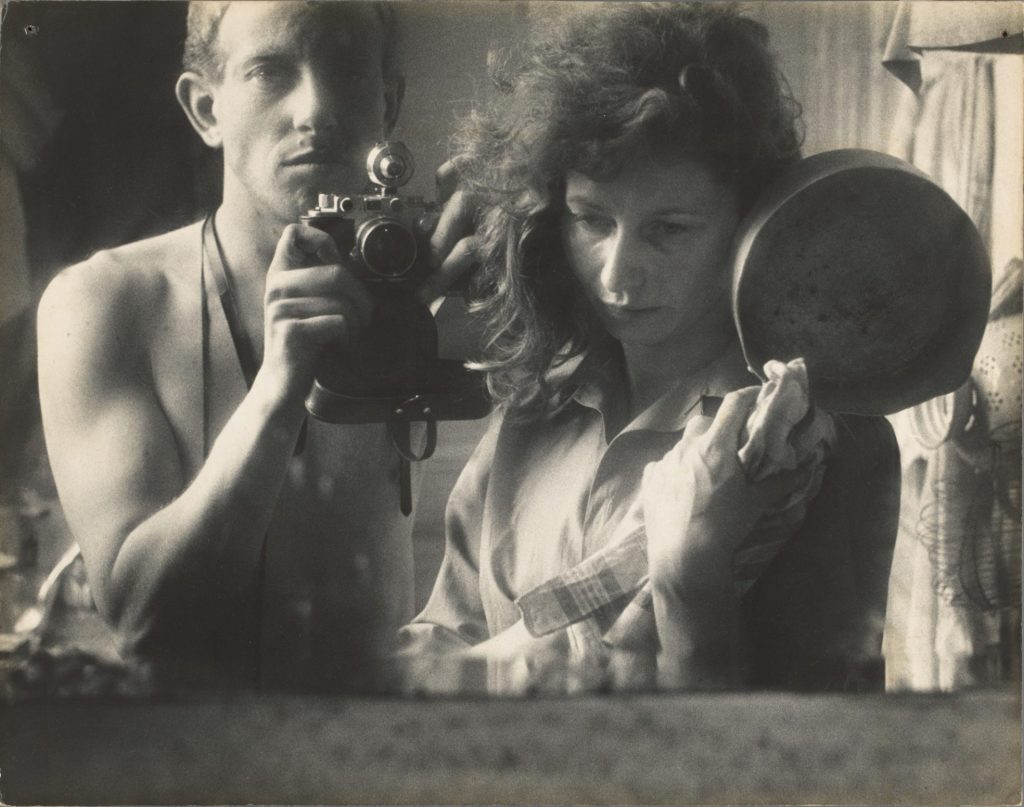
A period living in Paris in the early 1950s resulted in Love on the Left Bank, a photo-novel in which his shots – some staged, some natural – of an artistic circle formed a narrative of doomed romance. Pictures taken on his subsequent travels – student protests in Tokyo, segregation-era New York, dancers in the Philippines – would fill Sweet Life, his epic 1966 photobook which surveyed the joys and struggles inherent in the human condition.
Arguably, however, his greatest muse remained Amsterdam’s vibrant street life – its beatniks, potheads, lovers and strugglers – to which his lens always returned. And van der Elsken was as colourful as his subjects – “known for his bluntness and cheerful audacity,” as Rijksmuseum’s director Taco Dibbits tactfully puts it. In later life, with his bulging eyes, scruffy jacket and pointy beard, he might have been sketched by Rembrandt.
Today, van der Elsken is widely celebrated in the Netherlands. In addition to works from their own collection, the Rijksmuseum has borrowed photographs from Nederlands Fotomuseum, the Stedelijk Museum Amsterdam and Leiden University Libraries, as well as film footage from the EYE Film Museum.
But the core of the Rijksmuseum show lies in the private family archive, which the museum acquired from van der Elsken’s widow in 2019. Staff from the Rijksmuseum stumbled on the archive when they visited his widow to look at a dummy copy of Sweet Life.
“But then they saw what else was there: his entire work archive, stored in this tiny little wooden farm in the countryside near Edam,” recalls Hinde Haest, photography curator at Rijksmuseum. “It was stored in the living room, it was stacked in the old former horse stables. And this was a treasure trove, 40 years in the making. He was the most important Dutch photographer of the 20th century.”
Van der Elsken’s bohemian shots of free love, poverty and protests have influenced grunge-leaning artists from Nan Goldin to Patti Smith. And, Haest explains, his archive “gives a very good sense of the time and the developments that were happening in the Netherlands from the late 1940s to the late 1980s. It’s like a time capsule.”
But the cache also illuminates a pioneer’s process. Van der Elsken constantly innovated, experimenting in the darkroom and exploring ways of presenting his pictures in the context of photobooks. If writing is re-writing, then for van der Elsken photography was reprinting, cropping, reversing and reprinting once again. He could spend years working on a single project, only for it to remain hidden in his archive. Until now.
Suggested Reading

They keep on shooting: 40 years of Reuters
The Rijksmuseum retrospective delivers a deep dive into this practice – vitrines of working copies of books, contact sheets, and multiple prints that emerged from a single negative. It’s a dream show for a photography geek.
“You’d be surprised how much people like nerdy, especially in this digital age,” says Haest. “To actually look at vintage photographs that were made analogue, in the darkroom, over a long period of time. The skill and craftsmanship. I think that’s what people really enjoy.”
Van der Elsken’s handwriting can be found all over his prints and book proofs. “You come really close to the artist.” His portrayal of Amsterdam in the latter half of the 20th century is one of a political, social, cultural and sexual cauldron. But, I wonder, has the city’s reactionary pulse flatlined?
“No, I don’t think so,” says Haest. “Dolle Mina, a feminist movement that Ed photographed in his day, has been revived recently. You still hear a lot of counter-cultural and progressive sounds in Amsterdam.” Ed van der Elsken would approve.
Ed van der Elsken. Up Close is at Rijksmuseum until September 13, 2026