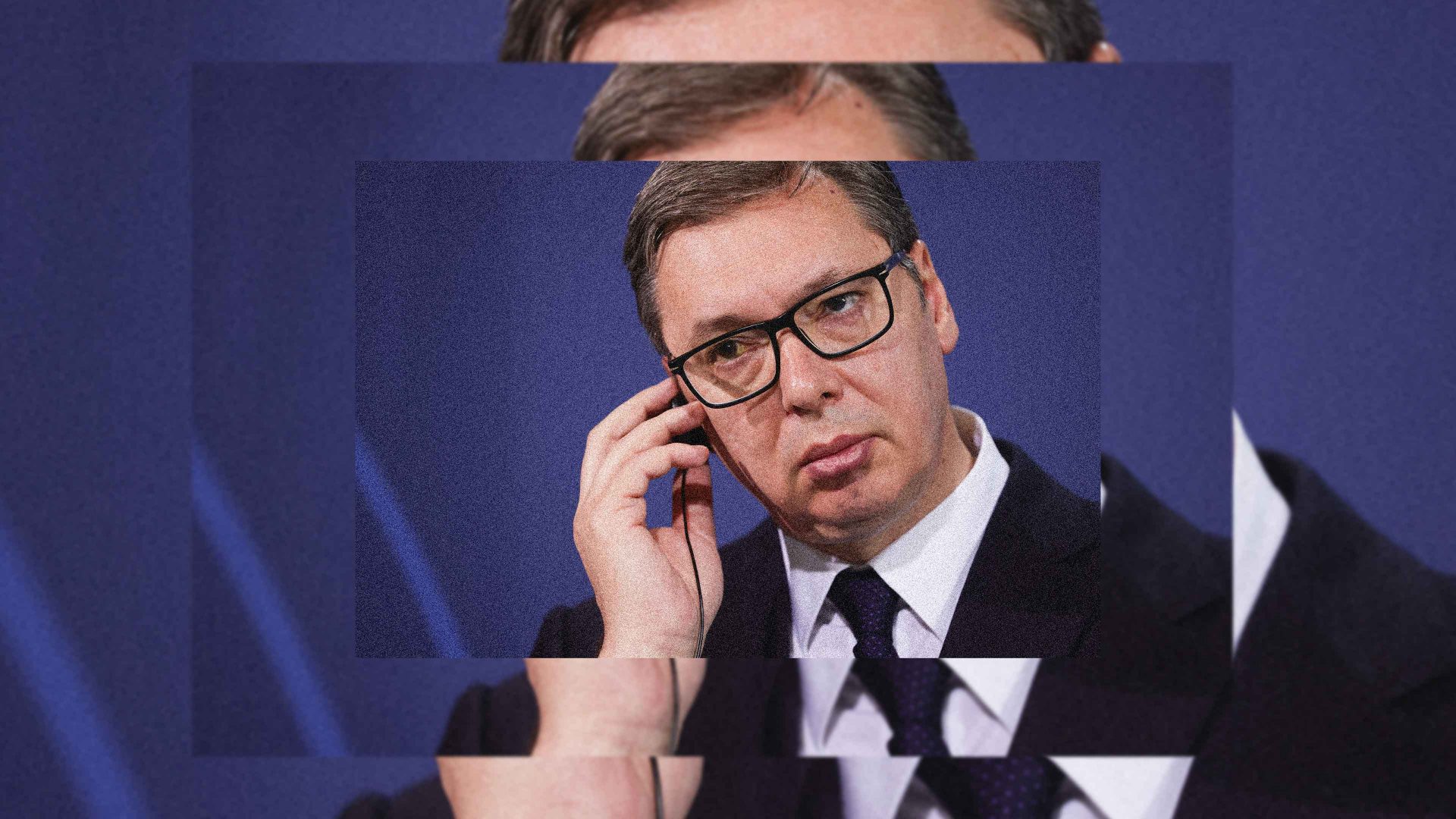
We go back a fair way, Aleksandar Vučić and I.
Back to the Kosovo war in the late 1990s, when he was running government communications for the Serb president, Slobodan Milošević, and I was doing the same for Tony Blair and then, later in the conflict, for Nato. I would build teams and systems to combat what we – justifiably in my view – called the Milošević Lie Machine; Vučić, who was overseeing this MLM, would seek to persuade national and international opinion that we – Nato, the US, the UK and the other 17 countries involved – were brutal aggressors.
Nor did he mind using some deeply illiberal tactics to ensure Serb media, and foreign media too, stuck to the Milošević line. At least I didn’t demand to see all copy written by UK media before it was published, fine journalists who criticised the government, or expel foreign media who did likewise.
I have gone on to do all manner of different things, inside and outside politics, whereas he has never strayed from the political path, rising through the ranks to become prime minister, then president, a post he has held for the last nine years.
Given back then we were at war, for obvious reasons we never met. But fairly early in the Vučić presidency, I was working with Edi Rama, the Albanian prime minister, and he arranged for me to meet Vučić, so I travelled to Belgrade. A giant of a man, several inches taller than I am, he was friendly enough, but fair to say that when the issue of Kosovo came up, his view had not moved one millimetre in the years since the war ended, even though the failure to normalise relations is one of the biggest obstacles on Serbia’s path to the EU membership it covets.
He was adamant: Serbia had been the aggrieved war victim, Nato the aggressive war criminals. I was adamant: Milošević was presiding over the ethnic cleansing of Kosovar Albanians, and the world had to act.
I was proud the Blair government played the role it did in getting the US to lead a military campaign that led to the fall of Milošević, and his prosecution for war crimes. He died of a heart attack, in his cell in The Hague, before judgment.
The rest of our conversation was polite, genuinely engaging, interesting. His politics were very different to mine; our position on either side of a brutal conflict led to an inevitable tension. But there was no escaping his intelligence, his knowledge, and his ability to amass and use power.
Last week we met again, after he agreed to be interviewed for The Rest Is Politics: LEADING. I was surprised he said yes. He had been on my target list for a while.
EU enlargement commissioner Marta Kos, with whom I had travelled to Ukraine a few weeks ago, and who saw Vučić fairly often, promised to put a word in. So she did, and back came the message that he would see us a few days later. Thanks Marta.
I wondered whether, given the issue of the continuing hostility between Serbia and Kosovo is such a huge stumbling block in the EU accession process, and Kos’s role in helping to fix the meeting, Vučić was planning to signal a new way forward. Far from it.
If anything, his views on Kosovo had hardened even more. There was not a man alive, he said, who could reach an agreement with Kosovo’s prime minister, Albin Kurti. There was not a Serb alive who thought anything other than that Nato intervened to take from Serbia land that was rightfully hers, and give it to someone else.
At one point, he even suggested that Donald Trump’s designs on seizing Greenland from Denmark were not so very different from what we did to Serbia back then. Insisting that the Nato attacks on Kosovo were illegal, he said we had opened a Pandora’s box of impunity that led all the way to the war in Iran. It was quite an argument.
Suggested Reading
The bizarre truth about my own vetting for No 10
I have grown used to being labelled/libelled as a war criminal in relation to Iraq. In truth I have always felt that the New Labour government’s role in reversing the ethnic cleansing in Kosovo was one of our finest achievements.
I guess it is always good to get a counter view, and boy does Vučić hold a counter view. He didn’t throw the war criminal jibe at me personally, but he got close, albeit in a fairly friendly manner!
Belgrade has changed enormously in recent years. A new national stadium built for EXPO 2027 is the first thing you see as you’re exiting the airport. High-rise buildings abound in the commercial centre. The roads are much improved. Wages and pensions have risen, and Vučić can point to decent growth figures.
One thing that hasn’t changed is the bombed-out army HQ, not far from Vučić’s office, which has stood there untouched as a reminder of the war for more than a quarter of a century.
This was the building that Jared Kushner and Donald Trump Jr were hoping to turn into a five-star hotel-cum-office-block, on their never-ending global tour turning Daddy Trump’s policies into money-making ventures for themselves.
Suggested Reading
The lesson Australian justice has for Trump – and for the world
It has fallen through, not least because one of his ministers is now standing trial over the process put in place to get the deal done. It sure is one ugly monument right now, but its presence in the centre of Belgrade has played its own role in cementing in the minds of Serbs this notion that they were the victims of the war.
Nato could once boast in polls of the support of between a third and a quarter of Serbs. It is now down to 4%, and you know what the most famous polling 4% in the world is – the proportion of people who think Elvis is alive.
The long-memory syndrome was never clearer than in the media coverage of the mere fact that I was there to do the interview in the first place. Not long after arriving, I did a social media post of my Tree of the Day from a park near my hotel, said I was in Belgrade, and that we would be interviewing the president.
Cue a mini-avalanche of news articles, print, online and TV, with the single new fact of the upcoming interview, and my admiration of Belgrade trees, followed by considerable regurgitation of their arguments against what Nato did in Kosovo.
I don’t speak Serbian but I understood enough to see the constant theme of the spin doctor who had helped Nato to bomb Serbia. Indeed in one of them, I was the “Nato bomber”. It all went up another gear later when we posted a few pictures of the meeting with Vučić himself, seated at a chessboard table in the library of the presidential palace.
Heaven knows how many articles there will be when the interview itself is out this week. I think it might be better if I don’t read them.
But do check out the interview. It is interesting on so many levels, and on so many issues, and for those of us who find it hard to understand how anyone can support Donald Trump, or Vučić’s friend Viktor Orbán, the Serb president does a pretty good job of explaining why other people might.
It is worth listening to for that alone. For if progressives are ever properly to beat the populists, it is vital at least to try to understand why they started winning in the first place.