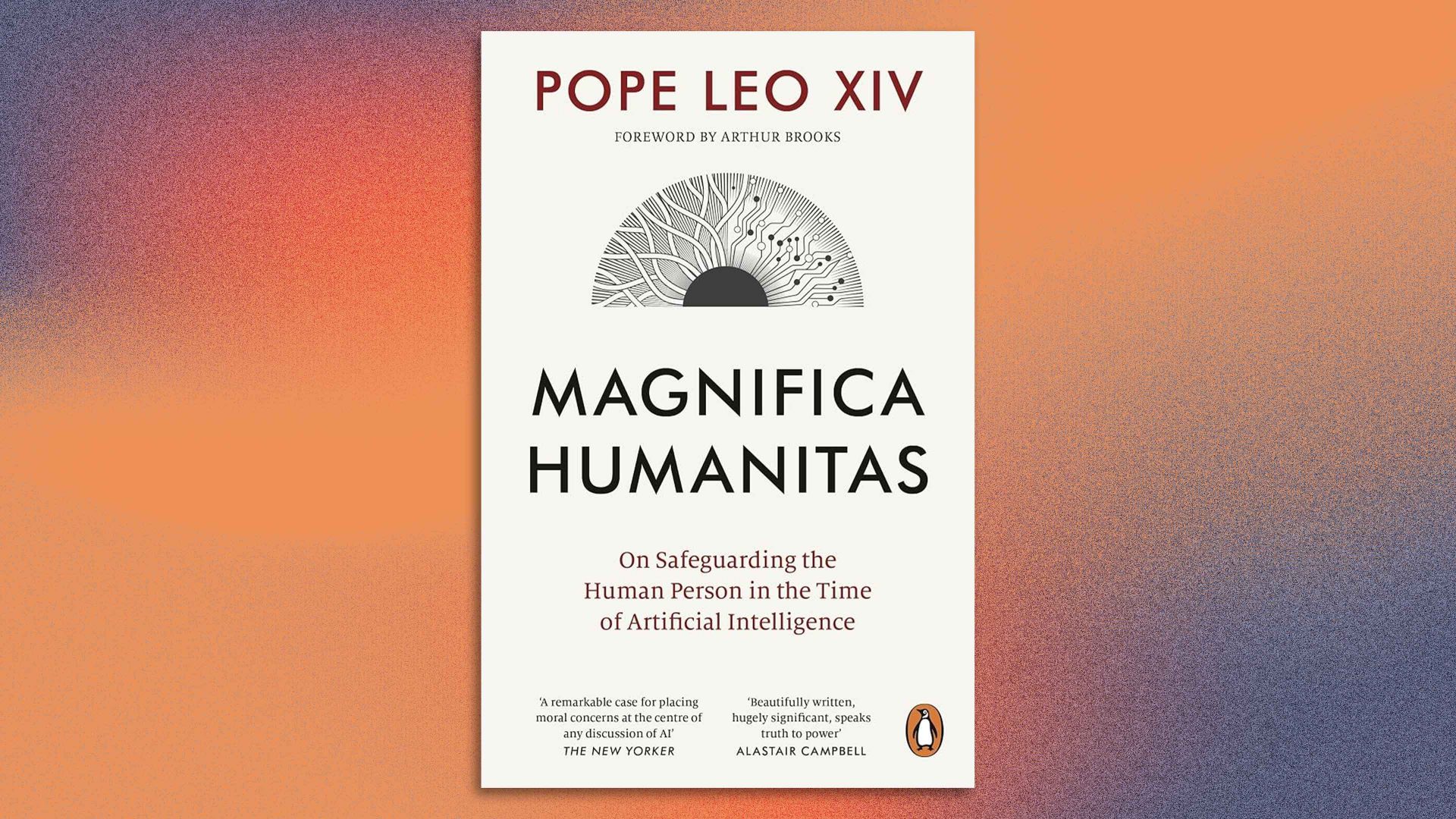
At first, I thought it was a wind-up… an email from Penguin Random House, telling me they were publishing the Pope’s Encyclical on Artificial Intelligence in book form, and “would you mind if we used something you said about it on your podcast on the front cover?”
Would I mind? Do you seriously need to ask me that? I would be delighted. Thrilled. Honoured beyond belief.
And so, up it popped last week, a beautifully designed book cover; at the top, POPE LEO XIV, in large letters, above “foreword by Arthur Brooks” in smaller type, above a splendid semi-circle graphic, AI wiring on one side, human cells on the other; back to large type for the title MAGNIFICA HUMANITAS, then the subtitle, On Safeguarding the Human Person in the Time of Artificial Intelligence, a quote below from the New Yorker magazine, and there, bottom right, tiny type, “Beautifully written, hugely significant, speaks truth to power, ALASTAIR CAMPBELL”. Honoured beyond belief.
I’ve done a few book blurbs in my time, and called in favours from friends and enemies to do blurbs for my books – currently putting the finishing touches to my 22nd – but this one made my little atheist heart soar. Pope Leo, living proof that God is good, whether you believe in Him or you don’t, and that not all Americans are bad, was rapidly emerging as my Person of the Year 2026, even before the book blurb thrill came along.
When the cover was published on social media, believers were even happier. Andrew O’Neill, former headteacher of a Catholic secondary school-turned-adviser to the Department for Education, said he never felt prouder to know me, adding “get it framed immediately!” Our founder and editor-in-chief Matt Kelly – Scouse, Christian name one of the Gospels, surname Kelly, so I am guessing Catholic – messaged me simply to say: “Wow!!!” before adding: “That’s got to be worth some sort of plenary indulgence at the pearly gates.” Fingers crossed, Matt.
Former Archbishop of Canterbury Justin Welby, a good friend who has often told me “you may not do God, but God does you,” adapted the formula to text me: “you may not [yet] do God, but you certainly do the Pope, and he does God.” He added that the Encyclical was “of vast significance and, if compared with Elon Musk’s recent interview in the Economist comes from another, better, more beautiful, joyful and hopeful world.” Indeed.
The blurb honour came despite my having mispronounced Encyclical on the podcast episode in which I first raved about the Pope’s vital 40,000-word contribution to one of the most important debates of our time. Perhaps it is my former triathlon days that made me pronounce the “cyclic” part as though talking about a bicycle… it is in-sick-lick-al, not en-sy-click-al. Lesson learned.
I am sure His Holiness would forgive me for the earlier mistake. He seems a very forgiving type, in addition to being highly intelligent, hugely empathetic, and a real antidote to that other American leader who thinks it is funny to post AI pictures of himself as the Pope. I suspect you know who I mean, but let’s not spoil the piece by naming him.

It is a golden rule of publishing that you don’t plug someone else’s book when your own is out, so, given that my new one will be in the shops not long after the Pope’s, I apologise in advance to Atlantic Books. But having given Magnifica Humanitas the big build-up, I feel I must include a couple of (the many) stellar passages for those yet to have read it.
‘Technology has the power to heal, connect, educate and protect our common home; but it can also divide, exclude and generate new forms of injustice. In the abstract, technology in and of itself is not a solution to humanity’s problems, just as it is not inherently evil. In practice, however, technology is never neutral, because it takes on the characteristics of those who devise, finance, regulate and use it.”
And this: “No computational system, however sophisticated, can create a heart that gives itself, or a conscience that discerns good from evil. Even when machines excel in efficiency, a human face that asks to be gazed upon remains the centre of our history.”
To repeat: “A human face that asks to be gazed upon remains the centre of our history.” Beautiful. Papam amo.
Suggested Reading
My Muskpuppet moment with ruddy idiot Rupert Lowe
It was ex-Australian prime minister Kevin Rudd, a Catholic who became an Anglican, who first alerted me to the significance of the Encyclical, when we were together in Hong Kong. This week, another ex-Australian prime minister, Presbyterian-turned-Catholic Malcolm Turnbull, sent me a fascinating speech he had made covering some of the same themes as the Pope. You can see it on his Substack. I think both the Archbishop and the Pope, whose Encyclical gets several mentions, would be impressed by Turnbull’s scale and interpretation of Biblical references.
Speaking at a 70th anniversary event for Catholic Social Services Australia, he entitled his speech “The Politics of Love,” which in itself is pretty interesting. He spoke also of hate, and no prizes for guessing which country he had in mind here: “When we make the case against those who spread hate it is not enough to say ‘This is unChristian’ or ‘this is wrong,’ we should point out graphically where hatred leads you – to a breakdown of society and to violence of the kind we see in other countries not very different from our own.’”
Then he brings it from the US and closer to home, this time no need to name Pauline Hanson and her One Nation party, for it is clear that is who he means. “There are those who, in the name of national security, speak hatefully about Muslim Australians or immigrants, of people from other cultures, who recklessly and falsely claim multiculturalism has failed and call for a monoculture. This land has never been a monoculture. They are doing as much for national security as the Christian Nationalists are doing for Christianity.”
He quotes a New York pastor he heard preaching earlier this year, Father Dennis Yesalonia. “You may have heard of Christian Nationalism,” he said. “Let me assure you it is not Christian. It is an evil ideology that tries to mislead those who profess their faith in Jesus Christ. We hear that message loudly through our Holy Father. Jesus Christ is not a proponent of war and death. Jesus Christ does not lead us to bigotry and hatred and jingoism. Jesus Christ does not condone bombing or hatred of our brothers and sisters.”
Another reminder there are some good Americans out there, even if we rarely see them speaking on behalf of their current government.
Suggested Reading

The right wing case for climate crisis denial is going up in flames
Finally, let’s stick with Australia and, Catholicism being the dominant theme this week, guilt. “Do you feel no guilt at all,” asks podcast listener Emily Moore, ‘that in the same week you are pontificating as usual about the need to do more to fight climate change, it’s announced that you’re heading off on a speaking tour of Australia?” The honest answer is… “Yes, I do.” I try to practise what I preach, and in most aspects of my consumption, I do pretty well. Long-haul flying, I confess, is not one of them. But I also love Australia, have done since the first time I went there, and though there may come a time when – fair play Zack Polanski – I say I will never use aeroplanes again until genuinely clean, green fuel is available, I cannot as yet envisage the rest of my life unfolding without occasional trips down under. Sorry, Emily. Please forgive me.