Many of the Italian competitors at the 2026 Winter Olympics in northern Italy had German-language surnames – such as Fischnaller, Oberhofer, and Kainzwaldner – rather than the Italian-language surnames of compatriots like Goggia, Brignone and Lollobrigida. This tells us that, like the tennis star Jannik Sinner, they probably come from the South Tyrol (Südtirol in German, and Alto Adige in Italian).
As I have written previously, the South Tyrol was the area taken from Austria and transferred to Italy after the defeat of the Austro-Hungarian Empire in 1918, at the end of the first world war. Even today, however, it remains to a considerable extent culturally Austrian, not least when it comes to winter sports – there is, after all, a lot more ice and snow in South Tyrol than in Naples and Rome. A majority of the inhabitants of the region are still native speakers of Austrian German, and two German-language newspapers are published in the South Tyrol (in Bozen/Bolzano): the liberal Neue Südtiroler Tageszeitung and the conservative Dolomiten.
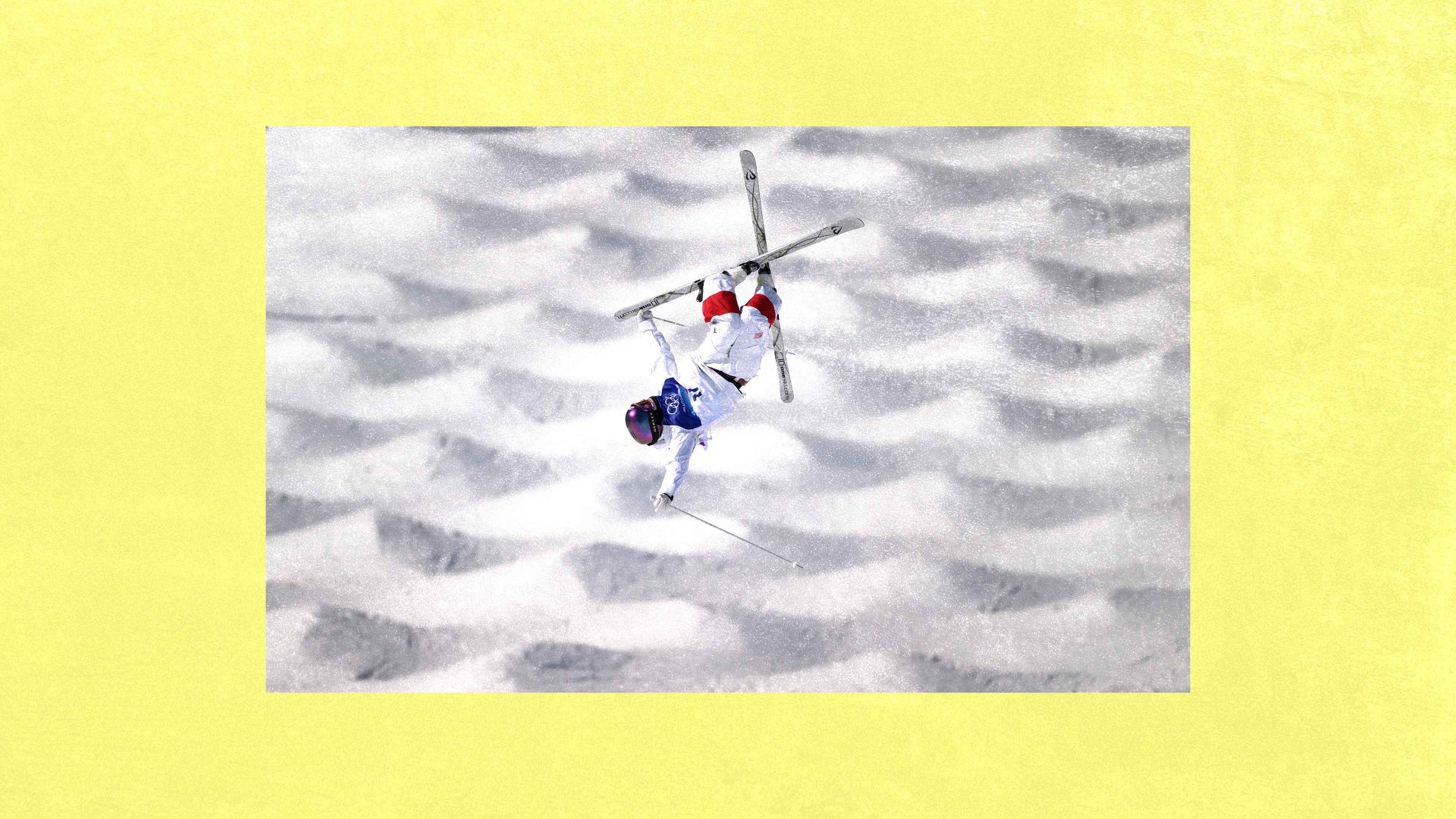
Dialectologists classify the varieties of German that are spoken in Austria as Bavarian dialects. These dialects have contributed to the technical vocabulary of the Winter Olympics, with the name of the relatively new downhill skiing event, first competed for in the 1970s, and mostly now known in English as moguls.
Moguls are a series of bumps on a skiing piste which are formed when skiers push snow into mounds as they perform sharp turns. This tends to happen naturally as skiers use the slope, but moguls can also be constructed artificially.
The term mogul comes from the Bavarian/Austrian German word Mugel, meaning mound or hillock. But as a result of a process of cross-linguistic folk-etymology, the word has come to be reinterpreted in such a way that it has lexically merged in English and other languages with the similar-sounding but completely unrelated word moghul.
Moghul, now more often written “mogul”, comes originally from Mongolian via Farsi (Persian), and is historically related to the word Mongol. This word was originally applied to a series of Muslim rulers who originated in Central Asia and who formed a dynasty which went on to govern the entire South Asian peninsula. In contemporary English, mogul has come to mean an important, influential, or dominant person who is now chiefly (and most often) a male media or other business magnate.
Not everybody in the South Tyrol speaks a German or Italian dialect. Cortina d’Ampezzo, usually known simply as Cortina, one of the main 2026 Olympic Winter Games venues, lies at the heart of an area where the little-known but fascinating language Ladin is spoken. (The name of the language is pronounced with the stress on the last syllable.)
Ladin is a member of the Rhaeto-Romance language family which is rather closely related to the south-western Swiss language Romansch, as well as to the north-eastern Italian language Friulian. (It is not, then, to be confused with the Judeo-Spanish language, Ladino.) Friulian has sometimes been called Eastern Ladin, as it shares the same historical roots as Ladin but, over the centuries, the two have diverged as a result of the influence on Friulian of the surrounding languages, notably German, Italian, Venetian, and Slovenian.
Suggested Reading


Fakelore and the spurious pastime of dwile flonking
Venue
Since the 1850s, the most common usage of the word venue has been in the meaning of “an appointed place for an event”, especially a sporting match or competition. Grammatically, it is the feminine past participle form of the Old French verb venir “to come”, from Latin venire, and is equivalent in English to come as in “he has come”.