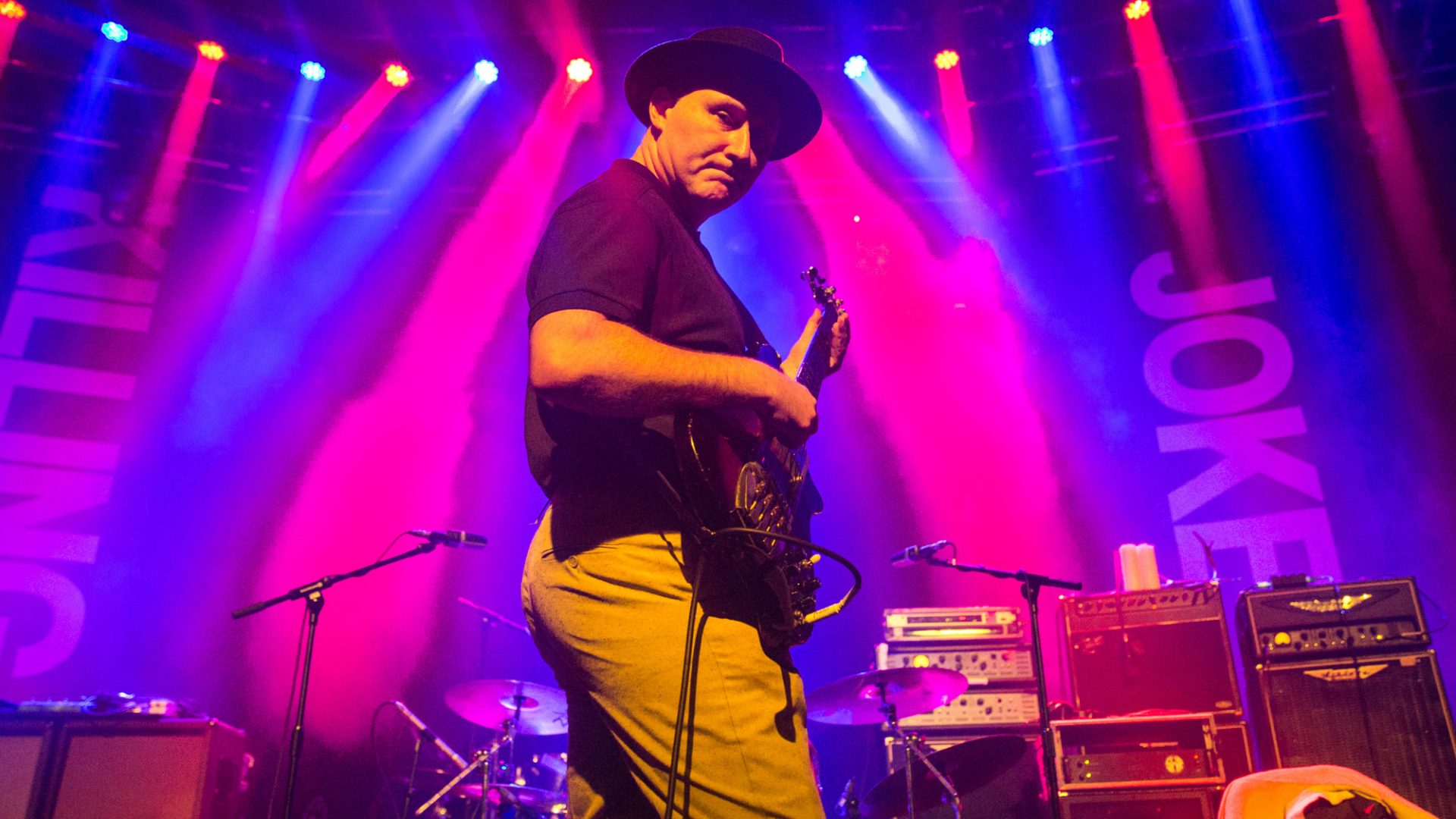
Jah Wobble is as good at anecdotes as he is at playing the bass. And he is one of the great bass players.
You might have heard the one about his rechristening by a drunken Sid Vicious, attempting to pronounce his real name, John Wardle. Or how he learned his instrument after being abandoned in an empty squat by disgruntled flatmates after burning all the furniture for heat.
There is the episode from his spell alongside college friend John Lydon in Public Image Ltd – 18 months he likens to “living inside Withnail & I” – when Fall drummer Karl Burns was briefly welcomed to the fold and spent his spare time glued to the studio’s arcade machine. After strong drugs were ingested, Wobble and guitarist Keith Levene “decided to give him proper real-life Space Invaders, me and Keith doing the sideways movement, getting faster and faster.
“We thought it would give him a buzz, but he thought he was inside the game and he couldn’t get out of it. I suppose the road to hell is paved with good intentions. He was in the wrong place at the wrong time.”
Escaping PiL despite the success of their throbbing, antagonistic masterpiece Metal Box (“the band was quite mad… three people all on different drugs”), Wobble spent a recuperative period working on the London Underground, during which he commandeered the station tannoy at Tower Hill and announced to the waiting passengers on the platform, “I used to be somebody. I repeat, I used to be somebody.” This was nothing, he says, remembering a driver colleague who would stop at Charing Cross and announce “alight here for Rio de Janeiro”.
Today, the man whose collaborators have included fellow mavericks Brian Eno, Sinéad O’Connor, Holger Czukay of Can and the much-missed producer Andrew Weatherall (on Primal Scream’s era-defining Screamadelica), is explaining how Dennis Waterman and George Cole link the punk summer of 1976 to the one of today.
There may not be the post-industrial decay of 50 years ago (“wrecking balls, brick dust in your mouth, everything run down, very rough, very poor”) but in 2026, “everyone’s looking to nick an extra 50 quid for themselves, like Terry and Arthur in Minder”.
Look, he says, at a typical narrative from the show: “Terry gets sent by Arthur to pick up some dodgy wardrobes and there’s a fiver in it for him, but it turns out there’s some stolen files in the wardrobes and Arthur didn’t tell Terry that. So Inspector Chisholm nearly nicks Terry but he gets away with it.
“Then it ends in the pub and Terry thinks he should get a tenner for his trouble and Arthur gives it to him but nicks it back in a different way. We’re back into that now; austere, cheap credit, people looking out for just themselves”.
In the music business – ravaged, he says, by streaming and damaged further by “fucking stupid” Brexit – he sees the after-effects of austerity and the cost of living crisis everywhere.
Leader of the Invaders of the Heart since 1982, he has recently grown used to playing sold-out gigs with only skeleton staff on hand in the venues. “We had a gig in a big city not long ago, I won’t say where, and it was rammed, 600 people. We go on stage, there’s no security, and while we’ve been backstage someone has stolen the keyboard player’s monitor and run off. That sort of thing is just my world, but I’m sure someone who works in a hospital would tell you the same kind of thing.”
In 1976, the effects of this sort of austerity, together with the threat of a rising far right, helped to create the fast-burning punk movement in which Lydon and their fellow college friend Sid Vicious became tabloid bêtes noires. “It opened the doors up,” says Wobble, noting that these are now closing in a changed world where making music is becoming a middle-class pursuit, for “people who can afford to take two or three years out to be in a band that doesn’t work, because they’ll be OK anyway. I haven’t got an axe to grind with them, but as my mate says, ‘they’re slumming it, but any time they can leave the stage’.”
Suggested Reading
Fans 1
Trump 0
That was certainly not the case for Lydon and Wobble, both from immigrant families and with “no bloody career plan” until the former joined the nascent Sex Pistols.
“From 1975 to 81, 82 he was so special,” he says of his former bandmate. “He represented something, he had real charisma.” After the Pistols imploded, “John had the gumption to get his mates in his new band, me and Keith.”
The seismic debut single Public Image appeared in late 1978, with Wobble’s propulsive bass and Levene’s jagged guitar setting the pattern for what lay ahead. By the time of second album Metal Box a year later, PiL were “like an unstable chemical compound, just absolutely fizzing. And the lyrics John wrote at that point were like Samuel Beckett, an amazing existential angst.”
However, Levene was struggling with a heroin addiction (he died in 2022) and Lydon was “not a leader, didn’t have the empathy.” At the point Burns arrived, “They were both arrogant, sneering, not very nice people”.
With a few exceptions like 1986 single Rise (produced by frequent Wobble collaborator Bill Laswell), he does not rate much of Lydon’s subsequent work (“artistically it’s kind of painting by numbers and sometimes he appears a bit of a parody”) or share his recent enthusiasm for Nigel Farage (“just a disruptor”) and Donald Trump.
But he bristles when he appears on podcasts these days and “people start by asking me, literally, ‘what about your fucking mate?’ Well, what about him? He has become a really easy target, and that’s too easy for me. It’s sanctimonious.”
The bassist is a strong believer in nationalisation, union membership and immigration, but loathes middle-class leftists who sneer at Leave voters. “I was gutted with Brexit and in despair at some of the people that I know who voted for it, because it was obviously an act of crass self-harm. But I hate the attitude of ‘Oh, they’re so stupid. Oh, they fell for Nigel’. That blue-collar disaffection is real and it’s been going on for years.
“A lot of my extended family voted for Brexit, and when we go to their parties, they’re playing ska and their black and Asian friends are there. These are smashing people. Then I’ve met middle-class Remainers who look at you like you work for them, supercilious and arrogant.”
On August 11, Wobble will be 68. It marks the start of a period of intense activity – a new single, an album of reimagined psychedelic-era Beatles covers made with his sons (his postman dad approved of the Fab Four but thought the Rolling Stones only fit for “mine clearance”) and a family gig at the Suffield Arms Fiesta, held in the extraordinary Norfolk pub owned by art dealer Ivor Braka and decorated with works from his gloriously eccentric collection.
The bassist is planning what sounds like a suitably eclectic set to “get everybody tranced out”, including back catalogue work and Chinese music made in collaboration with his wife, harpist Zilan Liao.
The main thing is to keep going. “Impermanence is everywhere,” Wobble says. “Seven years ago, I was talking to Andrew Weatherall about making a new double album together, and then he fucking died. The big thing is not to panic but to show some urgency in life, get things done and not make the mistake of thinking you’ve got for ever. You’ve got meaningful things you need to do, so get on with doing them.”
Jah Wobble & Family play the Suffield Arms Summer Fiesta in Norfolk on Friday, August 14, the same day his Mystic Liverpool: The Beatles’ Psychedelic Psongbook is released on Cherry Red