
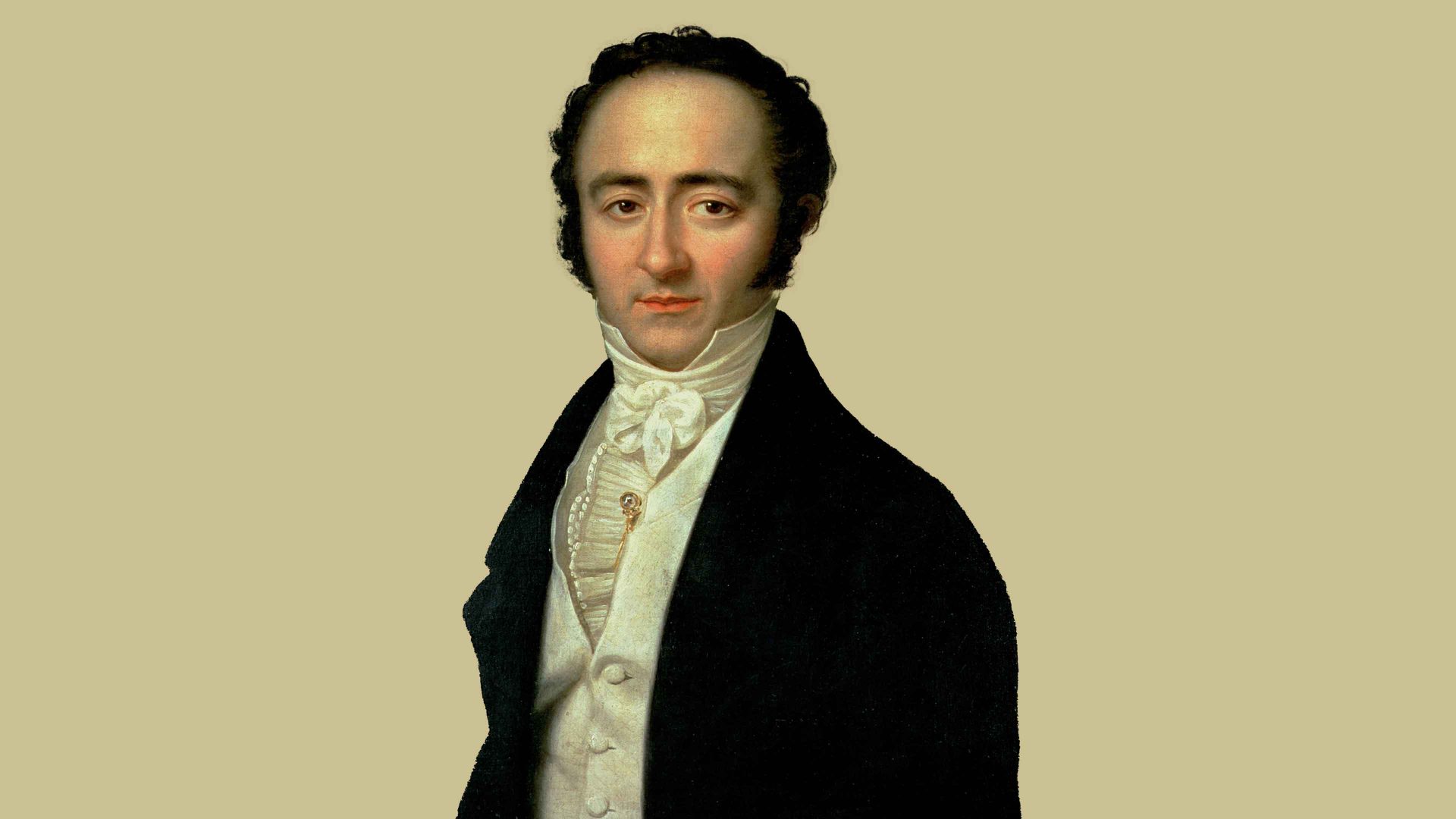
A recent Composer of the Week programme on BBC Radio 3 featured Franz Xaver Wolfgang Mozart. He was the son of that supreme musical genius, Wolfgang Amadeus Mozart, and was a first-class musician and composer in his own right. He published rather few compositions in his lifetime – no more than about 30, compared to over 600 by his father – but his works, though much appreciated by their fans, are not particularly well known.
English-speaking musicologists sometimes refer to Franz Xaver as FX, perhaps because few people in the anglophone world are entirely sure about how to pronounce Xaver. (Austrians normally say “Ksahfer”.)
The male given names of several members of the Mozart family are of linguistic interest. Wolfgang is an ancient (8th century) Germanic name which is usually translated into English as something like “way of the wolf” or “wolf-gait”; it was associated with the much venerated Bishop Wolfgang of Regensburg (934-994).
The Latin name-form Amadeus means “beloved of God” or “lover of God”; it corresponds to French Amédée, Spanish Amadeo, German Gottlieb, Greek Theophilos, Polish Bogumił, and Lithuanian Bogumilas.
Xaver is a Bavarian, Austrian and Swiss variant of Xavier. Rather extraordinarily, this name comes not from Latin, French or German but from Basque, a language whose homeland is 1,600km from Franz Xaver’s birthplace in Vienna. It originated in the place-name Etxeberria, a town in the Basque Country of Spain whose name means “the new house” or “new home”. Basque Etxeberria became Xabier and then Xavier in Old Spanish, and was ultimately borrowed into German as Xaver.
Suggested Reading
The beautiful linguistic chaos of modern Iran
The name Xavier and its variants became very popular in different parts of the Catholic world because of its association with the 16th-century Spanish Catholic saint, Francis Xavier, one of the founders of the Jesuit Order. Francis was given that name because he was born in Etxeberria; the town’s name is normally written as Javier in contemporary Spanish.
Franz Xaver Mozart, like his father (who died when Franz was an infant), was a native speaker of Austrian German. The many Austrian dialects of the language are classified by philologists as falling into the Bavarian sub-family of Upper German varieties spoken in the south-east of the German language area, including in the German state of Bayern (Bavaria), most of Austria, and South Tyrol in Italy (see my earlier column on the German-speaking Italian tennis player Jannik Sinner).
Neither Franz Xaver Mozart nor his younger brother, Karl Thomas, had any children. Franz Xaver is buried in Karlovy Vary (German Karlsbad, now in Czechia), which is where he died in 1844. Carved on his tombstone in German is the epitaph: “May the name of his father be his epitaph, as his veneration for him was the essence of his life.”
There is also a sculpture dedicated to Franz Xaver in Lviv, Ukraine (German Lemberg; Polish Lwów), where he lived and taught for 25 years from 1813. At that time Lemberg and Karlsbad were both situated within the boundaries of the dual monarchy of the Habsburg Austro-Hungarian empire, which was governed from Vienna and Budapest.
The Austro-Hungarian empire was very much a multilingual state, with 13 official languages: Croatian, Czech, German, Hungarian, Italian, Lithuanian, Polish, Romanian, Serbian, Slovak, Slovenian, Ukrainian and Turkish. German, however, was in practice its major lingua franca.
Etxeberria
Joseba Etxeberria is a former professional footballer who played 53 times as a winger for the Spanish national team, including in the 1998 World Cup; he was most recently manager of Real Murcia. His surname, like the names of many well-known British sports people such as Beckham, Hamilton and Sutton, was originally a place-name.