
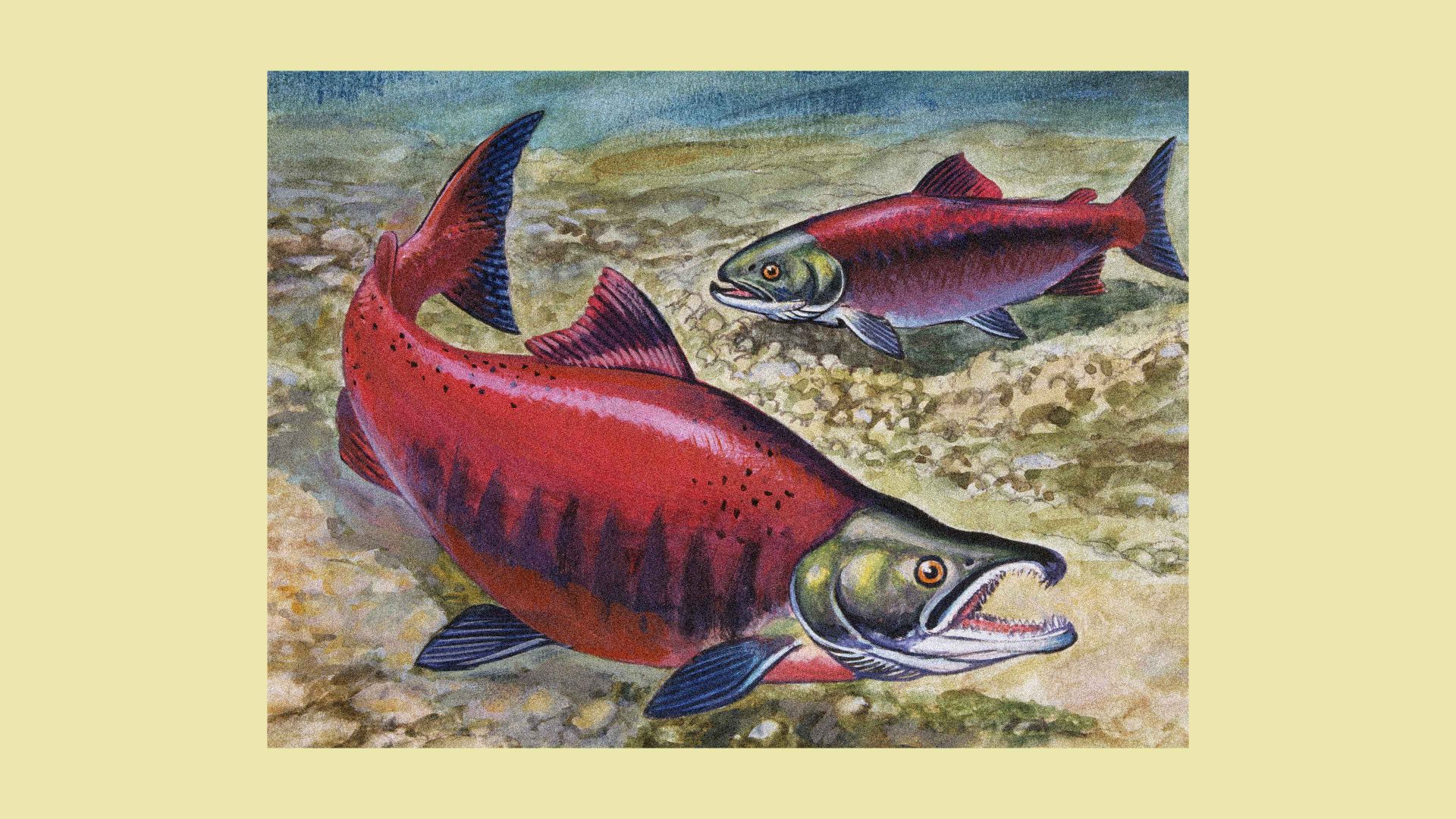
In many British supermarkets these days, you can buy fresh sockeye salmon fillets. Publicity materials associated with sockeye salmon (oncorhynchus nerka) argue that this fish is more attractive, tasty and succulent than other varieties of salmon.
It is a Pacific Ocean fish which is mostly caught wild off the Pacific Northwest coast of the United States and Canada, as opposed to the Atlantic Ocean salmon which usually comes to us from fish farms in Norway, the Faroe Islands and Scotland.
Obviously, the word sockeye is not English in origin – and it has nothing to do with the fish’s eyes either! This word is the result of a folk etymological process whereby speakers try to make sense of alien words by adapting them to more familiar local forms, such as when the word asparagus (from Ancient Greek via Latin) was reinterpreted by some English speakers as “sparrow grass”, or when French écrevisse was borrowed into English as “crayfish” (see also TNW #397).
The term sockeye was borrowed from one of the indigenous languages of the Pacific Northwest – Halkomelem (Halq’eméylem), a member of the Salishan family of languages. Specifically, it belongs to a group of languages called Coast Salish, spoken by indigenous North American people in British Columbia. The language has three major dialects: Downriver, Island, and Upriver, referring to the Fraser River, which is about 850 miles long.
In the Halkomelem language, the actual word in question is sθə́qəy̓, meaning “red fish”. The phonology – the sound system – of Halkomelem is extraordinarily complex. To get as close as possible to the indigenous pronunciation of this word, we need to look at the vowel and consonant sounds of their word for this fish one by one. sθə́qəy̓ starts with the consonant S, followed – as it would never be in English – by the same TH sound as we have in this (and not as in thistle).
Next is the vowel ə (shwa), the same sound which we have in English at the beginning of words such as about and ago. Following that is a consonant sound which does not occur in English, represented here by the letter Q – it resembles our K sound but is pronounced further back in the mouth (or vocal tract, as linguistic scientists like to call it).
The articulation of this sound involves making contact between the back of the tongue and the uvula, which is that small fleshy appendage which can be seen dangling down at the back of the soft palate. This sound occurs in many languages, including some varieties of Arabic, as well as in Inuit languages. The word ends with an ee-like sound followed by a glottal stop.
It is easy, then, to comprehend why the linguistically less gifted of those English speakers who first came across the word sθə́qəy̓ preferred to go with the much easier – to them – form “sockeye”, which consists of a combination, albeit a meaningless one, of two already known English words, sock and eye.
You can also sometimes buy fresh Keta or Chum salmon. This species is native to the northern, Arctic areas of the Pacific. The English-language name “chum “ comes from a native American term meaning “spotted” or “marked”; while keta comes via Russian from the Evenki language of Eastern Siberia.
Suggested Reading


When the Guardian was offended by television
Salmon
The word salmon first appeared in English in 1387 with reference to “a large fish belonging to the genus Salmo, family Salmonidæ”. It was borrowed into English from Anglo-Norman samoun, from Latin salon-em. This Latin word was probably a derivative of the verb salire “to leap” – salmon are known for their ability, when swimming upstream, to leap up waterfalls.