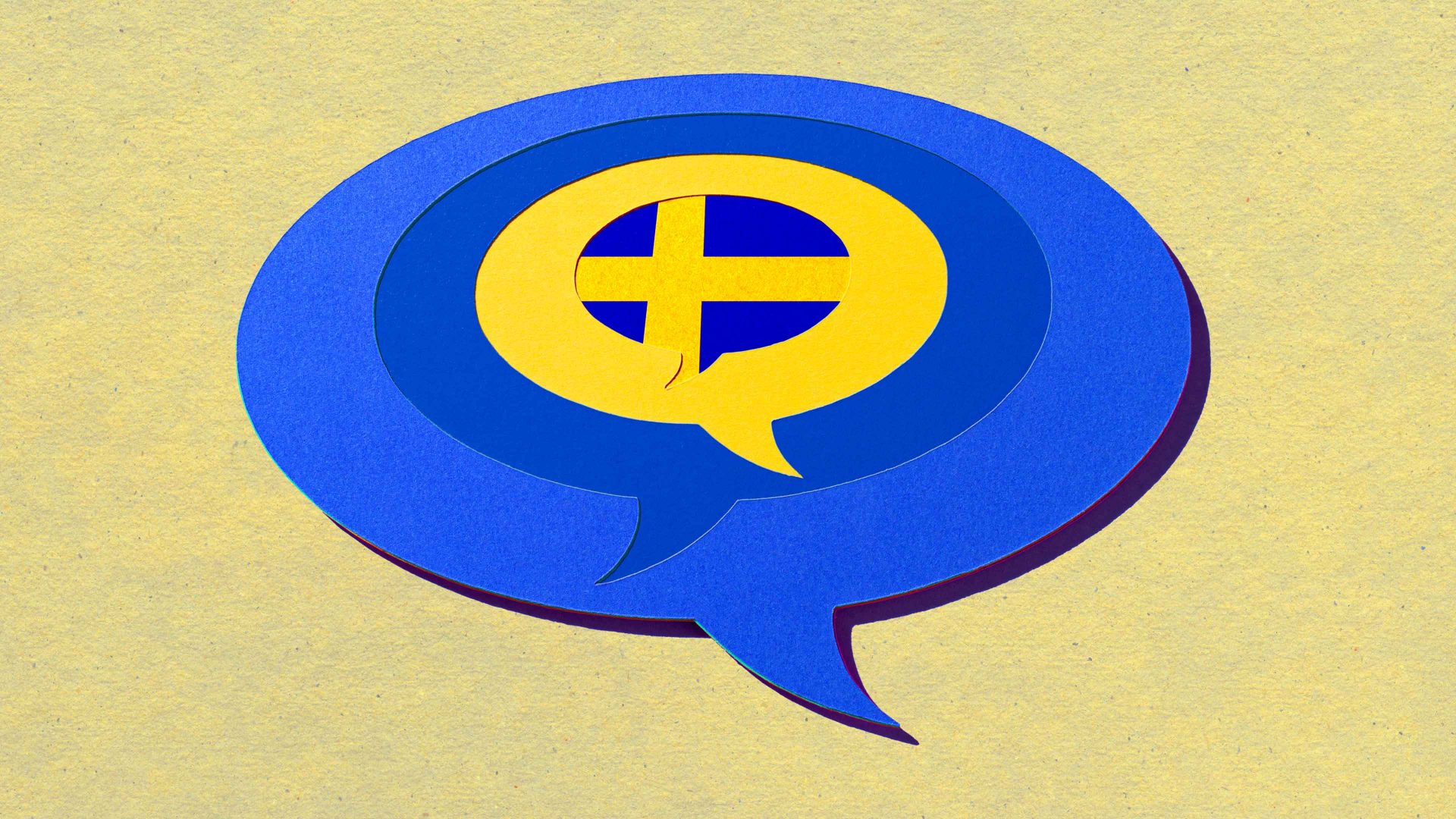
Philologists have traditionally divided the Scandinavian languages into two major groups – Eastern (Danish and Swedish) and Western (Icelandic, Norwegian and Faroese) – but in the contemporary context it makes more sense to distinguish between Insular Scandinavian (Icelandic and Faroese) and the Continental languages Norwegian, Danish and Swedish, with the last three all being mutually intelligible to a degree.
Orkney and Shetland Norn were two other closely related Scandinavian languages; sadly, they are now extinct, having died out in the 1700s.
Swedish is the Scandinavian language with the largest number of mother-tongue speakers, about 11 million. It is no surprise that a majority of Swedish speakers today are found in Sweden. But in neighbouring Finland, where Swedish is an official language, there is also a sizeable population of Swedish speakers – about 5% of the national population – and several areas of the country have Swedish-speaking majorities which have been in residence in what is now Finland since at least the 12th century.
A major national newspaper in Finland, Hufvudstadsbladet (with a daily circulation of around 30,000), is published in Swedish in Helsinki (Helsingfors in Swedish; Hufvudstad is an archaic spelling of the Swedish word for ‘capital city’). The country also has several regional Swedish-language papers. Vasabladet, which has a circulation of around 20,000, is published in the town of Vaasa on Finland’s west coast, where about a quarter of the population are Swedish speaking, and where many surrounding districts have Swedish-speaking majorities. The older Swedish language name of Vasa was Nikolaistad.
The Åland archipelago, an autonomous region of Finland which lies about 15 miles east of the Swedish mainland (about two hours away by car ferry), is a very special case in several respects. The archipelago is officially monolingual in Swedish; and according to the 1921 agreement established under the auspices of The League of Nations, it is an officially demilitarised zone whose inhabitants cannot be required to do military service.
Suggested Reading

My relationship to my flesh and blood
It is much less widely known that for centuries there was a sizeable Swedish-speaking minority in Estonia. This country, which over the centuries had been controlled at various times by Danes, Germans, Swedes, Lithuanians, Russians and Poles, was an independent nation from 1918 until 1945, during which time there was a community of about 7,000 Swedish speakers in the coastal areas and islands of what is now western and northern Estonia. When the country was invaded and taken over by the Soviet Union in the aftermath of the second world war, almost all of the Swedish-speaking minority fled to Sweden; by 1945, there were more than 20,000 refugees from Estonia in Sweden.
Estonia became fully independent again in 1991, but the descendants of the handful of Swedish speakers who chose to stay behind in what became part of the Soviet Union in 1944 are the only permanent Swedish-speaking residents in Estonia today. It is thought that they number no more than about 300 people.
There is also a small Swedish-heritage community in Ukraine, in Gammalsvenskby “Old Swedish Town”, whose inhabitants descend from Swedish speakers who left the Estonian island of Dagö in 1721 after the Russian Empire seized it. Today, it forms a neighbourhood of the village of Zmiivka (Kherson Oblast), which has been much fought over during the current Russia-Ukraine conflict, but is currently under Ukrainian control.
Aftermath
Aftermath was originally an agricultural term equivalent to “aftermowth”, referring to a second crop or new growth of grass after the first crop has been mown. Today it is most often used figuratively with reference to a state of affairs following some significant event, as in “the aftermath of the second world war”.