
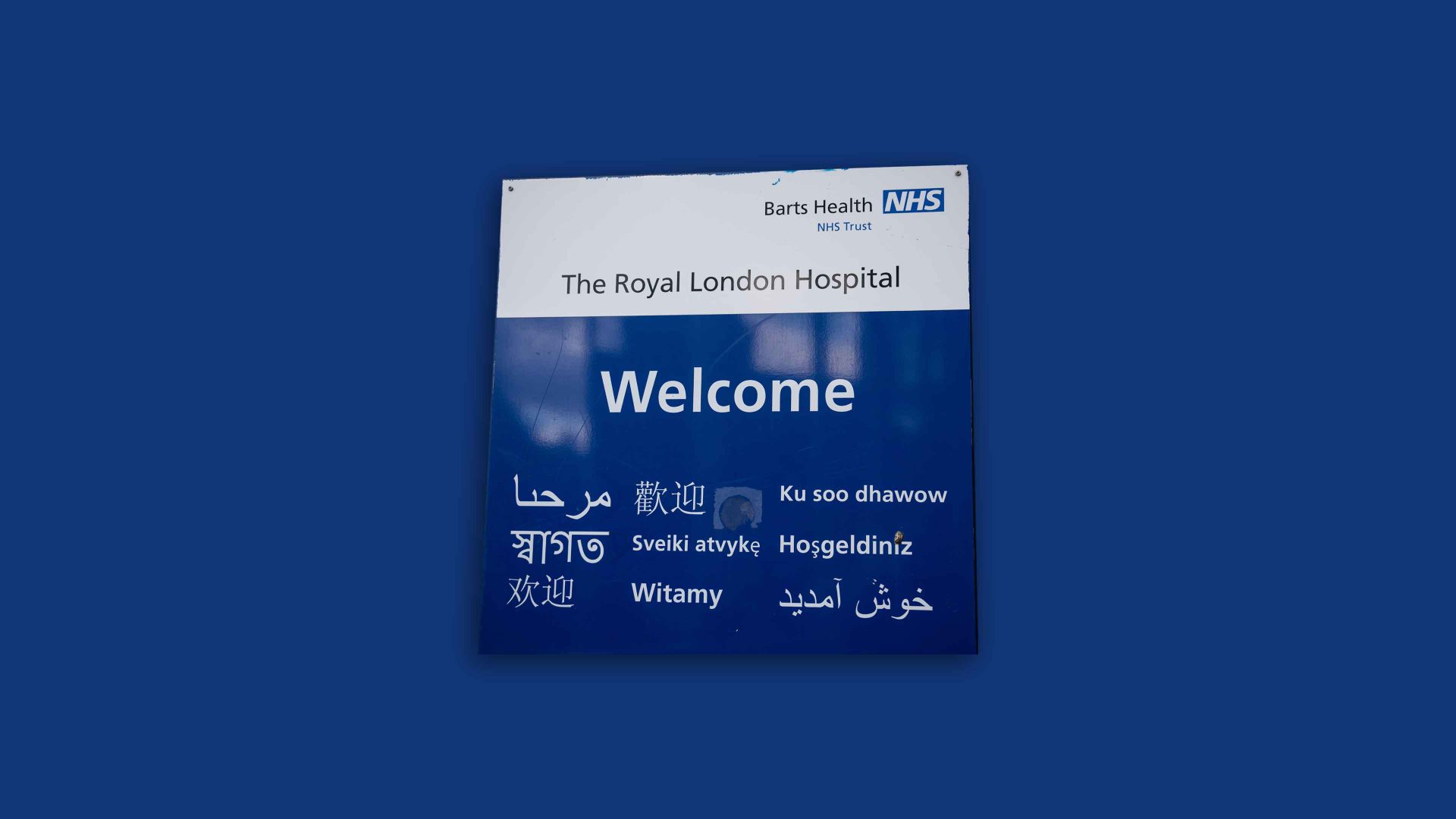
I have recently been in hospital for a week (and, thank you for asking, I’m fine now). It was an unwelcome experience, but one which was linguistically very interesting.
Although the hospital is located in a non-metropolitan, mainly rural catchment area, over 60 different languages are spoken among the staff there. These include South Indian languages such as Malayalam (from Kerala); Burmese and Nepalese; central European languages like Czech, Polish and Hungarian, as well as German; and languages from Eastern Europe including Greek, Ukrainian and Romanian.
There were doctors and nurses who spoke sub-Saharan African languages such as Shona and Yoruba; North African languages including Berber varieties, and various Arabic dialects. I also heard varieties of Chinese; Malay or perhaps Indonesian – they are very similar; and Tagalog from the Philippines.
I was instructed on how to say “thank you” in Malayalam (this language name is pronounced with the stress on the third syllable). And I was reminded when trying to say “thank you” to the female Portuguese nurses that while they said obriga to me, I needed to say obrigado to them because, in Portuguese, adjectives such as “obliged” agree in gender with the nouns which they modify, in my case “male person”.
I also learnt a number of new medical terms, mostly of Latin and Ancient Greek origin.
Suggested Reading


The lost voices of 15th-century Norfolk speak again
Of course I also heard the more familiar East Anglian accents and dialects spoken by the tea ladies, porters and cleaners, but also some strong non-British native English accents.
Everybody working in the NHS is required to demonstrate competence in English, and the linguistic abilities of most of the wonderful staff I encountered in the hospital were impressive. But one can’t help wondering how perfect crucial communications can be within any hospital where a similar plethora of languages, dialects and communicative styles is encountered on the wards, in the corridors, and in operating theatres.
The range of varieties of English which are spoken by people who have grown up and learnt their English outside the British Isles can be a problem for stay-at-home, elderly or hard-of-hearing Brits. It is worth remembering that when cinema films with soundtracks (“the talkies”) first arrived in Britain in the 1920s, people in this country complained they could not understand what the American actors were saying – this was for the good reason that they had never heard American accents before.
Many of my hospital staff were speakers of English as a Foreign Language (EFL), having learned it in school in their home country. They can be distinguished from speakers of English as a Second Language (ESL) who come from countries where English is in official use for very many or even most purposes; these tend to have a totally admirable mastery of English to the extent that we would say it is their primary language, even if it is not their first language. But they can be some of the most difficult non-native English speakers to understand because they are fluent and rapid speakers of institutionalised forms of ESL, with distinct accents and some different vocabularies.
Any comprehension difficulties are compounded when masks are being worn, because listeners are not able to read the speaker’s lips for clues.
And for all the non-British or non-local staff, patients with strong East Anglian accents and dialects are no doubt tricky to understand for the uninitiated.
Obliged
The word obliged comes originally from the Classical Latin prefix ob- “against, in front of, towards” – as also found in obstacle, object, obstruct – plus the verb ligare “to tie or bind”. It used to mean “to constrain, force”. Until the 1800s the word was pronounced “obleeged”.