
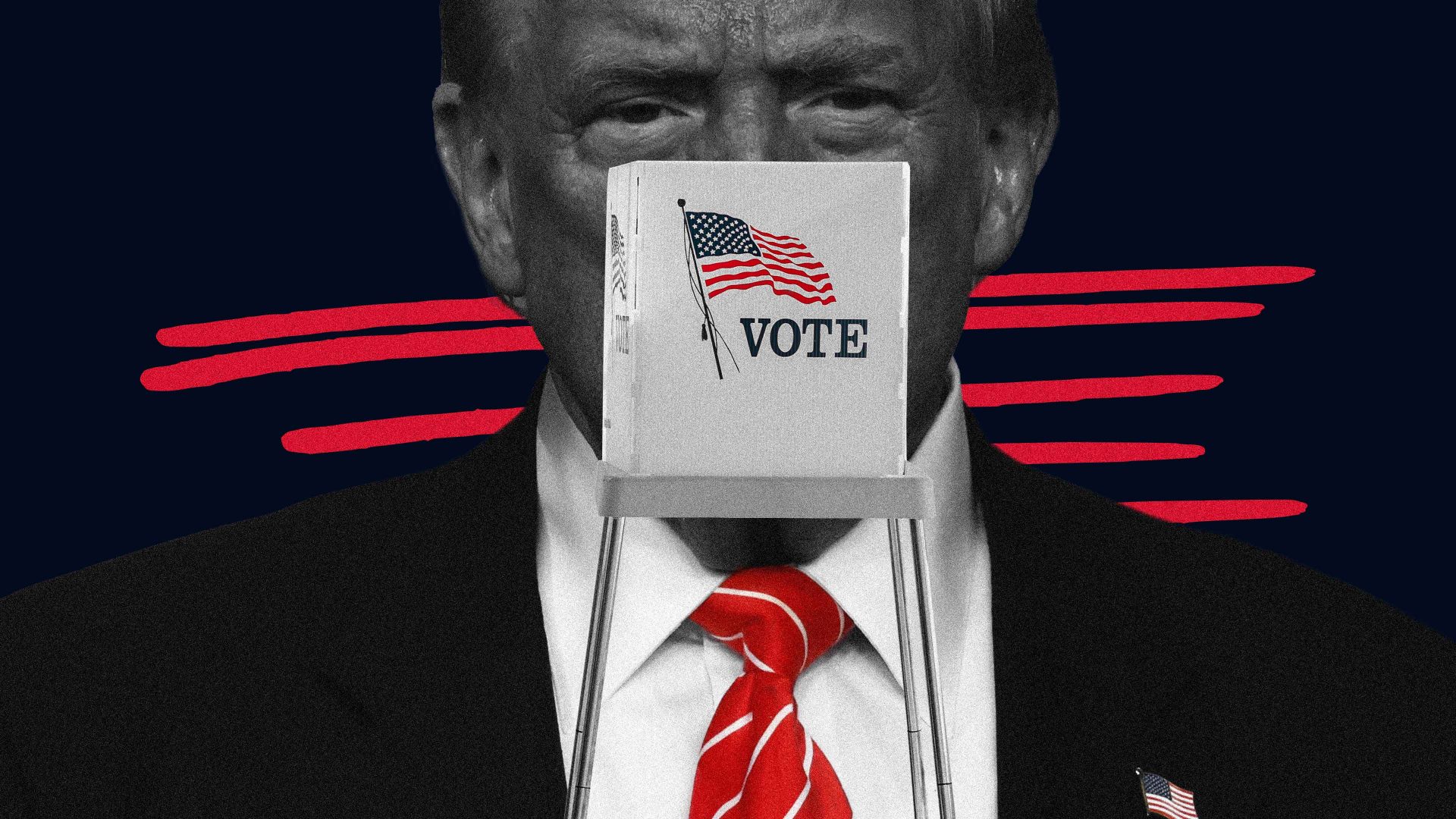
This could be the year when Donald Trump is stopped, or at least slowed, in his tracks. November’s mid-term elections will decide whether his powers are curtailed a lot, a little or not at all.
Normally, in the run-up to any election, one question dominates all others: who will win? This time, a second question must be added: will voters actually get who they want – or will Trump thwart their wishes? Let us consider these two questions in turn.
First, let us assume that the elections are conducted normally, and that all the votes are properly counted.
Republicans currently have small majorities in both the Senate and the House of Representatives. In 2024 the Senate ended up with 53 Republicans and 47 Democrats (including two senators who caucus with the Democrats); in the House, Republicans won 220 seats and the Democrats won 215.
The national polls look bad for Trump; so do the results of recent “special” elections (by-elections, American style). Every recent contest has seen a swing to the Democrats. In November they gained the governorship of Virginia on an 8% swing (using the British definition of “swing”). Last month they gained a traditionally safe seat in Texas’s senate on an 11% swing.
All 435 House districts are up for election. Converting national vote shares into seats is tricky. Local and regional factors can swamp national trends, and popular incumbents often avoid the calumny directed at their party.
The Cook Report, a respected source of analysis on election prospects, currently says the Democrats are ahead in 211 and the Republicans in 206. The other 18 are toss-ups – 14 being defended by the Republicans, four by the Democrats. Another website, Race to the White House, gives the Democrats a 69% chance of winning a majority.
Much could still happen between now and November. It makes sense to be cautious. However, if we ask what would happen if the mid-terms were this week, not in more than seven months’ time, the Democrats would have an excellent chance of victory.
YouGov asks a congressional voting intention question every week in its polls for the Economist. Sampling fluctuations mean they oscillate a little, but averaging their figures for the past four weeks – a total sample of almost 7,000 – the Democrats are eight points ahead, by 53-45. They don’t need to gain more support (though that would be nice). They just need to hold on to what they have and ensure their supporters turn out.
The Senate is different. Thirty-five states have elections this year. The Republicans are defending 22 and the Democrats 13 (31 Republican seats and 34 Democrat seats are not up for election this time.) The Cook Report reckons four are too close to call. If the Democrats hold the two they are defending (Georgia and Michigan) and gain Maine and North Carolina from the Republicans, they will still be outvoted in the new Senate by 51-49. To gain control they need to gain the two states that Cook says “lean Republican” – Alaska and Ohio.
Just now, the likeliest outcome is a Democrat House and a Republican Senate. The Democrats would be able to block new laws and Trump’s plans for the federal budget. They would also be able to hold inquiries and summon witnesses. This would give them a platform for exposing the failings and misdemeanours (insert “alleged” if you wish) of the Trump administration.
What the Democrats would NOT be able to do is block new Trump appointments to the Supreme Court or executive. And law-making will be a tricky business, requiring a Democrat House and Republican Senate to agree with each other, and with Trump, to pass new laws. The Democrats will have to be content with the power to hold up bills they don’t like, rather than insist on bills they want to enact.
All that assumes that the mid-terms are held, and the votes counted, as normal. Which takes us to the second big question. Will they?
Mark Bergman, an American lawyer, is keeping an exhaustive compendium of Trump’s current and potential breaches of the constitution and of the norms of decency. He has identified a number of ways in which Trump might try to thwart the wishes of the electorate. Bergman’s “threat landscape” includes:
- Trying to eliminate postal voting
- Insisting on tougher ID rules at polling stations “whether approved by Congress or not”
- Sending ICE immigration agents, national guardsmen and even the army to pro-Democrat areas to depress canvassing and voter-registration efforts, and deterring voters on the day
- Instructing federal agents to seize voting machines in battleground states and districts
Could any of these things really happen? A lengthy analysis in The Atlantic cites a federal law that specifically bans the presence of “any troops or armed men at any place where a general election is held”. That seems clear enough. However, I cut off that quote before the end of the sentence. As The Atlantic tells us, it concludes: “…unless such force be necessary to repel armed enemies of the United States.”
Can we be sure that Trump won’t twist the term “armed enemies” to get his way?
If, despite all that, the votes show the Democrats gaining the House, Trump could allege widespread fraud and try to persuade Mike Johnson, currently the Republican speaker of the House, not to seat any Democrat who gains a seat. Such decisions would be made by the existing House with its narrow Republican majority.
Might the Supreme Court overrule such a blatant attempt to reject the people’s verdict? Probably not. In 1972 it ruled that such an issue is “a non-justiciable political question,” and that each House of Congress has the constitutional right to rule on the elections of its own members and make “an unconditional and final judgment”.
In the end, a series of defences may be needed to stop Trump stealing the mid-term elections – not just legal, but political and social: the responses of judges but also politicians on both sides of the aisle, the media, civil society and, if necessary, the leadership of the military. Their task will be to tell the truth, defend citizens’ rights and uphold the constitution.
It is a measure of Trump’s behaviour, his choices for the Supreme Court, and his hold over so much of the Republican party that these things should even be in doubt.