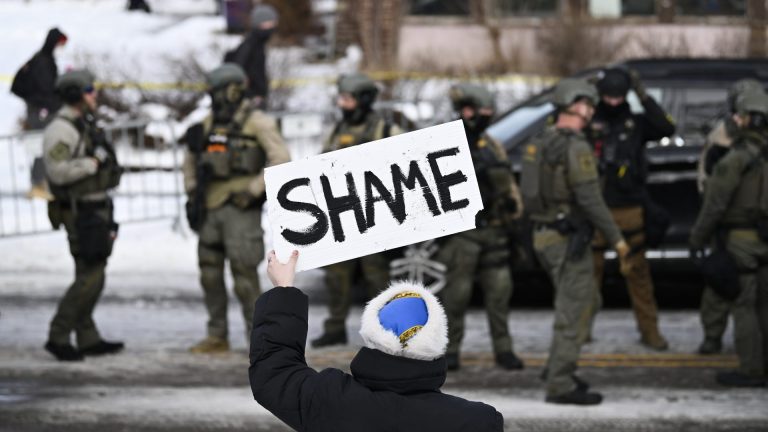
Within the past week, Donald Trump has twice bumped up against the hostility of American voters. The first prompted him to abandon his threat to invade Greenland. The second could force him to curb the actions of federal agents, who have now outraged many Americans in the way they killed two citizens in Minneapolis.
As public opinion has started to play a significant role in how Trump behaves, it’s worth looking closely at what is going on.
The Greenland episode is the more clearcut. A clue to the reason for Trump’s U-turn can be found in table 45 of a YouGov/Economist poll, published the day before he arrived in Davos. American voters were asked: “Do you support or oppose the US using military force to take control of Greenland?” By 72%-9%, Americans oppose the idea. Even Republicans reject it, by 52%-22%.
I’m not suggesting that this single poll stopped Trump’s plans. He may already have been looking for an off-ramp even as he dialled up his bluster, for his private polls will undoubtedly have given him the same message. Few of his own supporters wanted to attack a Nato ally. He might have been happy to offend the Danes, the Brits and the French. But taking on his MAGA base in a matter of war and peace was a fight too far. Chalk that up as another example of the TACO rule – Trump Always Chickens Out.
As for the actions of ICE (Immigration & Customs Enforcement), the polling evidence predates the second killing, of Alec Pretti, at the weekend. Last Thursday, the New York Times reported a new poll it had commissioned from the Siena Research Institute. It found that by 55%-36% Americans disapprove of the way ICE is doing its job. On this, most Republicans back ICE, but the 20% of Republicans that disapprove suggests that his base may be beginning to fray at the edges.
No wonder Trump is considering another U-turn. In an interview with the Wall Street Journal, he says he is “reviewing everything” about the Minneapolis shooting – a far cry from his normal habit of backing everything ICE does, however rough.
Do these two episodes reveal just a short-term tiff with the electorate, or signs of a deeper disenchantment?
The rejection of his threat to invade Greenland was certainly exceptional. But the poll figures on ICE are not. In fact, there is a remarkable consistency about the state of American opinion just now. Recent polls find that, time and again, they dislike almost everything he does by three-to-two. They disapprove of his overall performance, think America is heading “off on the wrong track”, say he’s failing on inflation, reject his stance on tariffs, oppose his policies on immigration, condemn his actions against Venezuela, and don’t want the US to bomb Iran or buy (let alone invade) Greenland. In each case, the numbers are similar.
This applies even to the recent controversies over ICE’s actions in Minneapolis. Two weeks ago, YouGov found that, also by three-to-two, Americans reject Trump’s view that the ICE agents were acting in self-defence when they killed Renee Good while she was driving her car.
Suggested Reading

ICE are now murdering people in the street
Having followed British public opinion for more than half a century, I have never seen such consistency in our domestic politics. However popular or unpopular our governments have been, verdicts on the way they have handled different issues have varied widely. Poll figures on, say, defence tend to be very different from those on the NHS.
Why, then, does today’s America stand out, with similar numbers of voters liking and hating pretty well everything Trump does? At election time, some US states allow straight-ticket voting, which enables voters to tick a box or pull a lever to back the Democrats or Republicans down the line, without having to vote separately for each race. Under Trump, many Americans have a straight-ticket mentality when answering polls. This makes their attitude to invading Greenland so remarkable. What is going on?
It’s a truism that America is as polarised as ever. Most Republicans and almost all Democrats retain their tribal passions for and against Trump. We see this division on our televisions whenever camera crews tour main street looking for voters to interview.
That, though, is only part of the story. Our television screens tend not to show voters with the looser allegiances of middle America. In this case, “middle” refers to politics rather than income or social class. Here, not in the polarised tribes, is where we find the voters who tend to decide who runs America and determine the majority on different controversies between elections.
The figures vary from time to time and from pollster to pollster. But, broadly speaking, around one third of voters regard themselves as Republicans and passionately pro-Trump; one third are Democrats and hate him. The final third – politically, middle America – say they are “independents”. They are less polarised in their views, and less interesting to reporters; but they matter far more at elections.
In 2020, the preferences of Democrats (95% Joe Biden, 4% Trump) mirrored those of Republicans (94% Trump, 6% Biden). Compared with our often footloose Labour and Conservative voters, tribal solidarity in recent American elections is off the scale. The numbers on each side broadly cancel each other out. Biden won because middle America’s independents backed him by 54%-41%.
In 2024, the Democrat and Republican tribes divided by virtually the same emphatic margins as in 2020. Members of both tribes were immune to anything the candidates said or did. The difference was that Trump closed the gap among independents sufficiently to win the presidency. He was still behind, by 49%-46%, but by reducing his deficit from 13 to three points, he regained the White House.
All of which shows that there have never been enough Maga voters to make Trump president. (The same is true of liberals on the other side.) He needed to attract enough of middle America in order to win. He failed in 2020 but succeeded in 2016 and 2024.
What has happened is that middle America has now turned against Trump. Just now, he lacks public support for any three of his latest international whims: invading Venezuela, bombing Iran and buying Greenland. The figures are similar for all three issues: overwhelming opposition from Democrats, majority support from Republicans, and, decisively, majority opposition from independents.
The picture is much the same for domestic issues such as inflation and immigration. The main difference is that fewer voters say “don’t know”. It seems that most people who take sides give either pro-Trump or anti-Trump answers whatever question they are asked.
This holds an important lesson for understanding American opinion, because it is not plausible that the similar three-to-two verdicts across the political battlefield are a matter of chance. They are similar for a reason. If voters considered each issue independently and on its specific merits, the range of polling numbers would be far greater.
Suggested Reading


Pedro Sánchez is outclassing Trump with the president’s own tactics
The obvious conclusion, which happily sits with both common sense and the nature of political debate these days, is that increasing numbers of voters are offended by Trump’s character and, as a result, condemn everything he does. This is true even of his much-vaunted policies to tackle immigration. His figures on this are not quite as bad as on everything else, but still poor. Most Americans now regard their president as a reverse Midas, who turns all he touches into dross.
One year into his second term he has upset two groups that are vital to his hopes of retaining a Republican majority in Congress in the mid-term elections. Independents have turned against him in a big way. They provided the foundations for Trump’s unpopularity today.
Moreover, he has also alienated a modest but far from trivial minority of Republicans. Opposition to invading Greenland has come at a time when there were already signs of unease within part of the Republican tribe. It may be starting to fracture. Trump is wise not to alienate his base further. In contrast, Democrat voters are far more unified… for now.
One final point. The similarities of the poll numbers across so many issues make it impossible to pick out a single issue as the key to Trump’s unpopularity. But if there is one that leads a tight pack, it is inflation. Fully 64% of independents disapprove of his record. So do as many as 24% of Republicans: another sign of twitchiness within his base.
In Davos, Trump claimed to have given Americans a land with “no inflation”. In fact, prices have risen by 2.7% in the past 12 months. This is only fractionally below the 3% he inherited and above the 2% target set by the Federal Reserve. Sadly for him, most independents and many Republicans simply don’t believe him.
What a pity the polls can’t answer perhaps the more interesting question: does he believe them himself?
 Most popular


Brits living in Dubai – sorry, but you’re awful

Trump: Dead soldiers are walking around without legs


How Brexit could come back to bite Sunderland


The quislings of the right have abandoned patriotism