When Pope Leo celebrated his first Mass after the Conclave, there was a moment when his cassock sleeve was pulled back during the blessing. It revealed that he wears an Apple Watch.
The first American Pope has since been photographed with an iPad at the lectern and has happily let it be known that he regularly plays Wordle with his brother, John Prevost, a retired school principal who lives across the Atlantic in the suburbs of Chicago.
These may be mundane symbols of modernity for most of us, but in an ancient institution like the Vatican, they are significant signposts of a generational shift in papal interests. That is underlined too by the fact that Bob Prevost graduated with a major in mathematics before he ventured into postgraduate philosophy and his doctorate in canon law.
In fact, Leo XIV made crystal clear from day one that modern technology – and artificial intelligence in particular – are issues he would prioritise during his papacy. In his very first address to the College of Cardinals, he made clear he did not choose his name after St Leo the Great, a pope of the very early Christian centuries who had been a strict interpreter of theological doctrine.
Suggested Reading

Pete Hegseth v The Pope
That had been suggested early on by commentators from the American Catholic Right. Leo clarified quickly that his inspiration was a much more recent Pope, Leo XIII, a humble Italian born not far from Rome in 1878.
Outlining his reasons on YouTube, Leo XIV, pointed to his predecessor’s authorship of the historic encyclical known as Rerum Novarum (“Of new things”), which addressed the great social issues of his time, and did so in the context of the first great industrial revolution.
“Today, the Church offers everyone its wealth of social doctrine in order to respond to another industrial revolution,” the current pope Leo wrote, “this one in the form of developments in artificial intelligence which pose new challenges for the defence of human dignity, justice and labour.”
And so, it is entirely consistent – and for close Vatican observers perhaps less surprising – that Leo broke with tradition by delivering his first encyclical, Magnifica Humanitas, in person flanked by one of Silicon Valley’s key AI developers, Christopher Olah, the co-founder of Anthropic.
After all, Anthropic has been most visible and vocal about ethics and safety in AI development. Most recently it locked horns with the US Department of Defence, refusing Pentagon demands to use its systems for autonomous weapons or as mass surveillance tools over US citizens.
Suggested Reading
The pope vs MAGA
Leo XIII’s encyclical, delivered on May 15, 135 years ago, sought to safeguard the rights and the dignity of working men and women, calling on governments to save “unfortunate working people from the cruelty of men of greed” who exploit human beings to make money – while also accepting the significance of scientific advance.
Leo XIV deliberately signed off on his 42,000-plus word encyclical on the same day, May 15, although he delivered it ten days later, shaping his predecessor’s message to the 21st Century and warning that the new, unthinkable applications and horizons of AI also have the capacity to destroy the labour market as we know it.
More importantly, he flagged the dangers posed by AI in warfare, imploring developers and governments to impose “the most rigorous ethical constraints” on weapons equipped with autonomous systems.
Using his own X account @Pontifex – and speaking to his 17.5 million followers – Leo posted extracts of his AI missive, some truly poetic: “Humanity, created by God in all its grandeur, is today facing a pivotal choice: either to construct a new Tower of Babel or to build the city in which God and humanity dwell together. In Jesus Christ, this humanity in its grandeur becomes the Way, the Truth and the Life, opening the path for each of us to grow toward fullness.”
At the time of writing, this post alone had been viewed nearly 21 million times.
The American Pope called on national governments to consider strict state regulation of AI development in tandem with protection for the workers whose jobs are threatened. He also called for the creation of a system of education to ensure students are taught to think critically about AI and technology – it speaks volumes about Leo’s philosophical training.
Suggested Reading
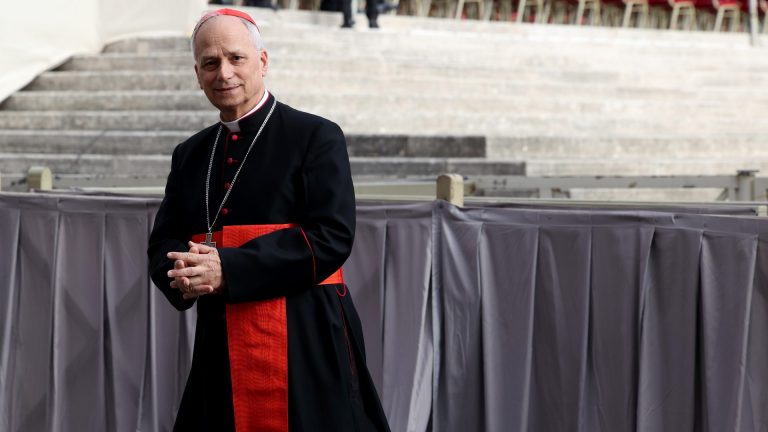
The new Pope’s first crisis
And in a clear nod to his immediate predecessor, Pope Francis, he argued that technology cannot be concentrated solely in the hands of a few, so that the gap between those included and excluded from the digital revolution is widened. This, he said, is neither morally nor ethically acceptable. The protection of children against exposure to violent, hypersexualised or fake information online did not escape his gaze either.
The Papal authorities have not been working in a bubble on AI: the tech bros of Silicon Valley have spent several years lobbying behind the Leonine walls in an effort to convince the Vatican that AI can be developed responsibly, just as they have done with myriad other national governments. Only last month, the issue of protecting children from the dangers of the digital world was the focus of a high-level meeting between Vatican officials and senior Google, Meta and Amazon representatives in Rome.
The general consensus on Leo’s encyclical has been positive. It was welcomed by the European Union, which advocates a strict regulatory framework. But – as a writer – I was a little disappointed that the encyclical doesn’t seem to address the festering issue of intellectual property and copyright when it comes to training AI systems. It also fails to acknowledge growing anxiety in the neuroscientific world about humans pretty much delegating day to day “thinking” to AI, from map reading to general memory tasks.
It has been remarkable to see an encyclical covered so extensively in the mainstream global media – and in more secular countries, such as Canada and Australia.
The palpable effect this Pope has had, in just one short year, on the global conversation is, in itself, almost miraculous.