
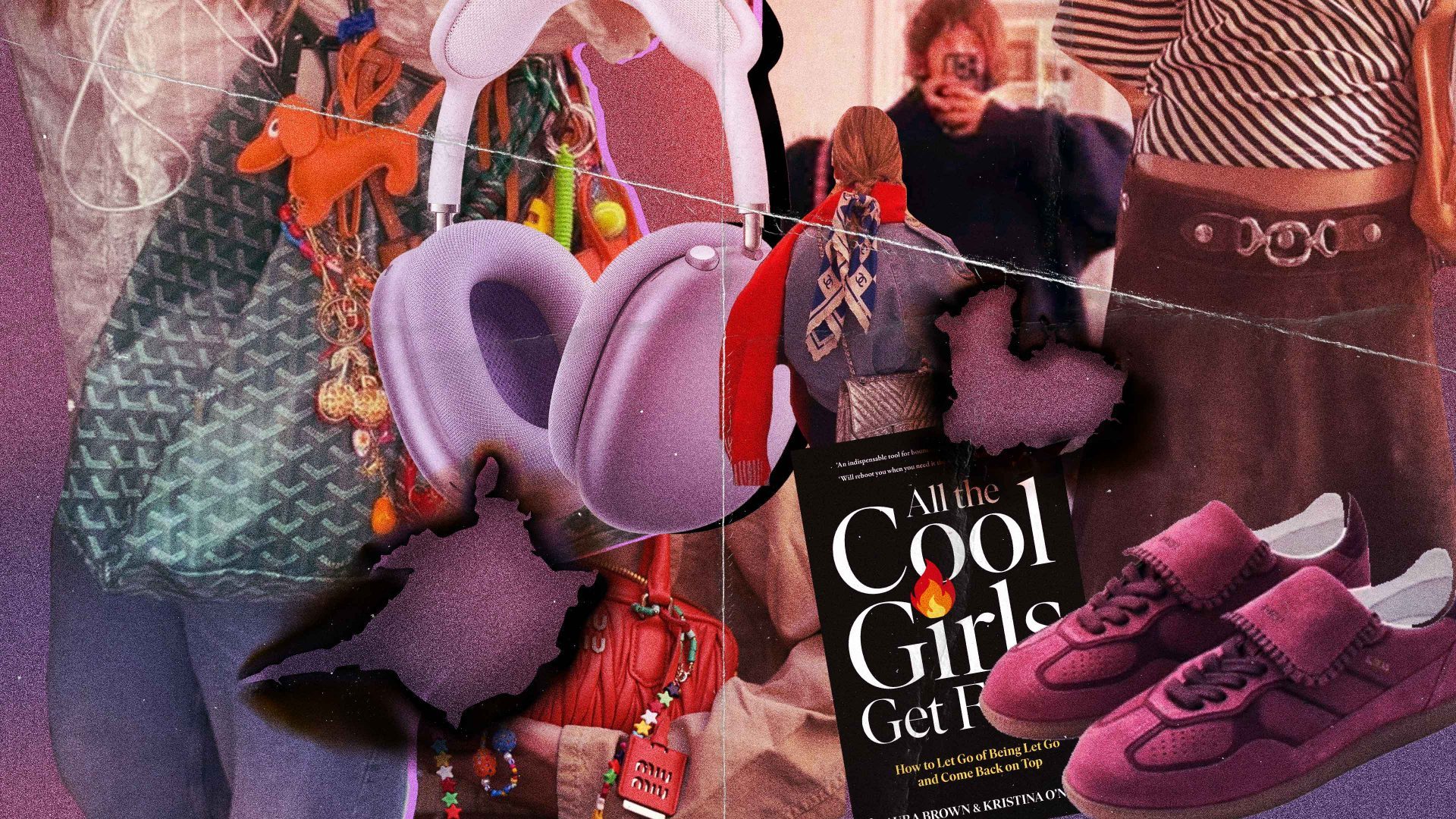
She customises her bags with charms and stacks bracelets up her arm. She rewears the same clothes from a wardrobe of vintage finds and independent labels. She writes with a signature pen, talks without using filler words, listens to Nirvana through wired headphones.
She’s serious about her health, her money and her boundaries. But she’s also totally spontaneous and has loads of friends and esoteric hobbies. After a long day spent figuring out how to be simultaneously ambitious and unbothered, she lights a candle and slips into a matching set of overpriced pyjamas.
She is the cool girl – potentially nonexistent but impossible to escape. You’ll feel her presence in shopping guides in Vogue and The New York Times, and the 3.2 million TikTok videos tagged #coolgirl, from which the above bible of cool girl commandments was derived.
Last Christmas, practically every gift guide on social media was dedicated to her niche tastes and proclivities. Even unemployment can’t escape her manicured grips: any young woman facing redundancy can now turn to self-help book All the Cool Girls Get Fired, by Laura Brown and Kristin O’Neill
Once upon a time the cool girl was an unknowable enigma, the kind of pop culture figure you might associate with people like Jane Birkin, Sade, Chloe Sevigny or Solange Knowles. These days, she’s a marketing tool. The aspiration’s still there – that’s why it sells – but the endless cycles of dissecting and repackaging of what it means, feels and looks like to be cool has transformed it into something to be easily bought.
Suggested Reading


Looksmaxxing: The male crisis, now with a skincare regime
The original cool girls aren’t immune from this, of course; a £20,000 Birkin bag is hardly an underground status symbol. The 2026 iteration, however, turns the simple act of having a personality into a box-ticking exercise, one that can be completed with an influencer affiliate discount code at checkout.
“Cool girl is hot. Cool girl is game. Cool girl is fun,” declares Rosamund Pike as Amy Dunne in Gone Girl, in what’s since become known as the “Cool Girl Monologue”. Back in the early 2010s, when both the film and Gillian Flynn’s original book came out, and fourth wave feminism went mainstream, lots of women – persuaded by Pike’s anti-hero – collectively decided that striving to be the cool girl was a bad thing.
This was easy enough, when we understood that performance to be for men. We put down our beers and set upon the noble pursuit of girlbossing instead, powersuiting our way up the Forbes’ Richest Self-Made Women list. (See: Elizabeth Holmes, Sophia Amoruso and Emily Weiss.) Then, inevitably, being rich and self-righteous became kind of cringe.
The feminine urge to rebrand, am I right? Ever since the court of public opinion decided that “girlboss” was a toxic term around 2020, culture has grasped at new ways to market femininity. Just look at how quickly brands and influencers latched on to Hot Girl Summer, coopting Megan Thee Stallion’s feel-good anthem into a trend that spawned everything from “Hot Girl Walks” to #HotGirlsForBernie (Sanders, that is).
The hot girls still exist, wearing pink “Make America Hot Again” caps or “Hot Girls For Zohran” T-shirts to signpost their political allegiance – perhaps the clearest sign that the phrase is now less associated with its original message of empowerment and more shorthand for “women have thoughts too!”
Since Hot Girl Summer, we’ve rattled through “girl” trends at a disorienting speed. Rat girls, feral girls, tomato girls, vanilla girls – there’s no point in explaining what they all mean, because they never lasted that long anyway. Rest assured, none of these fads went viral because there was a dormant subculture of women who just bloody love tomatoes. They were simply quick ways to signpost identity in a 20-second video.
By contrast, the return of the cool girl as an aspirational blueprint has endured a little longer. This is perhaps partly thanks to the fact that the term is so vague, subjective and indefinable that, like hotness, it appeals to nearly everyone.
She could be racking up lines to brat or burning incense to Sade. These days, the point isn’t what she’s doing but how she sells it, self-mythologising for the market instead of the male gaze or even herself.
The pursuit of cool isn’t an inherently bad thing – as late-stage capitalism pushes further towards homogeneity, we need subversive cultural figures who inspire us to think beyond the status quo. But contrary to what the current deluge of “cool girl” marketing might tell you, it cannot be prescriptive.
“Coolness is something I value, because without it everything sort of feels random and nondescript,” wrote Charli xcx in a recent Substack essay. “The second you apply a ‘something for everyone’ approach… to deliberately appeal to more people… is the moment that coolness dies.”
Suggested Reading
The witches of the internet
This is the question that her new mockumentary, The Moment, grapples with, as Charli navigates the tension between maintaining authenticity and cultural dominance at the height of brat summer. In the film, her record label partners with a bank to launch a brat credit card.
In reality, as culture critic Vinson Cunningham noted in a The New Yorker podcast, what ultimately tainted brat summer was its co-option into politics via Kamala Harris. “All of a sudden, this girl who just wants to party and hang out and make cool music has to mean something way more,” he says.
Perhaps the only person who is being – albeit unwittingly – upfront about what today’s iteration of the cool girls represents is Danielle Goldberg, one of the founders of “Cool Girls For Capitalism”. While campaigning for Andrew Cuomo in the New York mayoral election last year, she explained how the world’s dominant economic system needed a makeover to “be, like, sexy, as well.”
Goldberg, obviously, quickly became the subject of widespread derision. But whether they realise it or not, every self-described “cool girl” influencer that links out to an Amazon storefront is supporting the same idea.
There is, however, one suggestion that comes up in nearly every cool girl guide that I can get behind, usually phrased along the lines of “have interesting hobbies”. In other words: get a life.
We live in a world that encourages self-obsession, prompting us to narrate our ideal identity rather than actually have one. The cool girl is just another archetype to mould ourselves to. But if, by some miracle, her doctrine inspires us to step outside and discover ourselves beyond the marketing spiel, perhaps one day we can kill her off altogether.
All the cool girls are pretending. Better to stop obsessing over them and live in the real world instead.
 Most popular


Brits living in Dubai – sorry, but you’re awful


Trump: Dead soldiers are walking around without legs


How Brexit could come back to bite Sunderland


The quislings of the right have abandoned patriotism