

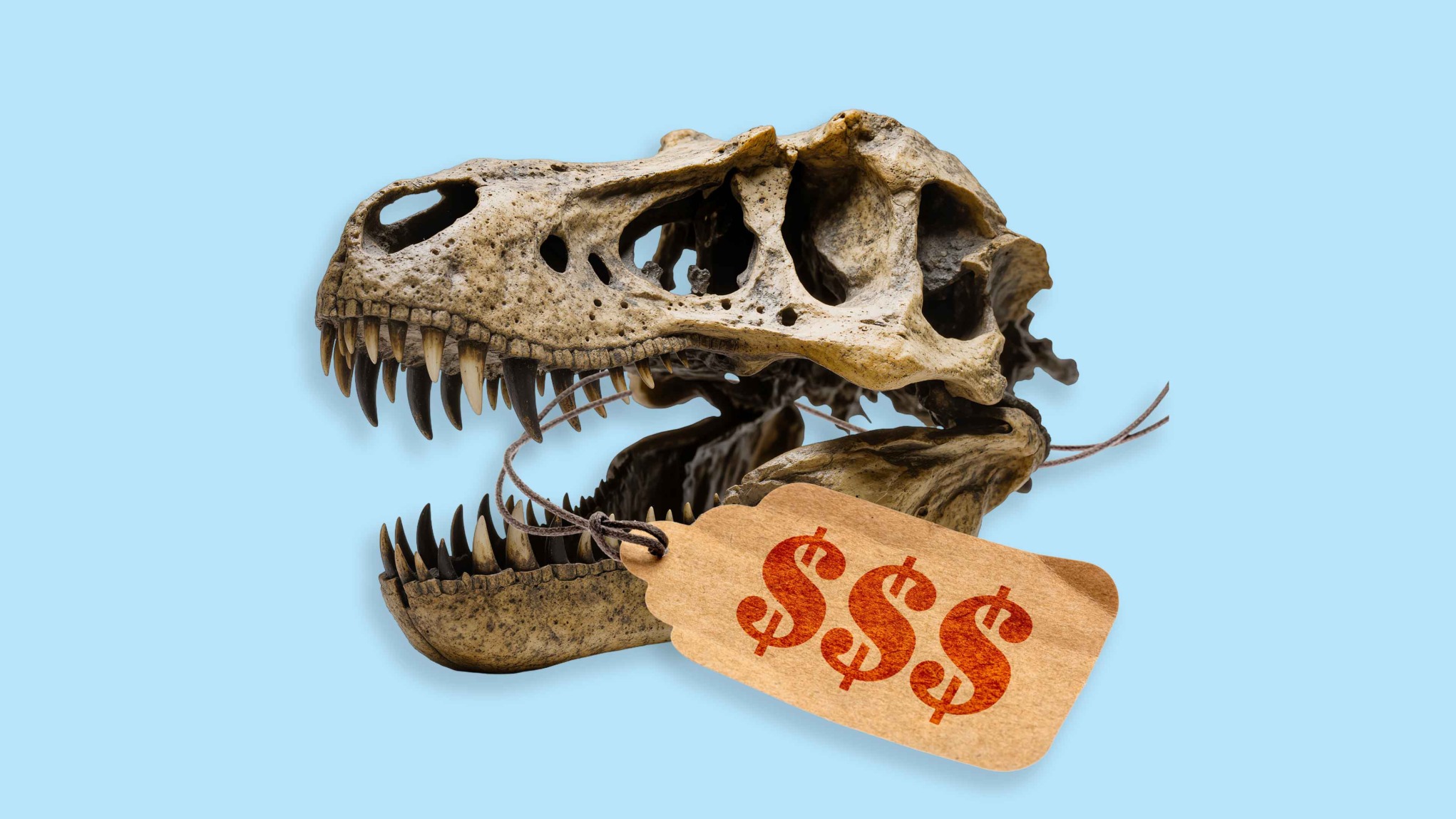
Kids adore dinosaurs. So do many adults.
King of the dinosaurs is Tyrannosaurus rex – the clue is in the name. Smaller than the Diplodocus, less armoured than a Stegosaurus, it holds a special place in the popular imagination.
Like the great white shark of Jaws fame, perhaps that is partly because it was an apex predator. Those teeth evolved to pierce and rip the flesh of its prey. There is a special kind of thrill in standing under a T rex skeleton (or even under the cast of a skeleton), imagining these terrifying killers.
In 2019 Jodi Pierson, a ranch-owner, found what was thought to be a small T rex on her land in the Hell Creek formation in Montana. With the help of a palaeontologist, she excavated the fossilised bones of what turned out to be an adult of a much rarer and more bijou species, Nanotyrannus. Only three Nanotyrannus skeletons are known to exist.
Last week “Jodi” (named after its discoverer) sold at Sotheby’s New York for $47.3m (£35.2m). That made it the second-most expensive dinosaur fossil of all time (“Gus”, a T rex proper, sold for $50.1m in July).
At these prices it is not surprising that dinosaur prospecting is now a thing. Expect a dinosaur rush.
Suggested Reading

Was Nietzsche really a Nazi?
Why are the super-rich buying dinosaurs for their private collections? This is not a new phenomenon, but the prices are going up.
Back in 2007 Nicolas Cage outbid Leonardo DiCaprio to pay $276,000 for the skull of a Tyrannosaurus bataar, another near relative of T rex. Cage returned it when he discovered that it had been exported illegally from Mongolia.
There’s only so much you can do with a Tyrannosaurus in your home. If you have a large room, you can spotlight it, put it in pride of place, and invite friends over to marvel at it and, by extension, at you, its proud owner.
You can take selfies under it, talk to it. You can even grind it into a paste and eat it: if you bought it legitimately it’s yours to do what you like with.
Ultimately the reason why individuals are buying dinosaur skeletons is probably similar to the reason many of them buy iconic paintings by blue-chip artists such as Jeff Koons or Damien Hirst.
Dinosaur skeletons are instantly recognisable and very expensive. They’re also very impressive. If you have one of these in your house, it’s like having a top-of-the-range sports car in your drive, but with knobs on.
It’s down to the phenomenon known as “the peacock’s tail”. The peacock has a very long train of feathers that allows it to put on a shimmering display. But the costs of lugging those heavy feathers around are immense.
Only a super-powerful individual could manage that, the tail feathers proclaim. The largely useless but stunningly beautiful display signals that individual’s potency and prowess. The high-end sports car in the drive, the million-dollar paintings in the hallway and the spotlit Tyrannosaurus skeleton in the living room are all examples of stage-managed conspicuous consumption.
Suggested Reading
Everyday philosophy: A 75,000-year-old lesson for humanity
Dinosaur remains in the possession of private individuals are proxies for their owners’ purchasing power. It’s not about the objects, but about what they connote: great wealth, but also, I’d suggest, great selfishness. We aren’t discussing ammonites picked up at Lyme Regis, but near-complete, rare specimens of significant scientific interest that should be available for research.
I’d go further and say that, like the greatest works of art, they should be on display to the public too. That is controversial, of course.
Some people think it morally acceptable for an immensely rich person to buy a Leonardo painting and keep it on a private yacht or lock it in a safe, destroy it even. I disagree. How humanity’s most important cultural heritage is treated should not depend on the whims of the highest bidder – especially as they’re probably just showing off anyway.
