PICK OF THE WEEK
The Testaments (Disney+, April 8)
How do you follow an Emmy-winning, six-season all-time classic of prestige television like The Handmaid’s Tale (2017-25)? By going back to the source material, of course: in this case, Margaret Atwood’s own Booker Prize-winning sequel (2019) to her original dystopian novel of 1985.
Bruce Miller is still at the helm as showrunner, and Elisabeth Moss, so compelling as June Osborne (aka the handmaid “Offred”) in the original series, returns as executive producer. Once again, we are in Gilead, the brutally misogynistic theocracy that has overthrown the US republic and is ruled by a pitiless elite of Commanders, calling themselves the Sons of Jacob.
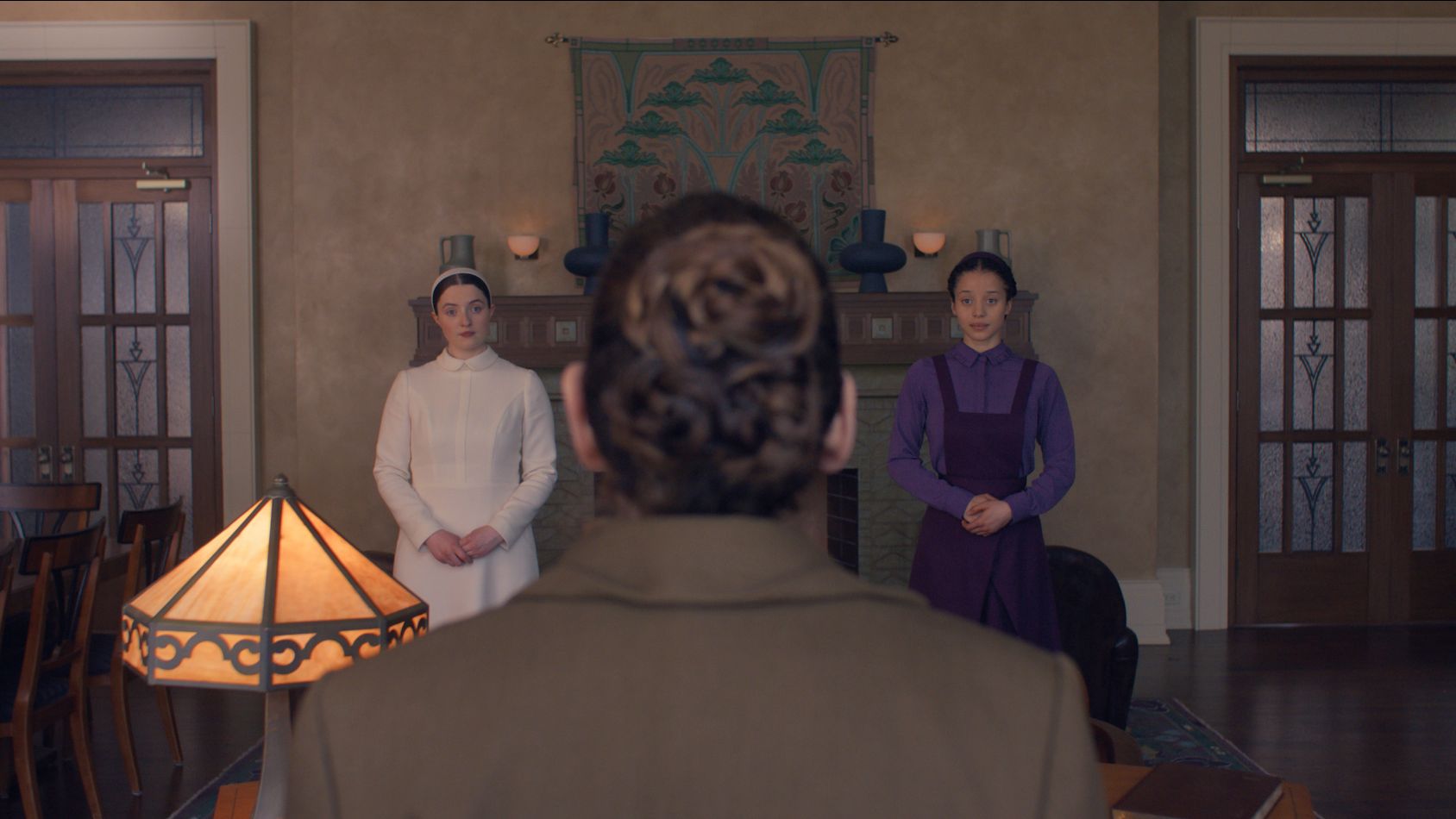
Though The Testaments is inspired by Atwood’s novel and respects its spirit rigorously, it is not constrained by its literary parameters. The principal read-across, in fact, is structural: a tripartite narrative, in which the next act in the saga is told through the eyes of Agnes (the excellent Chase Infiniti, who should have been Oscar-nominated for One Battle After Another), the adopted daughter of Commander Mackenzie (Nate Corddry) and her step-mother Paula (Amy Seimetz); Daisy (Lucy Halliday), originally from Toronto, where she says she was “defiled by Satan”, and now one of the “Pearl Girls” who form the lowest caste at Agnes’s exclusive school; and Aunt Lydia (played once more by the mighty Ann Dowd), who oversees the role of women and girls with “an iron fist in a leather glove in a woollen mitten”.
The success of the new series owes much to the bait-and-switch of its principal setting: an academy for the daughters of the patriarchal oligarchy that, like their homes, is lavishly appointed, with immaculate lawns, chauffeur-driven cars for the pupils and an atmosphere of (mostly) serene entitlement. Is this going to be Clueless (1995) or Mean Girls (2004) for Christian fundamentalists?
Not at all. Just below the surface of exquisite dolls’ houses, decorous etiquette and high-society teen talk lurk the violence, cruelty and vengeful totalitarianism of Gilead. Agnes’ best friend in the world may be Becka (Mattea Conforti), just as Shunammite (Rowan Blanchard) is the class rumour monger, and Hulda (Isolde Ardies) the girl who hopes she won’t be left behind by her peers: but none of that is of the slightest interest to their parents or to the Aunts whose sole concern is to arrange genetically and socially desirable matches with eligible Commanders for the pupils as soon they start to menstruate (the bell is rung joyously whenever that biological landmark is reached, and the girls exchange plum dresses for tailored green).
This is not an educational establishment at all, we realise – after all, the pupils are forbidden from reading – but a merciless finishing-school for child brides. Its credo is that girls and women are to blame for the terrible behaviour of men. As Aunt Vidala (Mabel Li) warns: “That kind of girl often earns a violent end for herself.”
It is in the harrowing contrast between impeccable gentility and true social horror that the show’s power is to be found. Though tutored in petit-point embroidery, hymnal work and the perfect hosting of a tea party, the girls are quite desensitised to the sight of rotting corpses hanging from a bridge. As Hannah Arendt observed in The Crisis in Education (1954), “the belief that one must begin with the children” is fundamental to “movements of tyrannical cast.”
Which poses the core question: is the spirit of rebellion innate to the human condition, or can it be eliminated by early indoctrination? And is Daisy – the supposed convert to the ways of Gilead – all she seems?
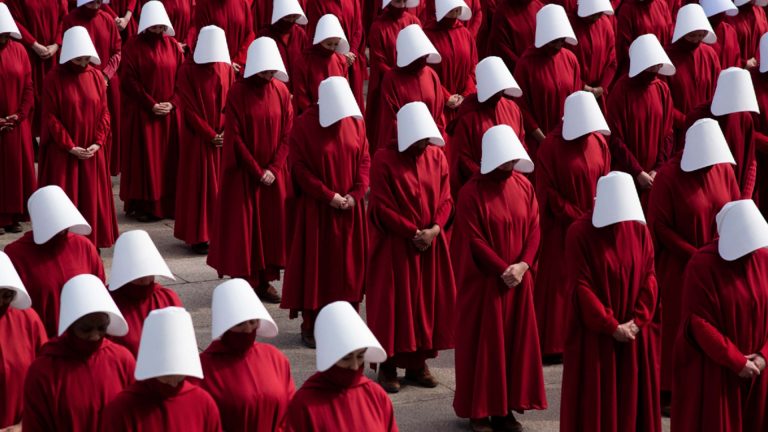
The distinctive aesthetic of the original series is also preserved – Leslie Kavanagh’s sensational costumes, the signature overhead shots and stately tableaux (a reel at a ball, a white-uniformed phalanx of beekeepers, the constant dissonance between carefully nurtured beauty and bloody, Old Testament savagery). Across ten episodes, we learn much that is new about the origins of Gilead and the moral choices that faced those who lived through its barbaric seizure of power. The work of the “Mayday” resistance persists. Along the way, we see some familiar faces, too, whose identity I shall not spoil.
What might have been a by-the-numbers spin-off proves to be a remarkable exercise in creative world-building, as powerfully resonant in 2026 as The Handmaid’s Tale was when it premiered in Donald Trump’s first term. A daunting challenge, triumphantly met.
Suggested Reading

Welcome home to Gilead
FILM
The Drama (general release)
It’s a sly omen of things to come that when English museum curator Charlie Thompson (Robert Pattinson) introduces himself in a Boston coffee house to book editor Emma Harwood (Zendaya), he does so by means of a minor subterfuge: spotting the novel she is reading, looking it up on his phone and then pretending to her that he was himself bowled over by it. Even the meet-cute in writer-director Kristoffer Borgli’s movie is tainted by deception.
After a whirlwind romance, the couple are busily preparing for their wedding. At a wine-tasting dinner with their married best friends, Rachel (Alana Haim in splendid form) and Mike (Mamoudou Athie), they all drunkenly agree to admit the worst thing they have ever done.
Cyber-bullying at school, locking a kid into a closet in an RV, using a girlfriend as a human shield against a snarling dog: all of which is unpleasant enough…until it is Emma’s turn and she reluctantly accepts Rachel’s invitation to “give us some hot tea”. The tea in question is seriously scalding: a truly shocking confession that dominates and disfigures all that follows.
What intrigues Borgli most is the sheer frangibility of the bohemian worldliness that the characters initially exude, the artifice of their moneyed equanimity. Emma and Charlie (of course) have a perfect apartment, with a spiral staircase, books galore, art on the walls and tasteful lighting. But none of that matters once the truth is out. In the new carnival of awkwardness, toes are curled, sentences die in a fog of aphasia, libido tanks. The groom does not so much get cold feet as crawl into an igloo of compressed trauma.
It is as a parable of deep delusion that The Drama works best. When Emma suggests that the choreography for the wedding dance is “a little performative”, she is subconsciously writing a slogan for the life that she and Charlie have built. They and their friends are used to talking airily about “anger issues”, “empathy” and “cultural things”. But everything they do is edited, curated, insulated from the sharp edges of reality. Trying to make sense of Emma’s disclosure, Charlie feebly alludes to Freud and Louis Malle. Even despair can become a social construct.
The ending may strike you as a little too tidy, but the two leads more than make up for that with their respective performances and undoubted chemistry. They also co-star in The Odyssey (July) and Dune: Part Three (December); and Zendaya is back on the small screen this month in the long-awaited third season of Euphoria (April 13, HBO Max, NOW, Sky Atlantic).
STREAMING
Bait (Prime Video)
When Daniel Craig bowed out as James Bond in No Time to Die (2021), I was one of many who thought that Riz Ahmed would be a great successor – his star being very much in the ascendant after his best actor Oscar nomination for Sound of Metal (2019).
It would appear, however, that director Denis Villeneuve has decided to stick with conventional practice in the as-yet-untitled Bond 26 (the bookies’ favourites are Jacob Elordi and Callum Turner). So all credit to Ahmed for leaning into the subject and turning it into this joyous six-episode comedy drama.
In the cold open, we meet his character, Shah Latif, stumbling in an audition for the role of 007. To keep his name in the frame, the struggling actor (“I played the translator in season seven of Homeland”) contrives to be photographed by the paparazzi as he leaves – and rumours that he is about to be cast as Bond quickly go viral.
Though his mother Tahira (Sheeba Chaddha) is delighted by the storm of speculation, his father Parvez (Sajid Hasan) is amiably baffled: “Did Craig Daniel die?” Meanwhile, his cousin and best friend Zulfi (Guz Khan, terrific) is working all the angles, not least as the founder of Muslim taxi app, Muba.
He also sees himself as natural bodyguard to Shah, who, it transpires, has already contacted a professional security consultant, Nigel (Rafe Spall). Displeased by this intrusion, Zulfi, who saved Shah from racist thugs when they were boys, warns him against “rent-a-feds” – advising him, for good measure, to control “your horny meerkat face” on the red carpet.
Part of the brilliance of Bait is that it addresses head-on the dilemmas of identity politics but does so with comic panache. When Shah’s ex-girlfriend Yasmin (Ritu Arya), a documentary maker, takes him to task for seeking to play “a white neocolonial MI6 agent”, their confrontation is serious but also glides beautifully into a romantic caper as the two of them ride in a rickshaw through Brick Lane in search of her misplaced bag.
There’s a dose of magic realism, too, as Shah – now in deep personal crisis – starts to speak to a pig’s head that has the voice of Sir Patrick Stewart. It shouldn’t work, but it does – not least because Stewart is having a blast being so unusually potty-mouthed. There are fine cameos from Himesh Patel, Nabhaan Rizwan, Sagar Radia and Sian Clifford.
It’s also a nicely self-deprecating touch that Shah is mistaken in the street for Dev Patel. “Say something about Slumdog!” says one fan, seeking a video message for his girlfriend. “She loves Slumdog!” The sudden proximity of the prize vies with the familiar burden of humiliation.
Of course, the question “Who should be Bond?” is really a proxy for the question “Who is British?” And as Shah says: “This is what British looks like.” Precisely.
BOOK
A World Appears: A Journey Into Consciousness, by Michael Pollan (Allen Lane)
Many years ago, I was lucky enough to sit next to the great philosopher Thomas Nagel at a dinner and to ask him about his famous essay What Is It Like to Be a Bat? (1974). “An organism has conscious mental states,” writes Nagel, “if and only if there is something that it is like to be that organism – something that it is like for the organism.” Needless to say, I had questions. The American sage was much more patient than I had any right to expect.
Michael Pollan also cites Nagel in the first pages of this delightful and thought-provoking book, not least to frame one of his own preliminary questions: “Is It Like Anything to Be a Plant?” As an award-winning writer on food, diet and (more recently) psychedelics – notably in the best-selling How to Change your Mind (2018) – he approaches the question of consciousness not as a professional philosopher but as an intellectual and cultural explorer.
This has two happy consequences. Though well-versed in the forbiddingly extensive literature on the question, he is more interested in answers, however provisional, than in scoring points in the arena of the academy. Second, unbounded by the borders of a particular scholarly discipline, he brings his own remarkable eclecticism to bear on the question; as likely to invoke James Joyce, Star Trek, Raymond Chandler, Luis Buñuel or his own experience in a cave at a Zen Buddhist retreat as he is the standard philosophical texts on the nature of consciousness.
A World Appears is therefore more of a cerebral travelogue than a library-bound thesis – and all the better for it. Along the way, Pollan is persuaded by state-of-the-art science that plants may well be sentient: they appear to learn, have a faculty that resembles memory and – wait for it – respond to anaesthesia.
He devotes welcome attention to the work of William James, his Principles of Psychology (1890) and his notion of the “stream of thought”. And, like a cohort of quantum physicists before him, he is fascinated by the inter-relationship between matter and consciousness and the radical concept of “panpsychism” – “the belief that everything – every grain of sand, every molecule of ink on this page, indeed every particle of matter or energy in the universe – possesses some teensy-weensy quotient of psyche, or mind, and these scintillas of psyche combine in some as yet undetermined way to form the subjectivity of complex beings like ourselves.”
The very different physicalist position of orthodox neuroscience – that our brains are simply computers – could hardly be more contemporary. In the age of artificial intelligence, humanity is conducting a real-time global experiment to test that argument. ChatGPT is the portal that leads to the question: What is it like to be a robot?
Pollan urges us not to confuse the dazzling complexity of coding with true subjectivity; to say that the mind is simply a network of computational processes, he writes, is “metaphor parading as fact.” But he remains refreshingly open to new ideas.
“Sometimes,” he writes, “not knowing opens us to possibilities that knowing, or trying to know, or thinking we already know closes off.” This is one of many reasons why A World Appears is a must-read.
 Most popular
How Jon Stewart told me the brutal truth about Trump and Hegseth

Screen scandal: How Ofcom lets GB News get away with it
The race to save the Beatles


The Brexit hardcore who still think it was right to leave