PICK OF THE WEEK
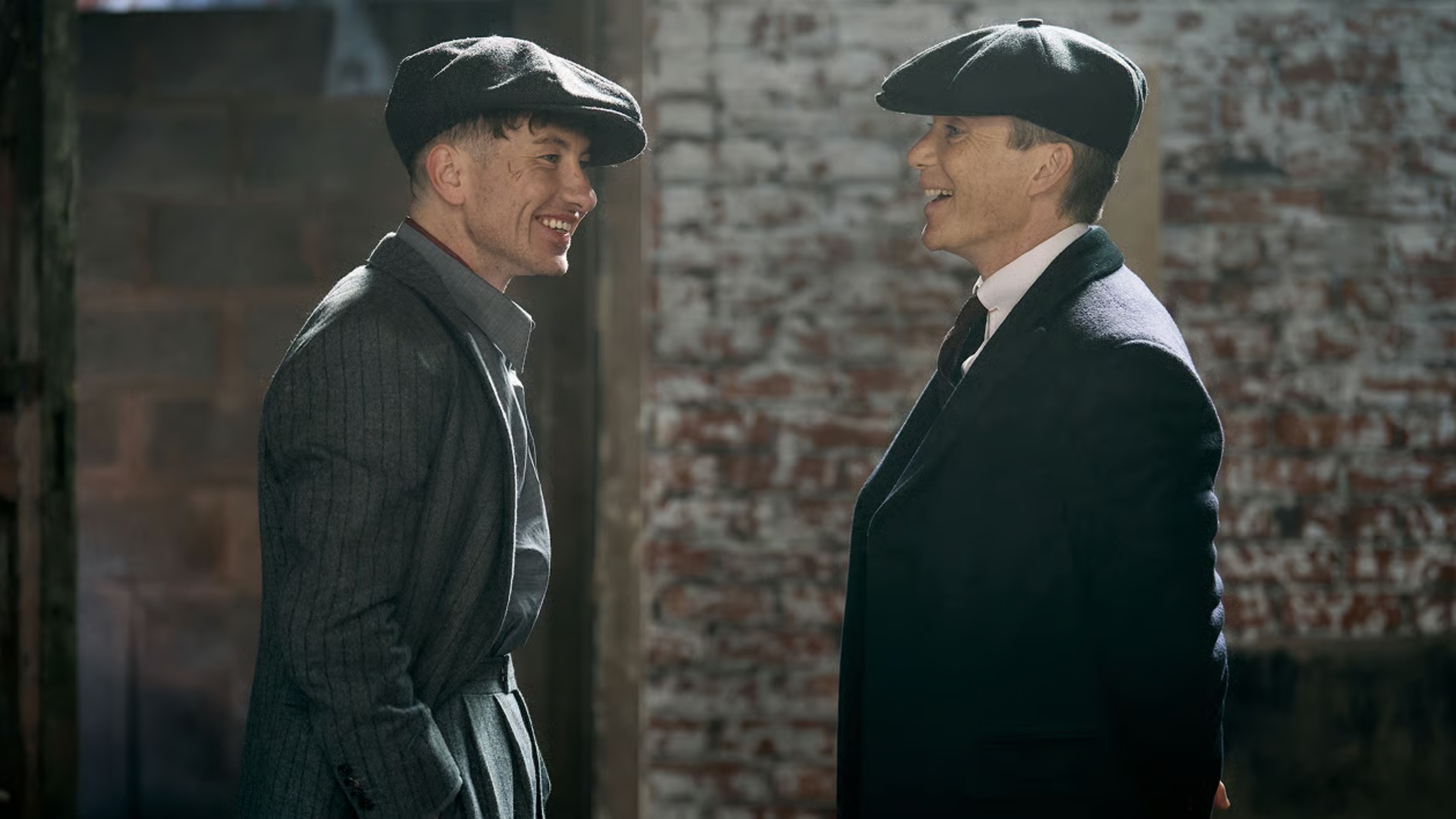
Peaky Blinders: The Immortal Man (Selected cinemas; Netflix, March 20)
“Just when I thought I was out, they pull me back in!”: Steven Wright has always claimed that his BBC crime saga set in Birmingham after world war one, which ran for six seasons from 2013 to 2022, owed more to westerns than to The Godfather.
All the same: as we are reunited with Tommy Shelby (Cillian Murphy) in this fine standalone movie, it is hard not to think of Michael Corleone’s cry of anguish in the third of Francis Ford Coppola’s trilogy – the frustration of the criminal kingpin seeking escape from his past but always dragged back by unfinished business.
In this case, Tommy, living as a recluse on his rundown Warwickshire country estate and writing his memoirs, is summoned to the city he once controlled by his sister Ada (Sophie Rundle), now an MP; and then by the mysterious Kaulo Chirklo (Rebecca Ferguson), “Queen of the Palmer Witches” and twin sister of the late Zelda, with whom he had a child.
That boy, Duke (Barry Keoghan), now leads the Peaky Blinders, ruling the city with impulsive violence; stealing morphine, weapons and livestock that are badly needed elsewhere as Britain stands alone against the Nazis.
On which subject: Tim Roth is great as Beckett, a senior figure in the British Union of Fascists – “Heil fucking Hitler!” – who is conspiring with Berlin to capsize the British economy by flooding the nation with £350 million in forged bank notes. Duke, who is looking for “trouble, opportunity” agrees to handle the fake currency, due to arrive in Liverpool, in return for a 20 per cent cut.
Wright has always enjoyed entangling the fortunes of the Shelbys with real history: Oswald Mosley, Churchill, the general strike and the Wall Street crash all featured in the original series. The movie’s improbable plotline is, in fact, based on the wartime Operation Bernhard led by SS Major Friederich Bernhard Krueger in 1942.
Yet The Immortal Man, ably directed by Tom Harper, owes even more to myth and the Arthurian legend of the returning king. When Tommy, crowned once more with his cap, muddied in his exquisitely tailored suit after an old-school brawl, and riding a black steed, is spotted on the streets of Birmingham – underscored by a newly recorded version of Nick Cave and the Bad Seeds’ Red Right Hand – the citizens rush up to greet him as if seeking a medieval monarch’s healing royal touch. As Ada says to her brother: “They pray to Christ, and to you.”
Since the series ended, Murphy has picked up an Oscar for Oppenheimer (2023), and it takes an actor of Keoghan’s extraordinary talent to play Mordred to the returning monarch; to be, in Tommy’s words, “my dark reflection”. Can he be more? Is Duke worthy to be the Rom baro, the gypsy king?
There are, as always, fantastic needle-drops: notably covers of Massive Attack’s Teardrop by Girl in the Year Above and of Angel by Grian Chatten. The infernal cityscapes of wartime, shot on film, are beautifully rendered by George Steel’s cinematography; hinting at the parallel, metaphysical battle for the souls of father and son alike.
Wright is now at work on the screenplay for Denis Villeneuve’s as-yet-untitled Bond 26 and a Peaky Blinders sequel series for the small screen set in 1953. Meanwhile, he and his troupe have tied an elegant bow on what became, against the odds, a mighty cultural chronicle.
FILM
The Bride! (General release)
Maggie Gyllenhaal’s second directorial feature is as much a homage to two movies released in 1935 as it is yet another adaptation of Mary Shelley’s horror classic – only four months after Guillermo del Toro’s operatic swing at the source material.
The first is James Whale’s Bride of Frankenstein, in which Elsa Lanchester played both the novelist and, if only for ten unforgettable minutes, the woman reanimated to be the creature’s companion. Jessie Buckley, astonishing as always, repeats the trick: as Shelley, trapped in purgatory, and as Ida, a party girl in 1936 Chicago, who is possessed by the writer’s seething spirit.
The second movie is Mark Sandrich’s Top Hat, perhaps the greatest to feature both Fred Astaire and Ginger Rogers, and precisely the sort of film that the ageing monster “Frank” (Christian Bale) loves to watch. His screen idol, in fact, is the dapper actor Ronnie Reed (Jake Gyllenhaal, the director’s brother).
Crippled by loneliness, he tracks down scientist Dr Cornelia Euphronius (Annette Bening), intrigued by her work on “reinvigoration”, and persuades her to create a bride for him. This entails exhuming the body of Ida, buried in a pauper’s grave after her death at the hands of the henchmen of mob boss Lupino (Zlatko Burić).
Unable to remember her past or name, Ida becomes (initially) “Penelope Rogers” and, prompted by Shelley, adopts the refrain of Herman Melville’s Bartleby, the Scrivener: “I would prefer not to”. In this feminist re-telling, the Bride becomes a furious rebel against patriarchy in all its forms, inspiring women to join her in “brain attack” and to emulate her black tongue and the Rorschach-style mark on her face. When she rounds on a room full of men, she bellows: “Me too!”
On the lam – their road trip taking them to cities associated with Ronnie Reed movies – she and her heavily stapled beau become a Gothic version of Bonnie and Clyde, with additional nods to Alex Cox’s Sid and Nancy (1986) and Oliver Stone’s Natural Born Killers (1994). When Frank finally meets Ronnie – “You’ll be pleased to know that I’m not alone anymore!” – he bursts into a version of Puttin’ on the Ritz; a mischievous reference to Mel Brooks’ Young Frankenstein (1974). As serious as her themes are, Gyllenhaal never stops having fun.
Less successful is a sub-plot involving detective Jake Wiles (Peter Sarsgaard, the director’s husband) and his assistant Myrna Malloy (Penélope Cruz): re-enacting the noir trope of the notionally junior woman being the brains of the team. But the world-building is terrific, thanks to Lawrence Sher’s cinematography, Sandy Powell’s costumes and Karen Murphy’s designs which evoke neon-lit art deco America with a twist of steampunk.
All this has proven a little too riotous for more delicate critics. But if you have a taste for what Euphronius wonderfully calls “disobedient geometry”, you will have a blast.
Suggested Reading

The shots and the shadows
RADIO/PODCAST
Waugh: What Is He Good For? (BBC Sounds)
In this terrific seven-part audio series, comedian and writer Russell Kane marks the 60th anniversary of Evelyn Waugh’s death with a celebration of his fiction and argues that the novelist – whom Graham Greene considered the greatest of his generation – was not simply the patrician elitist of caricature.
Each 14-minute episode is a bite-sized exploration of a classic Waugh novel, reinterpreted and reframed by Kane (who chose the life and work of the author as his specialist subject on Celebrity Mastermind). In Decline and Fall (1928) and the picaresque adventures of Paul Pennyfeather, for instance, he sees the eternal plight of the person who doesn’t belong and mocks from the outside: a conviction which he identifies as the engine of his own comedy.
Meanwhile, Kane compares Vile Bodies (1930), which satirises the “bright young things” of 1920s London, to today’s “Instagram influencer culture… a dream made up of code.” His own favourite Waugh novel, A Handful of Dust (1934), is, he reflects, an enduringly poignant study of boredom, commitment and infidelity.
The series is enhanced by fine interviewees: Ian Hislop, who makes the case for Waugh as a founder of modern British comedy; Kit de Waal who sees today’s celebrity culture doing the work of class in the novelist’s era; Paula Byrne, author of the excellent Mad World: Evelyn Waugh and the Secrets of Brideshead (2009); and Sophia Waugh, the novelist’s grand-daughter. Kane’s discussion with curator and writer Ekow Eshun about Black Mischief (1932) is especially interesting.
STREAMING
Young Sherlock (Prime Video)
What if the future sleuth of 221B Baker Street had once been a great friend of his eventual criminal nemesis? That is the entertaining premise of Matthew Parkhill’s spin on a very familiar tale, co-developed with Guy Ritchie, who also directs the first two (of eight) episodes.
Inspired by Andrew Lane’s series of novels, the story introduces us to the 19-year-old Sherlock (Hero Fiennes Tiffin) in the 1870s as a prisoner in Newgate, his release organised by his older brother Mycroft (Max Irons), an official at the Foreign Office. He is sent to the fictional Candlin College, Oxford – to work as a servant.
There, he meets undergraduate scholar James Moriarty (Dónal Finn): brilliant, charming and not yet embarked upon the dark path that will make him, in time, Sherlock’s deadliest foe and the “Napoleon of crime”. He likes to tease his clever new friend – “Look at you with your Art of War!” – and is always on the look-out for the craic (“big fat pints”). The pleasure-seeking Moriarty even flirts with his friend’s mother, Cordelia (Natascha McElhone), once she is sprung from undeserved captivity in an asylum.
Dyspeptic college head Sir Bucephalus Hodge (Colin Firth) is embroiled in something very sinister indeed – and the two aspiring detectives, as well as Shou’an (Zine Tseng), a Chinese princess skilled in the martial arts, are soon onto him. The trail leads to London, Paris and Constantinople, and an all-action caper that also involves Sherlock’s scientist father Silas (Joseph Fiennes). What is he up to?
In the 139 years since Arthur Conan Doyle’s A Study in Scarlet was published, there have been more than 200 Sherlock Holmes movies and many, many television adaptations.
Young Sherlock is an imaginative addition to the genre, full of premonitions: we meet Constable Lestrade (Scott Reid) of Oxford police (but ambitious to join the Met); see the teenaged detective sizing up a deerstalker; and, most intriguingly, watch a splinter of ice quietly enter Moriarty’s heart. But, starting with the choice of title song (Kasabian’s Days Are Forgotten), the spirit of the series is true to Ritchie’s two Sherlock Holmes movies (2009 and 2011): more of a romp than a cerebral character study, and none the worse for that. Worthy of a second season.
 Most popular
‘Operation Epic Fury – as it happened’
Is Star Wars dead?
Morrissey returns.. and heaven knows he’s mythical now


Iran War: Trump has now sealed his own fate