PICK OF THE WEEK
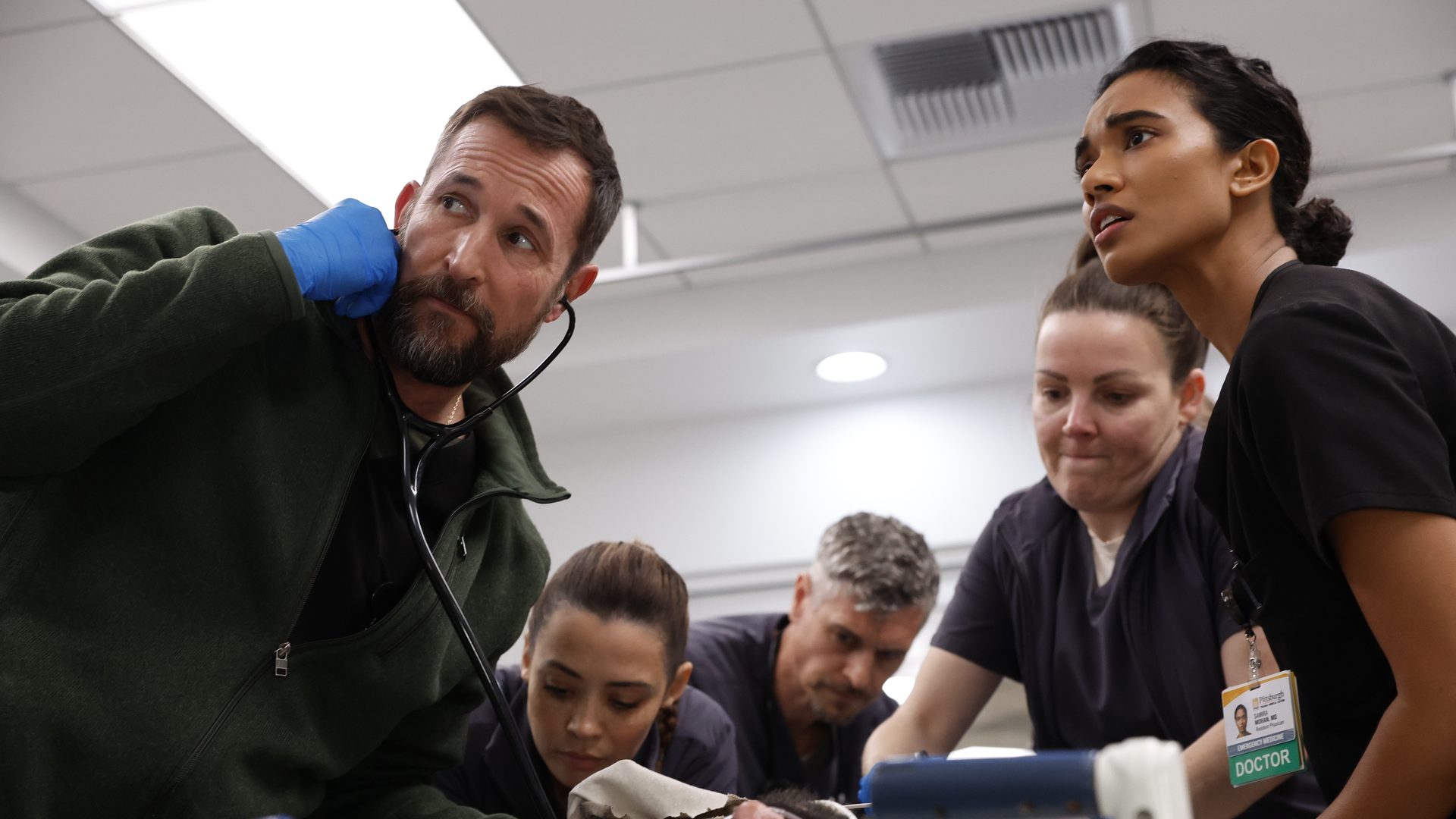
The Pitt (HBO Max)
In the age of global streaming, we have grown used to new shows, comedy specials and documentaries dropping on the same day all over the world. Not so in the case of this Emmy-winning, smash hit hospital drama, which debuted in America in January 2025. Cunningly, HBO Max has held back its release here to spearhead the streaming platform’s UK launch.
Having watched the first season and some of the second – which has not yet reached its finale in the US – I can report that it is, by some margin, the best medical series since House ended in 2012. Set in the fictional Pittsburgh Trauma Medical Center in Pennsylvania (nicknamed “the Pitt”), the show devotes each of its 15 episodes to an hour in the life of the hospital – the real-time narrative device that made 24 (2001-10) such a breakout hit.
At the centre of the tumult is attending physician Dr Michael “Robby” Robinavitch (an exceptional performance by Noah Wyle). On the day in question, he is burdened by memories of the death, four years before, of his mentor Dr Montgomery Adamson during the Covid crisis – for which he blames himself.
Around him swirls a terrific cast of characters: senior resident Dr Frank Langdon (Patrick Ball), who is keeping a secret from his friend and boss; single mother Dr Cassie McKay (Fiona Dourif), who wears an ankle monitor that can start squawking at the most awkward moments; worldly-wise charge nurse Dana Evans (Katherine LaNasa); second-year resident Dr Melissa King (Taylor Dearden); Nebraska-born med student Dennis Whitaker (Gerran Howell); whip-smart intern Dr Trinity Santos (Isa Briones); and student prodigy Victoria Javadi (Shabana Azeez), nicknamed “Crash” after she faints while watching a particularly gruesome procedure.
What makes The Pitt so compelling – aside from the banter, the meticulous effort to achieve medical accuracy and the ever-replenished bay of patients, each with their own story – is the authentic sense of remorseless pressure and barely manageable chaos. This is not a traditional hospital procedural, in which a number of cases are tied up in a single episode; nor an idealised portrayal of doctors as magicians.
If anything. Robby is more like a kindly, care-worn pastor, doing his best to solve the troubles of the world, in the certain knowledge that he will often fail. At the end of episode 11, that world is turned upside down. You’ll have to watch the show to see how.
Suggested Reading


The chaotic magic of Rebecca Lucy Taylor
Theatre
Les Liaisons Dangereuses (National Theatre, London, until June 6)
The success of Marianne Elliott’s revival of Christopher Hampton’s play, 41 years after its premiere in Stratford, has at its core the inspired casting of Lesley Manville as the Marquise de Merteuil and Aidan Turner as the Vicomte de Valmont. It is a double act to savour: a crackling spectacle of desire, deceit and despicable manipulation.
A pleasing symmetry, too, that Manville played the convent-educated ingenue Cécile de Volanges in that production (a role taken today by Hannah van der Westhuysen). When the Marquise charges Valmont to seduce Cécile – all part of a plan to humiliate the young woman’s future husband – he refuses (at least initially) on the grounds that “[a]ny one of a dozen men could manage it. I have my reputation to think of.”
Instead, he sets his pitiless sights upon the pious Madame de Tourvel (Monica Barbaro): “I want the excitement of watching her betray everything that’s most important to her.” What he does not foresee is that he himself will fall for Tourvel – to the disgust of the Marquise, who is both jealous and contemptuous of such weakness (“Love is something you use, not something you fall into, like a quicksand, don’t you remember?”).
Though the original epistolary novel (1782) by Pierre Choderlos de Laclos is now rarely read, Dangerous Liaisons (1988), Stephen Frears’ Oscar-winning adaptation (written by Hampton himself), casts a daunting shadow over any such production. In particular, the astonishing performances of John Malkovich as Valmont and Glenn Close as the Marquise are etched into cultural memory. (Side-note: Frears once told me of the surreal experience of criss-crossing the Atlantic to prepare for this lavish Hollywood movie while finishing off the low-budget cult comedy classic, Mr Jolly Lives Next Door, in which “Dreamytime Escorts” Rik Mayall and Ade Edmondson take Nicholas Parsons on a date and have an office next to a Hitler-worshipping serial killer played by Peter Cook.)
Wisely, Elliott handles the legacy of the movie by ignoring it. Her set, designed by Rosanna Vize, is an imaginative mobile labyrinth of rooms and mirrors, often with a huge starry globe overhead. The choreography by Tom Jackson Greaves is also tremendous – especially when expressing the harrowing proximity between Tourvel’s sexual longing and her religious ecstasy.
In his programme essay, Hampton reflects upon the play’s persistent topicality and its resonance in 2026 with “the repulsive concept of ‘post-truth’, where the most brazen lies are endlessly repeated until they’re believed; where the boundless greed and appetite for exploitation exhibited by the international super-rich is indulged until it seems absolutely normal; and where individuals can be cancelled for reasons justifiable or unjustifiable until the implacable gods of the internet appear to be sated.”
In which context: never forget that Laclos published his novel only seven years before the French revolution.
FILM
Orwell: 2+2=5 (selected cinemas)
George Orwell’s writing is both deeply familiar and remorselessly surprising. In this absorbing feature-length documentary, Raoul Peck – who directed the award-winning I Am Not Your Negro (2016) about James Baldwin – breathes imaginative life into Orwell’s ideas with a dynamic series of montages, clips from movies, news footage, graphics and AI sequences.
The author’s words are spoken by Damian Lewis because (remarkably) there is not a single surviving film clip or audio recording of Orwell. To put this in perspective: you can hear today the voices of Edison, Gladstone, Tennyson, Florence Nightingale, Bismarck, Queen Victoria and Theodore Roosevelt. But not Orwell.
Yet Lewis invests his words with compelling gravitas, leavened by a lurking wit and sense of mischief. Intentionally or otherwise, so much of what Orwell wrote is aphoristic. For instance: “The opinion that art should have nothing to do with politics is itself a political attitude.” Or: “Everything in our age conspires to turn the writer, and every other kind of artist as well, into a minor official.” Or: “To be corrupted by totalitarianism, one does not have to live in a totalitarian country.”
On which note: though Peck packs in footage and images of the Nazis, Stalin, Pinochet, Marcos, oppression in Myanmar, and Putin, he also includes George W Bush pressing the case for the Iraq war and Donald Trump’s incitement of the January 6 uprising. There are creatively deployed clips from movies such as David Lean’s Oliver Twist (1948), Ken Loach’s masterpiece, I, Daniel Blake (2016), Sydney Pollack’s Out of Africa (1985) and several screen adaptations of 1984 (1949) – Orwell’s final and greatest novel and the documentary’s centre of gravity.
His most profound insight was that the control of people’s minds and of the language they speak is the most important objective of all totalitarians. If you can persuade someone that 2+2=5, you can do anything.
Looming over the documentary from its opening shots is the tuberculosis to which Orwell succumbed aged only 46. As he had long expected, he did not live to grow old. But his ideas are more vivid, fresh and unsettling than ever.
FILM
They Will Kill You (general release)
In his book Cinema Speculation (2022), Quentin Tarantino writes with particular affection of the “Revengeamatic” genre of the 1970s to which he paid specific homage in Kill Bill (2003-4) and Death Proof (2007).
So it is no surprise that Kirill Sokolov – a devotee of Tarantino – has followed in his footsteps with this propulsive, blood-soaked action thriller; or that the Russian director has made such enjoyable use of tropes from the Hong Kong jiangshi subgenre of kung fu horror. This is old-school grind-house cinema at its finest.
In search of her sister Maria (Myha’la), whom she deserted after committing a crime, Asia Reaves (Zasie Beetz) seeks work as a maid at the Virgil ,an exclusive New York co-op. Its sinister superintendent Lilith Woodhouse (Patricia Arquette) takes her phone, introduces her to some of the residents, including Sharon (Heather Graham), and tells her to get some rest. No sooner has Asia settled into her quarters than things get very crazy indeed.
Well, wouldn’t you know it? The Virgil is the home of a Satanic cult founded in 1923 in which immortality is traded for regular human sacrifices. Maybe the tympanum above the entrance with a sculpture of the Devil was a clue? In any case: while in prison, Asia has learned serious martial arts and samurai skills and has a cache of weapons in her suitcase.
And so, in Beetz’s stand-out performance, rises one of the most formidable kick-ass heroines since Ripley (Sigourney Weaver) in the Alien movies. Even as Asia gets her head around the sheer supernatural weirdness of it all – the cult members can be killed but are rapidly restored to life – she never stops taking care of business.
At times, the sheer pace of the film recalls the John Wick franchise, but with added satanism. Both hunter and hunted, Asia races through crawl spaces, up and down elevator shafts, and past a floor of the Virgil that is entirely devoted to orgies.
Arquette lends humour to proceedings – not least when she tells a dying member of staff that, as soon as she resurrects, she should “please remember to clean up the blood.” Does They Will Kill You jump the shark? Yes, of course. But so what?
Great subgenre movies of this sort are meant to be pure, adrenaline-pumping entertainment. Not for the squeamish or the earnest. But for everyone else, great fun.
 Most popular


Screen scandal: How Ofcom lets GB News get away with it

James O’Brien says the press have gone mad – and it’s worse than you think

The evidence is growing: Trump’s team are using his chaos to get richer on the stock market

Now it’s official: Brexit was a disaster. Next, we must join a new EU