Tracey Emin: A Second Life (Tate Modern, London, until August 31)
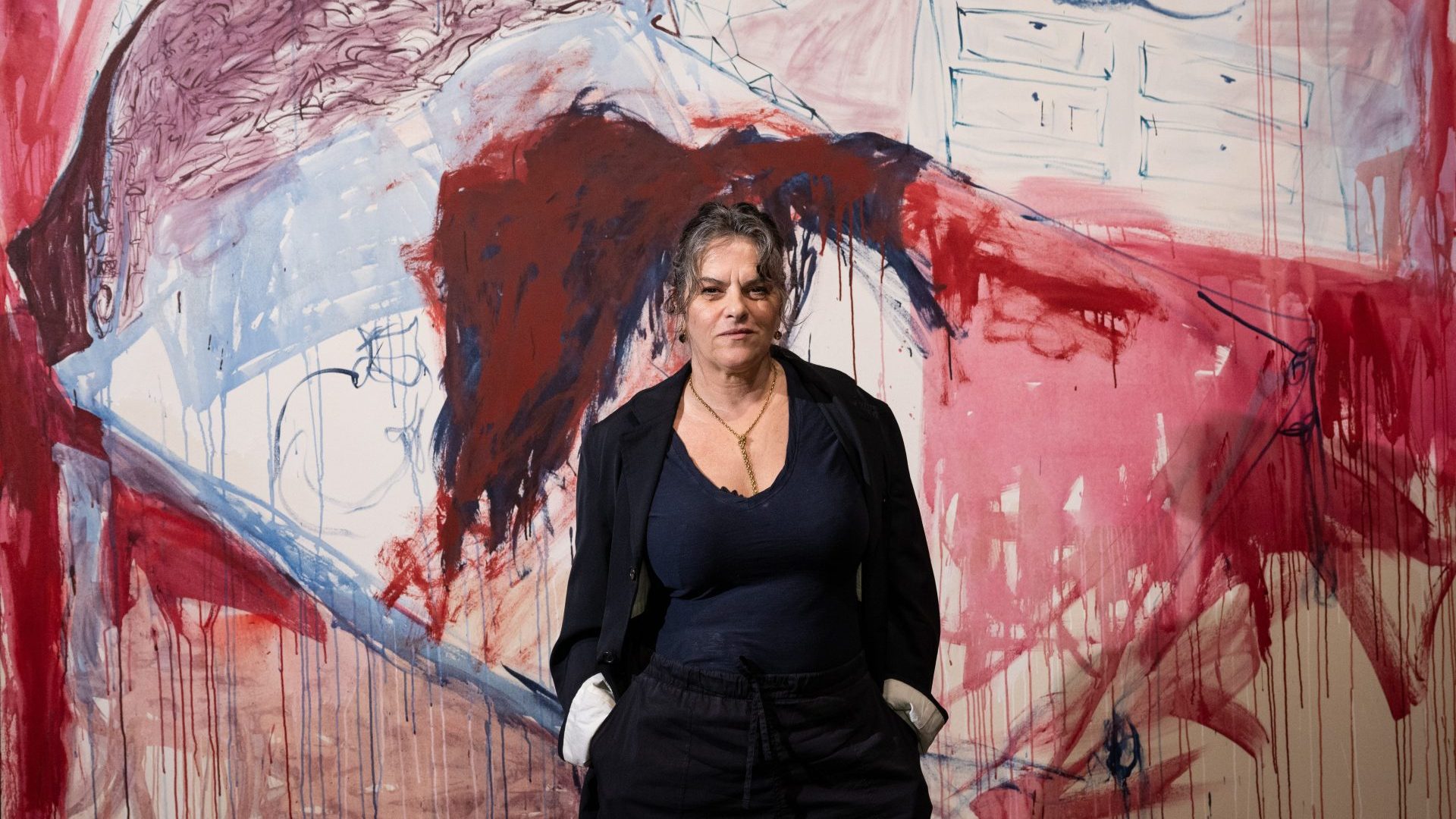
Almost three decades since her installation My Bed (1998) was shortlisted for the Turner Prize – she lost to a young film-maker called Steve McQueen – Tracey Emin has passed through the cultural Checkpoint Charlie that separates creative insurgency from enduring influence. This dazzling retrospective establishes beyond doubt her significance in British artistic history.
“I don’t want people to have to read notes to understand it or read books to understand,” she tells curator Maria Balshaw in an interview in the exhibition catalogue. “It’s visual. It’s art. It’s ideas. It’s something you feel.” What connects the 100 works on display – textiles, videos, bronzes, paintings, installations, polaroids – is indeed the artist’s personal sensibility, which oscillates between magnificent defiance and absolute vulnerability.
From her experience of rape and racism growing up in Margate via a painful abortion in the 1990s to her survival of cancer since 2020, she has transmuted every wound, every trauma, every recovery into creative expression. In the first gallery, photographs of destroyed paintings collected in My Major Retrospective II, 1982-1992 (2008) combine the audacity of the original canvases with the tininess of the images: an inspiration to consider all that follows as the work of a human being of colossal aesthetic ambition who has also suffered greatly.
Magnificent quilts are interspersed with frame after frame of Emin’s exquisite handwriting (“forgive me tiny little thing/ Your Soul is Free/ Forgive me – leave me –”) and neons that acquire fresh emotional resonance in this setting (“Meet Me In Heaven I Wait For You” and “I Whisper to My Past do I have Another Choice”).
A corridor is lined by two sets of photographs: one, from 2001, of a younger Emin, taking selfies of herself in her underwear; the other, a sequence shot between 2020 and 2025, showing her stoma, her scars, her body after surgery. The level of candour in this juxtaposition is intensely moving.
It is important, though, to honour the hard-earned optimism of this exhibition. Aged 62, named a Dame in the King’s birthday honours in 2024, and presiding over a colony of younger artists in Margate, Emin has called it “A Second Life” with good reason. As she tells Balshaw: “sometimes I think I died, and this is heaven.” The words of Beckett spring to mind: “I can’t go on, I’ll go on”. Emin’s persistence is at the heart of her greatness and one of many reasons why this is an unmissable show.
Film
The Testament of Ann Lee (selected cinemas)
In our age of revived spirituality, cults and religiosity, Mona Fastvold’s third feature film could hardly be more timely: a seriously intelligent and imaginative exploration of faith, its psychology and its human toll. Amanda Seyfried delivers the performance of a lifetime as Ann Lee (1736-84), founder of the Shakers, and missionary to pre-revolutionary America.
Narrated by Sister Mary Partington (Thomasin McKenzie), the movie traces Ann’s life from her upbringing in Manchester, via her youthful preoccupation with God, to the moment of epiphany when she and her beloved brother William (Lewis Pullman) join a community founded by Jane Wardley (Stacy Martin) and her husband, James (Scott Handy).
The “Shaking Quakers” experience convulsions as they confess their sins, speak in tongues and dance without inhibition in a fugue state of religious ecstasy. In these sequences, The Testament of Ann Lee is highly stylised, thanks to the choreography of Celia Rowlson-Hall and songs adapted by Daniel Blumberg.
This variant of dissenting Christianity appeals to Ann for two reasons: first, it is radically feminist, advancing the daring theological claim that Jesus will return as a woman; from which it follows naturally that “it is Christ who dwells in me”. Second, her experience of life in the community, marriage to one of its members, Abraham (Christopher Abbott) – who pressures her into BDSM practices – and the death of her four children before they reach the age of one, leads her to conclude that “fornication” is a barrier to communion with God and that the Shakers must observe celibacy.
This is a strict requirement and, without labouring the point, Fastvold implies that the respective states of religious and erotic bliss are closer in nature than the sect acknowledges. At any rate: “Mother Ann”, as she becomes known, is certain of the holiness of chastity and convinced that her mission is to export true religion to the New World.
Crossing the ocean from Liverpool to New York on the Mariah, Ann and her followers face the elements and an unknown fate in the colonies. In a forest clearing in Niskayuna, near Albany, they found a settlement of bucolic simplicity and utopian idealism. Fastvold lingers upon the sheer millenarian scale of Ann’s ambition and her undoubted stature as a visionary facing adversity and persecution.
In this sense, The Testament of Ann Lee is a companion piece to last year’s The Brutalist, which was directed by her husband Brady Corbet (they co-wrote both films). Once again, Fastvold and Corbet are fascinated by the pulverising forces that made America; by the power of aesthetics (Shakers are associated with beautiful minimalist furniture); and by the price that people pay for their beliefs. A movie of deep weirdness, mysticism and erudition, and one to relish.
Suggested Reading

The Secret Agent’s carnival of death
Film
EPiC: Elvis Presley in Concert (general release)
Though Baz Luhrmann’s 2022 biopic has a certain pyrotechnic, maximalist appeal, bolstered by Austin Butler’s fine performance as Elvis, this is a much better and more significant film. In the course of their original researches, the director and his team unearthed 59 hours of lost footage in a Kansas salt mine and have spliced it together with interview material to create a truly spectacular concert movie.
The primary achievement of EPiC, which captures Presley’s return to the stage in 1969 after military service and years of servitude to the movie business, is to liberate him from the caricature of his Las Vegas era. We have grown used to the idea of late-stage Elvis as a doped-up physical wreck, a fast-declining puppet on Colonel Tom Parker’s strings. But this is not what we see on screen, as he and his band prepare for the gigs and then play at the International Hotel on Paradise Road: quite the opposite, in fact.
As he whittles down 500 songs to 50 and then 20, he is having the time of his life with his musical gang: charming, engaging and very funny. He knows he has to win over a “new audience” and it is no accident that he covers the Beatles’ Yesterday and Something (“very suggestive lyrics, man”), Simon and Garfunkel’s Bridge Over Troubled Water, and Bob Dylan’s I Shall be Released (about whom he also jokes amiably onstage).
Elvis’s first appearance on The Ed Sullivan Show on September 9, 1956, seen by 60 million, was the Trinity Test of modern popular culture. It all started there. In EPiC, we see the 34-year-old planning the second phase of his revolution.
He wants to make “better movies”, tour Britain and Europe (Parker always vetoed foreign travel) and leverage his global star power into something new and spectacular. Storming through Burning Love, In the Ghetto, Love Me, Are You Lonesome Tonight, Suspicious Minds, Polk Salad Annie, Always On My Mind and many others, he tells his band to “play the hell out of it”.
Imagine if he’d lived. He’d only have been 50 on the day of the Live Aid concerts. Imagine if he were still alive today: younger than Clint Eastwood, Willie Nelson, Yoko Ono, Sophia Loren. What might he have gone on to do?
Well, he didn’t. But Luhrmann’s movie – one of the greatest concert films ever made, up there with Stop Making Sense (1984), The Last Waltz (1978) and Woodstock (1970) – reminds us that he is the mains socket into which every subsequent rock and pop star has plugged in. See EPiC in IMAX if you can.
Streaming
Paradise (Disney+)
Where would entertainment be without the end of the world? In December, season two of Fallout dropped on Prime Video, just as Vince Gilligan’s terrific Pluribus ended its first run of episodes on Apple TV+. On Netflix, a third series of The Last of Us is on its way and Kathryn Bigelow’s fine nuclear thriller, A House of Dynamite, is still available.
Now, to add to the stockpile, here comes the second season of Dan Fogelman’s very enjoyable take on the post-apocalyptic genre, once again starring Sterling K Brown as secret service agent Xavier Collins, who we last saw leaving the city-scale underground bunker in Colorado to find his wife Teri (Enuka Okuma). Also returning is the plutocratic puppet-master of the survivors’ colony, Samantha Redmond AKA “Sinatra” (Julianne Nicholson), who was shot in last season’s finale by special agent Jane Driscoll (Nicole Brydon Bloom). How much does the master-manipulator remember – and what is she going to do about hapless president Henry Baines (Matt Malloy)?
The new season makes a strong start with an episode of pure world-building – introducing Annie Clay (Shailene Woodley), a former junior doctor turned guide at Graceland (yes, Elvis again), who hunkers down in its basement when disaster strikes (courtesy of a “mega caldera” or volcanic depression that causes an ash cloud to wrap itself round the planet). Her solitude is broken by an apparently menacing gang – in fact, “a bunch of nerds who outlasted the popular kids”, touring what remains of America to shut down nuclear plants safely.
They are also hoping to find still-working vintage parts in Elvis’s huge car collection. When Annie and the group’s leader Link (Thomas Doherty) fall for one another, he tries to persuade her to join them in their quest to locate the bunker.
Meanwhile, we learn more about Xavier’s past: his secret service training, his first conversations with Teri (they were patients in the same ward), and his relationship with deceased president Cal Bradford (James Marsden). The performances are strong, the twists plentiful and the post-cataclysmic landscape well rendered. Tall a tale as Paradise undoubtedly is, it is a fun way to spend the End Times.
 Most popular

Matthew Goodwin’s by-election diary
The big secret of Small Prophets
I’m in Ukraine, a nation let down by America
The Queen, the palace and the media were accomplices in the Andrew fiasco