PICK OF THE WEEK
Nouvelle Vague (selected cinemas)
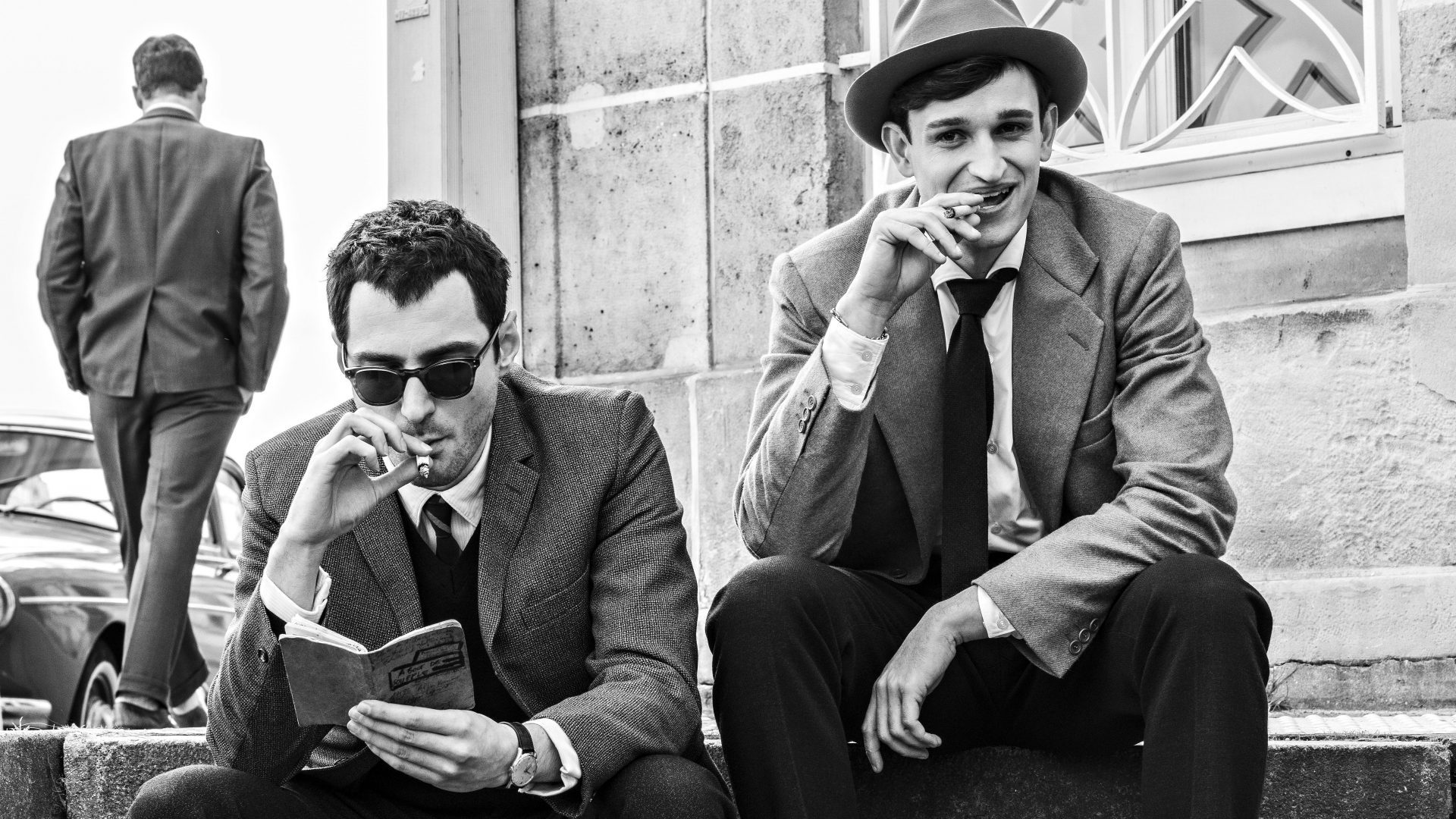
The French New Wave in cinema of the late 1950s and 1960s is too often discussed in reverential, purely cerebral language that short-changes its youthful exuberance, rebellious energy and sheer sense of fun. Only two months after the wonderful Blue Moon – for which Ethan Hawke has quite rightly received an Oscar nomination – Richard Linklater’s latest movie is, again, a love letter to a cultural milieu and an enchantment in its own right.
Paris, 1959: Jean-Luc Godard (Guillaume Marbeck) is frustrated that he has yet to direct his first feature, unlike his fellow critics at the film magazine Cahiers du Cinéma – François Truffaut (Adrien Rouyard), Jacques Rivette (Jonas Marmy), Claude Chabrol (Antoine Besson), and Éric Rohmer (Côme Thieulin). With money filched from the journal’s cash box, he heads for Cannes, where Truffaut’s The 400 Blows is hailed as a debut of greatness.
At the festival, Godard persuades the producer Georges de Beauregard (Bruno Dreyfürst) to back the movie that he and Truffaut have co-written – a true crime yarn that will become Breathless (1960), the most celebrated movie spawned by the movement. Not that anyone (other than perhaps Godard, behind his trademark shades) has the slightest notion that they are involved in the creation of a cultural legend.
At the gym, he recruits Jean-Paul Belmondo (Aubry Dullin) to play the Bogart-obsessed criminal Michel Poiccard but faces a tougher task in persuading the established American actress Jean Seberg (Zoey Deutch) to take the part of Patricia Franchini, the aspiring journalist who sells the New York Herald Tribune on the Champs Elysées.
The four-week shoot is a study in stop-go ingenuity that seems to some of his collaborators to be total chaos. At the café every morning, Godard writes lines for the day’s scenes before the crew can start work: he uses natural light and doesn’t bother with sound (which will be added in post-production). Irritated by continuity quibbles, he insists that “reality is not continuity!”
Indeed, Godard’s mercurial directing style is matched by a taste for aphorism: “Disappointments are temporary, film is forever”; “The best way to criticise a film is to make one”; “A filmmaker is either a plagiarist or a revolutionary”; “All you need for a movie is a girl and a gun”. As the masterpiece comes together – somehow – he is already mythologising himself as a model for all future auteurs.
There is plenty to be learned about the New Wave from, say, André Bazin’s two-volume What is Cinema? (1958-9) or Truffaut’s seminal 1954 essay, A Certain Tendency of French Cinema. But Linklater’s movie – shot stylishly in monochrome and academy aspect ratio – shows that cultural revolutions require human interaction, rebellious celebration and sheer mischief as much as aesthetic and intellectual brilliance.
He is himself the product of the indie wave of the Nineties, to which his breakout movie Slacker (1990) contributed so much. The subtext to Nouvelle Vague is that the next Godard will be a kid with no money, but a couple of iPhones, a gang of like-minded guerrilla filmmakers and a dream of the impossible.
Suggested Reading
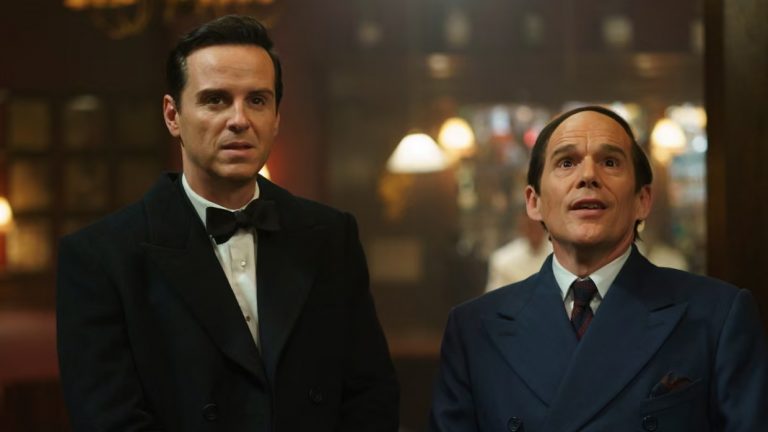

Richard Linklater’s Blue Moon is simply exquisite
THEATRE
Arcadia (The Old Vic, London, until March 21)
After the National Theatre premiere in 1993 of his mighty drama about time, science, sex and society, Tom Stoppard reflected that every playwright “wants [his work] to survive and be revived, to survive the writer’s death.” A little more than two months since he drew his last breath, Carrie Cracknell’s splendid revival, staged in the round, suggests how generously posterity will smile upon his work.
Set in a single room in Sidley Park, a fictional Derbyshire country house, the action shifts between the period 1809-12, as tutor-in-residence Septimus Hodge (Seamus Dillane) teaches the prodigiously bright Thomasina Coverly (Isis Hainsworth), and the present day, scene of a scholarly quest for historical answers that pits landscape and literary specialist Hannah Jarvis (Leila Farzad) against the bombastic and ambitious Sussex University don Bernard Nightingale (Prasanna Puwanarajah).
Nightingale believes that the records at Sidley Park may lead him to an academic scoop about the reasons for Lord Byron’s departure from England in July 1809. Though he never appears on stage, the great poet and libertine is at the heart of the drama and its meaning – the personification of the Romantic movement which has its modern counterpart in the “New Physics” that is dear to Valentine Coverly (Angus Cooper), a graduate student at Oxford.
Reading Thomasina’s notes from her classes with Septimus, Valentine grasps that she intuited, without mathematical proof, the notion of “iterative algorithms” (computational procedures that utilise loops) and the second law of thermodynamics, according to which heat flows spontaneously from hot to cold and the entropy of a system either increases or is stable. As she tells her teacher: “You cannot stir things apart.”
In this respect, Stoppard was much influenced by James Gleick’s book Chaos (1987) and the work of the quantum physicist Richard Feynman. But the undoubted erudition and philosophical ambition of Arcadia does not eclipse the play’s preoccupation with human foible, love and the majesty of art. Arcadia pulses with emotion and sexual yearning, forces that endlessly challenge the determinism of Newton’s universe. As Valentine’s sister Chloe (Holly Godliman) puts it: “the only thing going wrong is people fancying people who aren’t supposed to be in that part of the plan”.
In art and ideas, as in love, the search is the whole point – as Septimus explains to Thomasina when she laments the burning of the great library of Alexandria by Roman soldiers. “We shed as we pick up, like travellers who must carry everything in their arms,” he says, “and what we let fall will be picked up by those behind. The procession is very long and life is very short. We die on the march. But there is nothing outside the march so nothing can be lost to it.”
As I left the Old Vic, I recalled what a gracious and captivating guest Stoppard was at Spectator lunches, and how sad it is that he is gone. Yet as Hermione Lee writes in her definitive biography, Arcadia “will last as long as there are actors and theatres. The play was the answer to its own question: what will survive of us?”
FILM
Is This Thing On? (general release)
Wandering around New York’s West Village, high on a hash cookie and fretful after his recent separation from his wife Tess (Laura Dern), Alex Novak (Will Arnett) doesn’t have the $15 cover charge to get into the Olive Tree Café on Macdougal Street and so, on a whim, puts his name down instead for an open mic slot at the legendary Comedy Cellar downstairs. Predictably, he is pretty bad. Less predictably, he displays a scintilla of comic talent.
Loosely based on the story of British comedian John Bishop, Bradley Cooper’s third movie as a director is his most intimate yet and is full of pleasures. Dern and Arnett are superb as the couple who, after 26 years together, have run out of road. “I think we need to call it, right?” she says, brushing her teeth before bed. “I think so too,” he replies, no less calmly.
Apart, they recover aspects of their identity they thought were gone forever. Tess, a former Olympic volleyball player, returns to the sport as a coach. More haphazardly, Alex finds out that his capacity for wit is dormant rather than dead. What starts out as a coping mechanism – he riffs onstage about the failure of his marriage – becomes a fresh source of confidence and delight.
As an avid fan of stand-up, I enjoyed the long-take sequences at the cellar, featuring real-life comics such as Jordan Jensen, Chloe Radcliffe, Reggie Conquest, Sam Jay and Dave Attell, rather more than the familiar, if well-executed, marital narrative arc. Between spots, Alex is amiably roasted by his new friends – and realises that this an initiation ritual that might just transform his life. Ciarán Hinds and Christine Ebersole are great as his parents, and Cooper himself is very amusing as Alex’s stoner actor friend, Balls.
STREAMING
Steal (Prime Video)
The first episode of Sotiris Nikias’ thriller series is a pitch-perfect dramatisation of a hi-tech heist and its crackling menace. A gang of thieves, heavily armed and wearing prosthetics to fool facial recognition systems, storms Lochmill Capital, a fiduciary pensions fund in the City, and forces Zara Dunne (Sophie Turner) and Luke Selborn (Archie Madekwe) to make six trades, draining £4 billion into unknown accounts.
DCI Rhys Kovac (Jacob Fortune-Lloyd), assisted by DI Ellie Lloyd (Ellie James) and financial expert Darren Yoshida (Andrew Koji), is assigned to lead the investigation into what the news channels say is the biggest armed robbery in history. He is certain that the villains had an inside man. But who? And why is MI5 poking its nose into his case?
Turner is excellent as Zara who quickly turns amateur detective herself as the plot thickens and the twists multiply. Like Park Chan-wook’s new movie No Other Choice, this six-episode show makes time amid the action to explore the resentments and pathologies curdling within late capitalism.
Why are footsoldiers like Zara and Luke paid £30-40,000 a year, while members of the firm’s “investment committee” expect to take home £2 million? Enhanced by cameos from Anna Maxwell Martin and Peter Mullan, Steal is a superior suspense drama that deserves a second season.