PICK OF THE WEEK
Jay Kelly (Netflix)
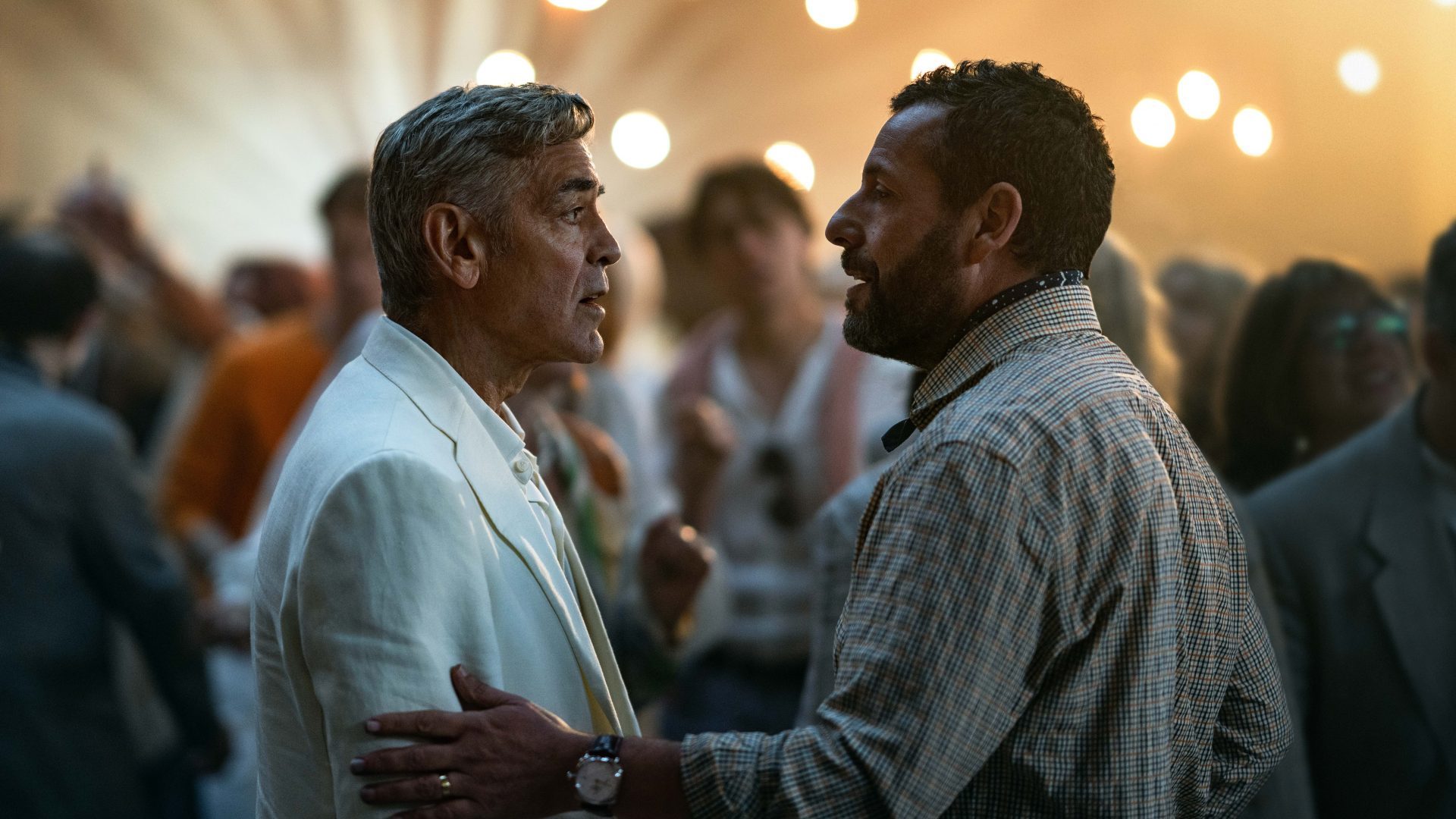
The title card of Noah Baumbach’s 13th feature is supplied by Sylvia Plath: “It’s a hell of a responsibility to be yourself. It’s much easier to be somebody else or nobody at all”. The eponymous movie star, played with panache by George Clooney, has spent a lifetime being somebody else. But has he really taken the poet’s second option – pursuing success at the price of his own humanity?
The premise is straightforward: after the death of the director to whom he owes his career, Peter Schneider (Jim Broadbent), and a confrontation with his former acting classmate Timothy (Billy Crudup), who thinks Jay stole his career, he heads off on a whim to accept an award in Tuscany and to spend time with his younger daughter Daisy (Grace Edwards) who is travelling around Europe.
The caprice of a movie legend, of course, has colossal logistic implications. A private jet is secured to carry actor and entourage – led by his manager Ron (Adam Sandler) and publicist Liz (Laura Dern) – across the Atlantic. They travel in what amounts to a motorcade. Everywhere Jay goes, there is a slice of cheesecake: long ago included in his rider, for reasons nobody can remember.
En route to the Tuscan ceremony, Jay looks back on vignettes from his life: how he took the movie part that Timothy believed he was destined to play; how he neglected his children; how he let opportunities for true love get away.
Especially painful are the scenes with his elder daughter Jessica (Riley Keough, tremendous) where he seeks a pat form of redemption that she is not prepared to provide. “Do you know how I knew you didn’t want to spend time with me?” she asks. “Because you didn’t spend time with me.”
As lush and seductive as Linus Sandgren’s cinematography undoubtedly is, Jay Kelly is not a sentimental movie. Baumbach leaves us in no doubt that, to adapt Graham Greene’s words, the star has a splinter of ice in his heart. When Schneider – based on Baumbach’s own mentor, the late Peter Bogdanovich – begs him to lend his name to a project that could restore his status and finances, Jay turns him down abruptly.
At the funeral, the director’s devastated son presents him with a neckerchief as a keepsake. As he walks away, he absent-mindedly hands the gift to his staff. In such moments of casual indifference is revealed a glacial ruthlessness lurking behind the dazzling smile.
What Baumbach delivers is not a love letter to Clooney or the long line of screen icons in which he undoubtedly stands, but to movies and what they represent. Jay Kelly is a true feast of cinematic reference: to Fellini’s 8½ (1963), Woody Allen’s Stardust Memories (1980) and Ingmar Bergman’s Wild Strawberries (1957).
A hilarious sequence on a train, in which Jay mixes with regular passengers and gets to play hero, pays homage to Preston Sturges’s Sullivan’s Travels (1941) – which, true cinemaniacs will spot, directly inspired the Coen brothers’ O Brother, Where Art Thou? (2000), starring none other than George Clooney. Jay’s memory of his young daughters putting on back-garden vaudeville skits riffs on a classic scene in Bob Fosse’s All That Jazz (1979). And so on.
Although the movie ends with fact and fiction blending – Jay watching a reel of clips from Clooney’s own movies – it is Sandler who steals the show in his best performance since the Safdie brothers’ Uncut Gems (2019). Unlike his client and friend, Ron really does try to balance his career with the family to whom he is devoted (Greta Gerwig is, as always, excellent as Ron’s wife, Lois, holding the fort in his absence).
The price he pays is etched into his sad features, as he oscillates between deep frustration with Jay and unbreakable affection for him. Clooney already has two Oscars. This should be Sandler’s year.
Suggested Reading

Richard Linklater’s Blue Moon is simply exquisite
PODCAST
The Bomb (BBC World Service/Sounds)
The third season of this consistently excellent podcast series – Kennedy and Khrushchev – is the best yet. Ingeniously, it is co-presented by Max Kennedy, nephew of John F Kennedy, and Nina Khrushcheva, the great-granddaughter of Nikita Khrushchev, each of whom brings a hefty share of dynastic folklore to the narrative.
Across ten episodes, the story takes us from Khrushchev’s first meeting with JFK (still a senator) in 1959, via the Bay of Pigs fiasco and the two leaders’ 1961 summit in Vienna, to the nail-biting drama of the Cuban Missile Crisis itself in October 1962. In Vienna, the 67-year-old Soviet leader remarked that JFK was, at 44, the same age his son Leonid would have been had he survived the war. Yet it was the US president, apparently youthful and vigorous, who was suffering from agonising disability, while his robust Russian opposite number remained in rude good health.
The experts interviewed in the series are world-class, including Serhii Plokhy, author of the definitive account of the crisis, Nuclear Folly (2021); JFK’s biographer Fredrik Logevall; and Sergey Radchenko author of To Run the World: The Kremlin’s Cold War Bid for Global Power (2024). Highly recommended.
FILM
Christy (general release)
In years to come, HBO’s magnificent teen drama series, Euphoria – season three is due in 2026 – will be remembered as a finishing school for superstars: Zendaya, Jacob Elordi and Sydney Sweeney.
In David Michôd’s boxing biopic, based on the life and career of Christy Salters Martin, Sweeney shows, as she did in Tina Satter’s Reality (2023) and Michael Pearce’s Echo Valley (2025), that, for all the noise about her glamour and politics, she is an actor of huge talent and serious range.
As a longtime student of MMA fighting, she was not as surprising a pick to play Martin as some have assumed. To inhabit the role, she gained two-and-a-half stone, wore brown contact lenses, and immersed herself in Martin’s origins in the West Virginia of the late 1980s (Don King promoted his first female fighter as “the Coalminer’s Daughter”). The punishing scenes in the ring gave her concussion.
But the true power of Sweeney’s performance is psychological rather than physical. Professional boxing is an escape for Christy (“I think I found my thing,” she says to her girlfriend). But it is also a trap, as she is increasingly subject to the coercive control and abuse of trainer-turned-husband Jim Martin (Ben Foster, physically unrecognisable as the paunchy monster).
Rightly fearing his capacity for violence, she echoes his homophobia in pre-fight trash talk and claims in interviews that she is just a regular housewife who happens to box for a living. Sweeney’s calibration of ferocity and vulnerability, of ambition and despair, is remarkable indeed.
From time to time, a single performance makes a by-the-numbers movie unmissable: Al Pacino in The Devil’s Advocate (1997); Michelle Williams in My Week with Marilyn (2011); Leonardo DiCaprio in J. Edgar (2011); Michael Fassbender in Steve Jobs (2015) and Natalie Portman in Jackie (2016). Courtesy of its formidable star, Christy must now be added to that eccentric list.
CHRISTMAS BOOKS
Here’s a quickfire festive round of titles that I haven’t reviewed in 2025 but would recommend as gifts:
Margaret Atwood’s long-awaited memoir, Book of Lives: A Memoir of Sorts (Chatto & Windus) is everything one could hope for. The 86-year-old Canadian novelist looks back on a prolific and hugely successful career with candour and abrasive wit. “I am a sulker and brooder,” she concedes, and not one to suffer fools even slightly (“One glance from my baleful eyes and strong men weep, clutching their groins, lest I freeze their gonads to stone”). From her love of nature via her unexpected position on #MeToo (which cost her many admirers) to her enthusiastic embrace of the acclaimed television adaptation of her 1985 masterpiece The Handmaid’s Tale, she relishes both her private life and the strange public persona of the famous writer: “I have dimmed and flickered, I have blazed and shot out sparks, I have acquired saintly haloes and infernal horns. Who would not wish to explore these funhouse mirrors?”
For a richly entertaining account of a cultural archetype, Peter K. Anderson’s The Dandy: A People’s History (Oxford University Press) is hard to beat. For anyone with an interest in philosophy and science, Graham Harman’s Waves and Stones (Allen Lane) is a mind-bending, intellectually astounding exploration of the nature of reality itself. For the cineaste in your life, Dominic and Justin Hardy’s Children of the Wicker Man (The History Press) is a wonderful addition to our knowledge of a classic movie.
Speaking of which: imagine Chinatown (1974) relocated from Los Angeles to Milwaukee and focused not upon water rights but dairy products, and you will be prepared for the noir majesty of Thomas Pynchon’s first novel in twelve years, Shadow Ticket (Jonathan Cape). It is 1932, and private investigator Hicks McTaggart is on the trail of Daphne Airmont, daughter of the “Al Capone of Cheese” (this is Wisconsin, remember). It is hard not to love a novel that features a “Dairy Metaphysics Symposium” in Sheboygan. But, as always with Pynchon, the satire is laced with menace, as the detective story becomes entangled with the rise of fascism.
David Szalay’s Flesh (Jonathan Cape), a worthy winner of the Booker Prize, has been widely and wildly mischaracterised as a literary outgrowth of the manosphere – which is a bit like saying Camus’ L’Étranger (1942) is all about men’s response to proto-feminism in the 1940s. In fact, Szalay’s flinty, economical prose matches the broader metaphysical investigation upon which he embarks in recounting, episodically, the tale of Hungarian-born István: namely, what makes us human and how far do we exist distinct from the bodies in which we shuffle through life? Finally: any new title by Olivia Laing is cause for celebration, and The Silver Book (Hamish Hamilton) is no exception. Set in the Italian film world of the 1970s, the novel’s core is the love story between real-life designer and art director Danilo Donati and the fictional Nicholas, spliced into the making of Fellini’s Casanova (1976) and Pasolini’s Salò (1977). Haunting, surreal and absolutely compelling.