
FILM
28 Years Later: The Bone Temple (general release)
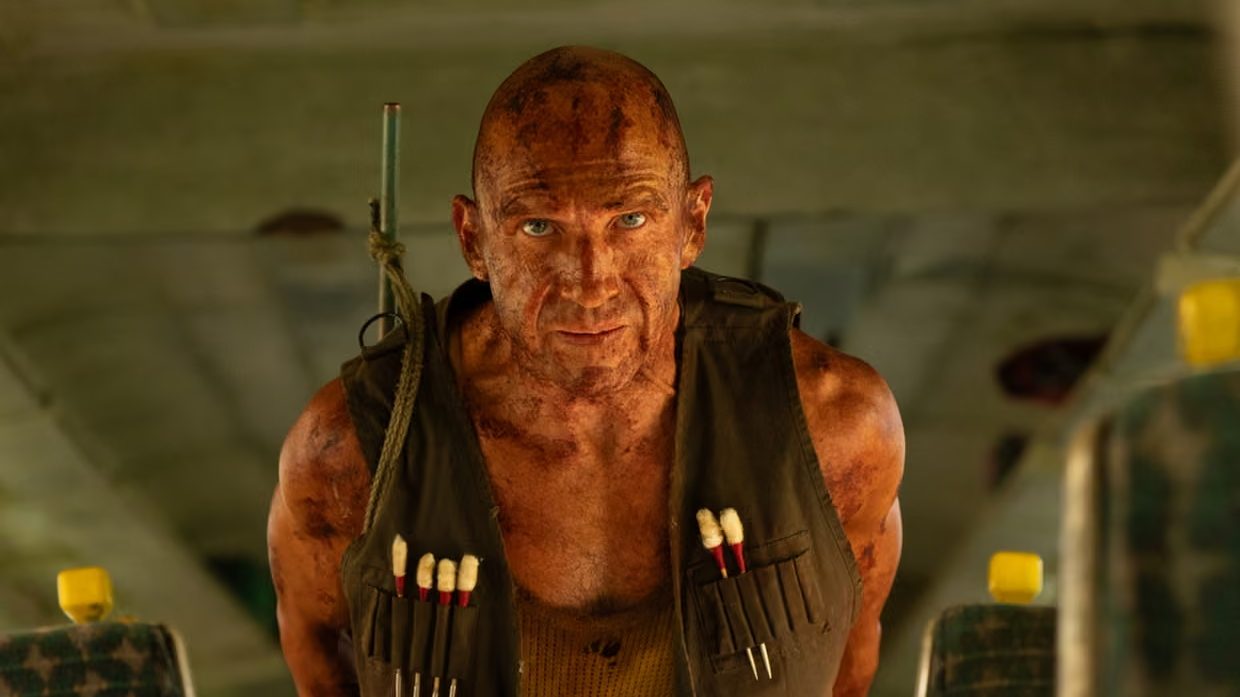
So, for starters: Ralph Fiennes as Dr Ian Kelson, slathered in orange iodine, dancing to Duran Duran’s Girls on Film in the towering necropolis he has built to honour the dead in the post-apocalyptic age of the “rage virus”. He gives Ordinary World and Rio a spin, too.
Next: Jack O’Connell at his murderous best as Sir Lord Jimmy Crystal, leader of a marauding gang that pays homage to Jimmy Savile; each of its members, or “fingers”, grotesquely decked out in lurid track suits, golden bling and platinum blond wigs.
In their bloody rituals, they say “Howzat?” rather than “Amen”. For good measure, Sir Lord Jimmy believes himself to be the son of Satan – or “Old Nick” – on a diabolically inspired mission to kill wherever he goes: what he describes as “charity”.
In last year’s third instalment of the franchise they launched in 2002, Danny Boyle and Alex Garland delivered a master-class in dystopian world-building that focused upon a colony of survivors on Lindisfarne, connected to the mainland only by a causeway. Garland returns as writer, while Boyle hands over the directorial reins to Nia DaCosta, who makes terrific use of the rich setting established in 28 Years Later.
Like Kelson and Sir Lord Jimmy, 12-year-old Spike (Alfie Williams) is back from the previous movie and – thanks to a violent turn of fate – finds himself inducted into the “Jimmys”. Meanwhile, the Durannie doctor (he even has a picture of Simon Le Bon in his hut) befriends a mutant Alpha, whom he names Samson (Chi Lewis-Parry). After they bond over strong opiates, Kelson starts to believe he might be able to cure the infected giant.
Owing more to J.G. Frazer’s The Golden Bough (1890) than to the conventional zombie genre, The Bone Temple is a no-holds-barred exploration of cults, superstition and what happens to humanity when reason collapses. As O’Connell bellows that “pride moves inside me like maggots in the corpse of Christ!”, he gives monstrous authenticity to the bespoke varieties of paganism that would follow catastrophe.
“The world had an order, a way about it” says Kelson, looking back to the Before Times. “The foundations seemed unshakeable”. In the quarter century since 28 Days Later was released, the foundations of our own world have become much more precarious. As if to make that very point, the movie ends on a cliff-hanger, with the welcome return of a familiar face.
STREAMING
The Rip (Netflix)
In the finest traditions of neo-noir, Joe Carnahan’s excellent crime thriller is set in a fallen world of corruption, disillusionment and greed – in this case, within the Miami Police Department.
After Captain Jackie Velez (Lina Esco), speeding towards an informant in trouble, is ambushed and gunned down, her team is squeezed by the Feds who suspect she was on the take. Detective Sergeant J.D. Byrne (Ben Affleck) – who was romantically involved with Velez – reacts badly to this suggestion, not least because it is made by his brother (Scott Adkins), an FBI agent. Lieutenant Dane Dumars (Matt Damon) confides in Byrne that he now hates “being a cop”.
All the same, the team chases a lead to a suspected drug cartel “stash house”, where they find Desi (Sasha Calle) – and $20 million in cash. What to do about a “rip” of this scale? Again, the rules of noir apply: the money hums with its own gravitational force field, disrupting the cops’ morality, camaraderie and professional code.
Why won’t Dane phone the discovery into the commander back at HQ? Why won’t he answer J.D.’s questions? Detective Mike Ro (Steven Yeun) doesn’t trust either of them. Detective Lolo Salazar (Catalina Sandino Moreno) is unimpressed by J.D.’s outrage at the idea that they should all take a dip: “Are you gonna pay child support for my girls?”
Much of The Rip amounts to a “bottle episode”, exploiting the claustrophobia of the house to compress and heighten the tensions within the team. Outside, the street is suspiciously empty – except for a streetlight which is blinking the word “PIGS” in Morse code. When all hell breaks loose – as it was always going to – the single-location format is dropped and we are plunged into a satisfying shoot ’em up chase finale, with a twist or two along the way.
Friends since elementary school, Damon and Affleck are the most dependable on-screen male duo since Robert Redford and Paul Newman. In Good Will Hunting (1997), Dogma (1999), Air (2023) and now this superior crime flick they have always made deft use of their telepathy and ability to finish one another’s sentences – a facility that works especially well in scenes of confrontation.
Their partnership as founders of the production company Artists Equity may also be consequential for the movie industry, and positively so: unusually, the two actor-producers were able to persuade Netflix to pay all 1,200 members of the crew a bonus if The Rip performs well for the streaming platform – as it certainly deserves to.
STREAMING
Hijack (Apple TV+)
“How can the same shit happen to the same guy twice?” The question posed by John McClane (Bruce Willis) in Die Hard 2 (1990) springs to mind as corporate negotiator Sam Nelson (Idris Elba), hero of the Kingdom Airlines skyjacking in season one, finds himself embroiled in another hostage-taking crisis – this time on the Berlin subway.
From the off, however, we sense that all is not as it seems. For a start, Sam is still struggling with the aftermath of the KA29 crisis and a personal tragedy – and is in the German capital in search of answers. When he runs into a former intern from his firm, Mei Tan (Jasmine Bayes), on the train, he is edgy and distracted. “I saw the piece in the FT,” she says. “You’ve been through a lot. Hey, I get it. I’d be a mess.”
He is, and he’s barely listening. Worried about his estranged wife Marsha (Christine Adams) who has retreated to a remote Scottish bothy, he has an appointment with a German official. But – as it turns out – there’s another hi-jack to handle.
The first episode ends with such a huge reveal that it is hard to elaborate too much further upon the plot. Suffice it to say that Toby Jones, as British intelligence agent Peter Faber, turns up at the U-Bahn control centre – now a situation room – to lend a hand and, if he can, to help Sam. Marsha’s partner, DI Daniel O’Farrel (Max Beesley), heads off to question one of the Cheapside Firm crime syndicate behind the Kingdom Airlines hi-jack – now on remand – to find out how the two plots are connected.
As the train driver Otto Weber (Christian Näthe) tries desperately to maintain some sort of composure, the passengers in the carriages behind squabble and test one another. Is one of them a spy working on the hi-jackers’ behalf? Where do the concentric circles of villainy and subterfuge lead? The writing is taut and often witty, a cut above the template dialogue normally granted to secondary characters in thrillers.
The recently knighted Elba is as good as ever, unafraid to play an action hero who is also a mess of vulnerabilities and psychological scar tissue. Hijack is certainly worthy of a third season – if showrunner Jim Field Smith can dream up yet another emergency, siege or heist for Sam to walk into. In the meantime, there is another Luther movie from Netflix to look forward to, with Elba, Ruth Wilson and Dermot Crowley all returning.
BOOK
Attensity! A Manifesto of the Attention Liberation Movement – The Friends of Attention (Particular Books, January 20)
Explicitly inspired by the founding text of modern environmentalism, written by Rachel Carson and published in 1962, the authors of this remarkable book hope that it “becomes a kind of Silent Spring for our era – a document that can galvanize real change in an area of existential urgency”. Their mission is nothing less than to reclaim human attention from “fracking” by the digital-industrial complex “that extracts money from a billion vegetative humans suspended in an infinite web, eyes glazed.”
Though about 30 “attention activists” associated with the Strother School of Radical Attention, founded in 2023 in Brooklyn, collaborated in the writing of this book, the three front-of-house figures are D. Graham Burnett, Alyssa Loh, and Peter Schmidt. What distinguishes their work from the standard diatribes about the “attention economy” and its ill effects, is that they comprehensively reframe the question they address.
During the 20th century, they argue, our understanding of “attention” was narrowed down to “that which can be quantified, bought, and sold”; to the metrics and prices that can be extracted from the “stimulus-and-response kind of attention”. As a consequence, “[t]he latest global land-grab is a scramble to drive freehold stakes into the very stuff of our consciousness” and smartphones are “the satanic mills in our pockets”.
Their definition of “attention”, in sharp contrast, is much more expansive; embracing care, curiosity, play, love and freedom. They are not anti-tech, but anti-exploitation, seeking instead to reclaim “our attentional commons”.
How? Drawing upon the lessons of Quakerism and of past campaigns for women’s suffrage, for civil rights, and against Big Tobacco and Big Oil, the book proposes a strategy of study, coalition-building, the creation of “sanctuaries” (“spaces where people can gather, care for each other, experiment with different kinds of attention, and conceive brighter futures”), and a crusading sense of solidarity nurtured by the recognition that we are “being bio-hacked at a societal scale”.Couched in the bracing petitionary language of Sixties counterculture and peaceful guerrilla activism, Attensity! is genuinely original and refreshingly unexpected. It will make you see the world differently.