In the editing suite of Florentine Films in New Hampshire, where the film-maker Ken Burns makes his extraordinary documentaries, there is a neon sign that says: “It’s complicated”. For a cinematic historian, that is always a sound philosophy – but especially so in these pulverising, polarised times.
At a day of events hosted by the Eccles Institute at the British Library to celebrate his new series, The American Revolution, Burns tells me that he and his co-directors, Sarah Botstein and David Schmidt, positively sought out the pluralities, ambiguities and complexities of the colonies’ rebellion against George III and their transformation into a constitutional republic.
“The main skeleton is the military progress,” he says, “and, around it, are adorned all of these complex social dynamics. I want to try to tell them, free of the fashions of historiography that often bog us down, or limit us to one particular point of view, or one particular template of interpretation.”
This mandated a triple wariness. First, the great documentarian had to deal with a traditional narrative that is “encrusted with the barnacles of sentimentality, nostalgia”: the received idea of the Declaration of Independence on July 4, 1776 as a frictionless, sanitised moment of collective enlightenment and political virtue.
Second, he did not want to minimise the significance of an achievement that, for all its flaws, cost and incompleteness, remains, in his view, “the most important event in world history since the birth of Christ”.
Third, Burns and his team, who started work on the project a decade ago when Barack Obama was still president, had to avoid the siren song of contemporary events and commentary.
“You have to realise that these rhymes of history are going be constantly changing,” he says. “And so we tie ourselves to the mast, like Odysseus, and listen, and don’t let any of those moments affect us.” To give a sense of what “those moments” have entailed: last year Donald Trump ended all federal funding of PBS, Burns’s longtime collaborator, “much under assault” as he now reflects.
I have seen all 12 hours of the series – due to be aired by the BBC in June – and it is Burns at his phenomenal best; as good as The Civil War (1990), The War (2007) – his award-winning account of the second world war – and Vietnam (2017). The story, from the initial surge in the colonies of opposition to George Grenville’s Stamp Act of March 1765 to parliament’s declaration of the war’s end in February 1782, is intrinsically fascinating; but much enriched by the depth, breadth and nuance with which Burns tells it.
At all times, he says, “the objective was to inoculate us from the fear of complication, which is, of course, one of the tendencies right now.” For a start, what is often recounted as a straightforward battle between American rebels and British authority is shown to have been – in addition – a horribly violent civil war and a global conflict.
In many cases, the battle divided families. As the British Sergeant Roger Lamb recorded seeing during the ceasefire at Saratoga in October 1777: “a soldier in the 9th regiment, named Maguire, came down to the bank of the river, with a number of his companions, who engaged in conversation with a party of Americans on the opposite shore. In a short time something was observed very forcibly to strike the mind of Maguire… the loud cries of ‘my brother! My dear brother’ which accompanied the transaction, soon cleared up the mystery, to the astonished spectators.”
Suggested Reading

How to build a world after America
What tore siblings apart also reconfigured the geopolitical map. The war was fought on an imperial chessboard of four continents and seven seas. As Pulitzer Prize-winning biographer Stacy Schiff points out in the series, the American patriot cause would probably have failed had it not been bankrolled by the French to the tune of $25-30bn in today’s money.
In 1799, Spain joined France in the war against England. The German states and parts of the Iroquois confederacy that supported the Loyalist cause could not, in the end, muster sufficient force to quell the rebellion.
In his relentless quest for documentary honesty, Burns does not shield our gaze from the crooked timber of humanity out of which the American republic was carved. Among the historians who appear frequently in the series is another Pulitzer-Prize winner, Rick Atkinson, who is working on the final volume of his magisterial trilogy on the revolution. As he puts it: “I think most Americans are much more willing to accede to the notion that George Washington was imperfect, that he had, during his lifetime in Mount Vernon, at least 577 slaves. He’s still the indispensable man. He’s still a man of great attributes and skills… But he’s flawed. [Thomas] Jefferson had even more slaves. He’s flawed.”
Parallel to this is the need to liberate specific social groups from what EP Thompson called “the enormous condescension of posterity”. Native Americans and the enslaved are central to the story. As professor Stephen Conway, author of A Short History of the American Revolutionary War (2013), says: “Even as the revolution moves to this more universalist idea, the rights of all men, there’s a paradox all the way, isn’t there? That the South comes into the war mainly to defend the institution of slavery, from the threat posed to it by the British”.
In the final episode, the Black entrepreneur and abolitionist, James Forten (1766-1842), voiced by Morgan Freeman, expresses succinctly the revolution’s core hypocrisy. “Our country asserts for itself the glory of being the freest upon the surface of the globe… but one dark spot still dimmed its lustre. Domestic slavery existed among a people who had themselves disdained to submit to a master.”
Women, who were crucial from the germinal moments of the revolution in mobilising boycotts of British goods, are prominent throughout the series. The poet Phillis Wheatley (c.1753-84), voiced by Amanda Gorman, is hailed as the first African American to be published, while the organiser and writer Mercy Otis Warren (1728-1814), voiced by Meryl Streep, often described as the “Conscience of the Revolution”, is honoured as a key supporter of the Boston Tea Party of 1773 and a consequential activist.
Yet it is possible both to recognise that the founding fathers had feet of clay and often acted abhorrently by contemporary standards, and to acknowledge their exceptional ambition and foresight. You do not have to endorse the “Great Man” theory of history popularised by Thomas Carlyle to accept that the revolution involved a remarkable convergence of genius and intellectual idealism.
It mattered, for instance, that Patrick Henry (1736-99) of Virginia was, in Jefferson’s view, “the greatest orator that ever lived”; that when he declared, at the Second Virginia Convention (1775), “Give me liberty or give me death!”, the earth shook.
In Common Sense (1776) – according to Burns the “most important pamphlet in American history” – the English-born Thomas Paine (1737-1809) reframed the struggle as a battle against hereditary tyranny and a new chapter in the history of humanity: “We have it in our power to begin the world over again… The birthday of a new world is at hand.”
And, even as they pondered the separation of powers, the relationship between states and nation, and the transition from subjecthood to citizenship, the framers were uncannily aware of what perils might lie ahead.
“When a man unprincipled in private life desperate in his fortune, bold in his temper, possessed of considerable talents… is seen to mount the hobby horse of popularity,” warned Alexander Hamilton (1755/7-1804) in 1792, “It may justly be suspected that his object is to throw things into confusion that he may ‘ride the storm and direct the whirlwind’.” How uncomfortably resonant those words seem this week.
At an evening preview of the series, Burns warms to the theme: “Jefferson, who’s stuck in Paris as an envoy, writes to [James] Madison, who’s writing the code, the very complicated ones and zeros of the document – with the exception of the first sentence of the constitution, which is poetry – and says: what if someone should lose an election, but pretend false votes?”
That letter was written in 1787. Now, 239 years later, as Trump threatens to “nationalise” elections, Steve Bannon calls for ICE agents to “surround the polls come November”, and the FBI seizes ballots from the 2020 presidential contest in Fulton County, Georgia, Jefferson’s speculation is more justified than ever.
Suggested Reading
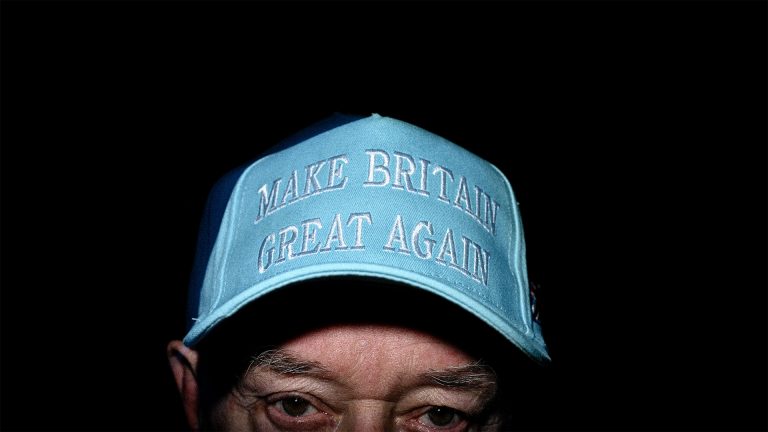

Keeping Trumpism out of Britain
For Jeffrey Goldberg, editor-in-chief of The Atlantic, which is in partnership with Burns and his team as they tour the series, there is a striking contrast between this anniversary and 1976. “It was really just about tall ships and fireworks and hot dogs,” he tells me, “and everybody was like: ‘The constitution’s great. This is good. Everything’s going fine’. This is a more interesting anniversary… The question that I ask all the time is, are we experiencing a midlife crisis, a nervous breakdown, or terminal illness?”
Having disciplined himself to block out the clamour of current events while filming the series, Burns has launched it into a world where its contemporary traction is as powerful as its historical authenticity. He and his co-directors have travelled to 40 cities, spoken at inner-city schools, universities and libraries. He has also appeared on the huge podcasts that played such a role in the 2024 presidential election: notably The Joe Rogan Experience and Theo Von’s This Past Weekend.
To watch The American Revolution is to witness the origin story of a nation that is now experiencing convulsion after convulsion; the precise nature of which, as Goldberg says, has yet to be definitively diagnosed. And will the antibodies of the constitution prevail? “These were vaccinations against tyrannical monarchy,” he says. “And so we’re now literally experimenting: let’s see how good these vaccines are. That’s what this whole period is.”
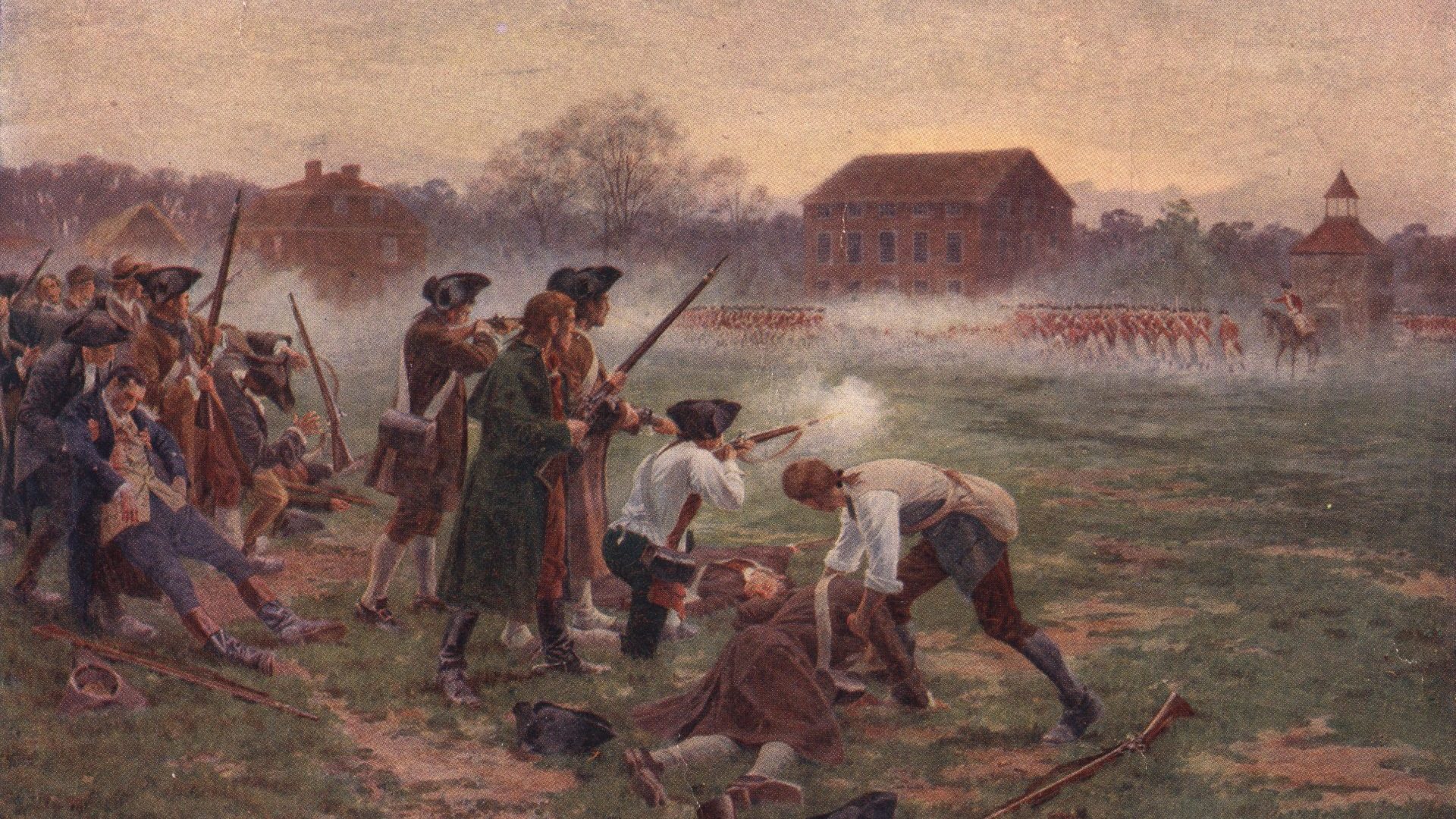
The story itself is not linear. It was very far from certain when what Ralph Waldo Emerson later called “the shot heard around the world” was fired at Old North Bridge on April 19, 1775 that the British would be defeated at Yorktown in October 1781 and that the founders would nurture what went on to become the most powerful nation in history.
As the author Joseph Ellis says in the series, Washington was not a world-class field commander – but he was preternaturally resilient: “At some point, he reaches the insight – and it’s a very basic insight – he doesn’t have to win. The British have to win. He only has not to lose.”
Instead, Washington went on to become the first president, warning his fellow citizens when he left office after two terms not to become entangled in the foreign conflicts that he believed to be injurious to the health of the republic. One can imagine what the first president would have made of the latest capricious operation launched in the Middle East by the 45th and 47th holder of the office.
In Goldberg’s words, the MAGA movement that has now regained control of the executive has “a very brittle understanding of history”, directing the National Park Service to remove any signage or material that draws attention to slavery. This, he says, “betrays a lack of self-confidence” – though he does not underestimate the challenge of defending what he calls the “complicated centre” in a social media era that “privileges extremism”.
It is striking that Burns, Botstein and Goldberg all zero in on Congress – the subject of the constitution’s first article – as the dormant force in the mix right now. “There’s a very unnatural thing that’s happening in Washington in the last years,” says Goldberg, “which is that members of Congress, who are granted immense Article One powers, just don’t use them because they don’t want to be attacked by Donald Trump on Twitter.”
The series concludes with the words of Benjamin Rush (1746-1813), the only physician to sign the Declaration of Independence, in 1787, voiced by Edward Norton: “nothing but the first act of the great drama is closed. It remains yet to establish and perfect our new forms of government; and to prepare the principles, morals, and manners of our citizens, for these forms of government… The revolution is not over.”
Is it over now? Will the founders’ implicit instruction to future generations be heeded? The inconvenient truth is that more than 77 million Americans wanted a convicted felon, twice impeached, with openly autocratic aspirations back as their president. Whatever this moment is, it is not the constitutional equivalent of summer flu.
Yet Burns, now aged 72, with more than 40 documentaries to his name, insists upon a guarded spirit of hope, a belief in the “active, muscular, democratic spirit”, the power of art, conversation and literature. With almost ascetic zeal, he observes the duty never “to put our thumb on a contemporary scale and make some judgement about the current moment.”
And therein, I think, lies his greatness as a historian, film-maker and magus of the public covenant: “We trust the evidence of the past to be the greatest teacher that we have. Good, bad, and indifferent.”