It is 12.02pm on January 20, and the temperature in Washington DC is -2ºC – though, with wind chill, it feels even colder on the west front of the US Capitol. The breath of the honoured guests on the reviewing platform fogs in the icy air, as the president-elect and the new first lady step up to the lectern.
As he puts his left hand on a family Bible, chief justice John Roberts invites him to take the oath of office: “Please raise your right hand and repeat after me: I, Tucker Swanson McNear Carlson, do solemnly swear…”
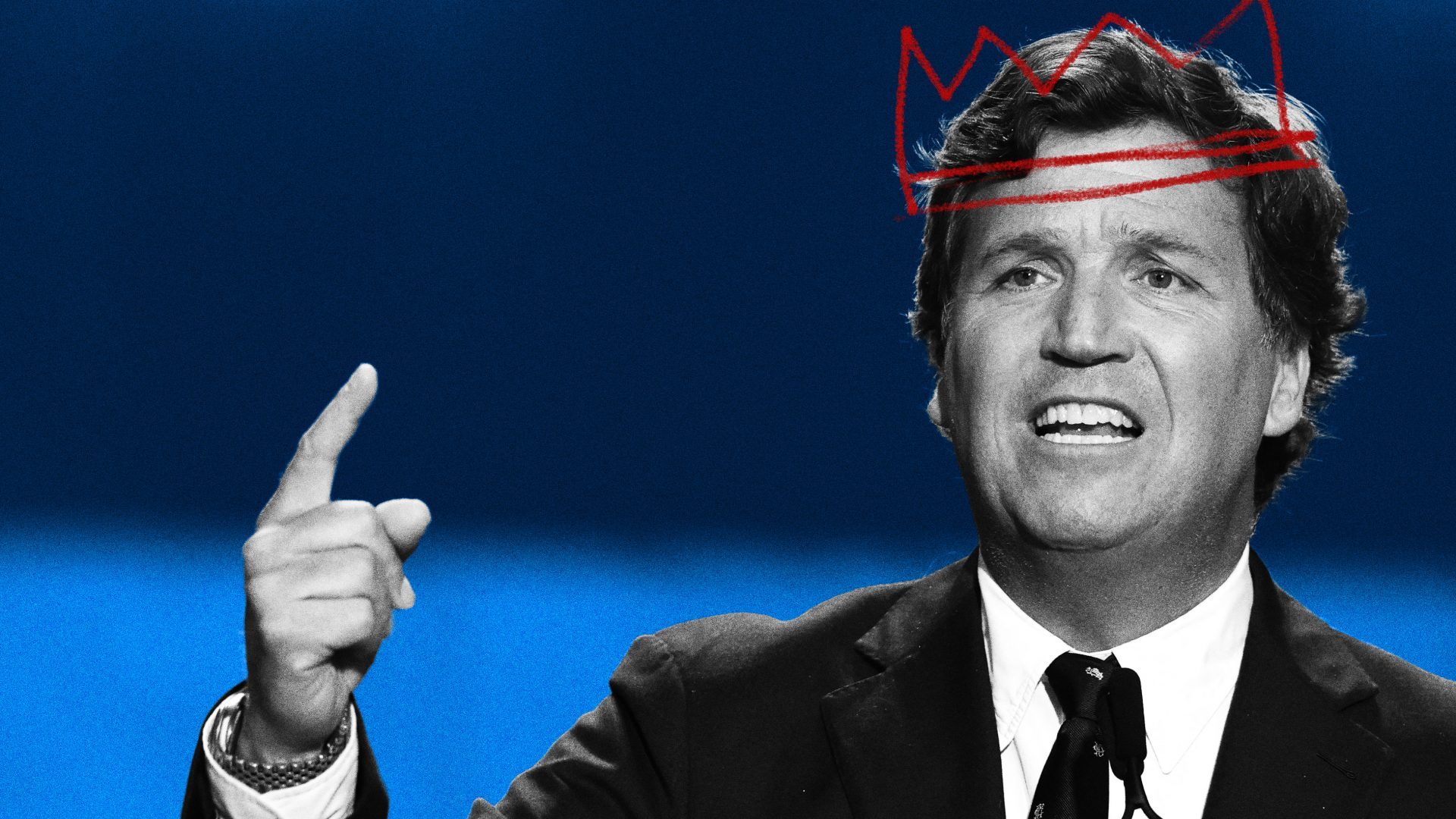
Far-fetched? Maybe. But, after reading Jason Zengerle’s fine new book, Hated by All the Right People: Tucker Carlson and the Unravelling of the Conservative Mind (Scribe), I am more certain than ever that the star podcaster and former Fox News host has ambitions far beyond his present media celebrity.
The strength of Zengerle’s exhaustively researched character study is that it is more accurately categorised as a “life and times” than a conventional biography. In his remarkable evolution from print journalist to leading light of the MAGA movement – from a clubbable member of the Beltway tribe to a conspiracy theorist and amplifier of neo-Nazis, white supremacists and Holocaust revisionists – the 56-year-old Carlson personifies the pulverising changes that have transformed US media and politics in the past 30 years.
As a youthful recruit to The Weekly Standard – a neo-conservative magazine edited by William Kristol and owned by Rupert Murdoch – Carlson was a disciple of the “New Journalism”; his idols were Hunter S Thompson, George Plimpton and PJ O’Rourke. He lunched a lot, loved his cross-party tribe of friends, and, with his trademark bow tie, cultivated the image of a libertarian rascal.
Yet his cocktail party persona and trademark manic laugh concealed a deep capacity for resentment. Though he inherited his conservative politics from his father, Dick, who ran Voice of America for Ronald Reagan and was George H W Bush’s ambassador to the Seychelles, the formative experience of his life was the departure of his mother Lisa McNear Lombardi when he was six.
After a brief attempt to share parental responsibility, Dick was granted full custody of Tucker and his younger brother Buckley (named after William F Buckley Jr). They never saw their mother again, and after her death in 2011, were awarded $1 each in her will. Though Carlson is famously uxorious, having married his high school sweetheart Susie Andrews in 1991, his proud sexism is thought by many to have deep roots in childhood trauma.
Kristol is next up in his pantheon of treachery, blamed for encouraging him to support the war on terror in his writing and early broadcasting. In June 2004, he told the Washington Post: “I am embarrassed that I supported the war in Iraq”. Having scorned Pat Buchanan, the “America First” opponent of foreign entanglements, as an antisemite and paleo-conservative, Carlson began to think that he had been backing the wrong team and to despise the instincts of the Washington hawks, who were supposedly doing Israel’s bidding at the cost of US blood and treasure.
This talent for grudge-holding was matched by resilience and a consummate ability to adapt. To be feted as a writer of wit and insight was one thing. To have the fame of a personality on cable news – as that medium began to dominate political discourse – was something else entirely.
Hired as a regular on CNN on a retainer that was more than double his Weekly Standard salary, he was promoted to the role of host in 2000 and then, at the age of 32, became one of the stars of the flagship debating show Crossfire.
But that taste of glory was not to last long. After a legendary appearance by Jon Stewart in October 2004, in which the Daily Show presenter accused Carlson and his Democratic counterpart Paul Begala of “hurting America”, the show was cancelled and he moved on to MSNBC.
When that didn’t work out, he was reduced to a much less prominent role on Fox News, acting as a political analyst when so invited, but more often playing the jester on the weekend edition of Fox & Friends; careering around the set in a go-kart, cooking with Billy Ray Cyrus, playing the cowbell with Blue Öyster Cult.
As Zengerle writes: “To his friends and admirers, his was a sad and cautionary tale – of a smart and talented journalist who’d been seduced and ultimately ruined by TV.” True, he needed to support his growing family. But – in common with Donald Trump – he also intuited that entertainment and news were converging.
Just as the future president was happy to take part in comedy roasts and WWE bouts, so Carlson grasped that the era of solemn expertise and élite credentialism was drawing to a close and that authenticity – being yourself, being a good sport – lay at the heart of the quest for power in the 21st century.
In 2006, he was a contestant on ABC’s Dancing with the Stars – and was knocked out in the first round. His ambitions as a gameshow host were scuppered when his pilot for a quiz called Do You Trust Me? was rejected by CBS. “I want to have an interesting life,” he told friends. “That’s my goal.”
There was one last itch to scratch before he went all in with the new political culture that would go on to spawn Trump’s presidencies, MAGA and his own phenomenal rise as a right-wing influencer. At the Conservative Political Action Conference in Washington in February 2009, as Republicans reeled from Barack Obama’s election as president, Carlson delivered a speech that made the audience heckle, in which he declared that right wing media needed to match the accuracy and seriousness of the New York Times.
To that end, he and his college friend Neil Patel founded The Daily Caller, a digital platform intended to be a conservative counterpart to The Huffington Post. Having raised $3 million and hired a bench of talented reporters, they launched the website in January 2010.
Curiosity and Carlson’s media celebrity ensured an early surge in traffic. But, to his dismay, interest in the Caller waned rapidly. Of necessity, he became fascinated by digital analytics and soon grasped the essentials of the attention economy.
Clicks were not driven by facts but by emotion; by fury rather than democratic virtue. As Zengerle notes, the stories that popped were those that “in addition to appealing to conservatives, actively antagonized liberals”. Being loathed was, in effect, more rewarding than being right. As Carlson would later say to Hungarian prime minister, Viktor Orbán: “You’re truly hated by all the right people.”
In this context, he could only look on with envy as Steve Bannon, later Trump’s chief strategist in the White House, turned Breitbart News into a populist-nationalist engine of the new “alt Right”. All that mattered to Bannon was the site’s ferocious purpose and message; journalistic polish and accuracy were optional extras.
Yet the comparative disappointment of the Caller was eclipsed by Carlson’s increasing ascendancy at Fox News. Five days before the 2016 election, the network announced its new 7pm show, Tucker Carlson Tonight.
After some musical chairs following Megyn Kelly’s departure to NBC News and Bill O’Reilly’s disgrace over allegations of sexual harassment, Carlson landed the coveted 8pm slot. It was to become the channel’s most influential show; by July 2020, the highest-rated programme in US cable network history with an average audience of 4.33 million.
In this incarnation, Carlson chose to surf the Trump wave rather than to be part of it. From the start, he sought to influence the candidate, not simply to support him. The day after the Fox host broadcast a segment on the influx of Muslim refugees to Sweden and the allegation that the government had covered up a surge of crime by migrants – “The masochism of the West really knows no bounds” – Trump, to general bafflement, raised the issue at a campaign rally in Florida.
Suggested Reading
Meet Tucker Carlson. The most dangerous journalist in the world
As Zengerle puts it, “Carlson realized that the words – and, ultimately, the deeds – of the president could be manipulated through the television itself.” Jared Kushner, the president’s son-in-law and adviser, put it bluntly: “You can’t work in this White House and not watch Tucker Carlson.”
To this day, the circumstances of his sacking by Fox in April 2023 remain unclear. He himself believes that his scalp was part of Murdoch’s $787 million settlement with Dominion Voting Systems over the channel’s shameful showcasing of Trump’s “stolen election” narrative. It probably didn’t help that Ann Lesley Smith, briefly Murdoch’s fiancée, had told him that she believed that Carlson was “a messenger from God”. Whatever the causa causans, he was out – and free.
Twenty years before, “freedom” had been a euphemism in the media world for reputational death. But Carlson again grasped that power was shifting fast, this time from the old cable news world to the digital ecosphere, or what would soon be nicknamed “Podcastistan”. Starting on X, he relaunched himself as a podcast host and roving speaker, on a mission to define US conservatism in the 2020s and beyond.
In December 2023, he and Patel founded The Tucker Carlson Network – and it is at this stage of the story that the sheer scale of his ambitions became clear. Knowing that Trump would never listen to a long-format podcast, he now sought to influence him directly: by text, phone and in person.
He had already trolled Fox, by posting on X a prerecorded interview with Trump at the precise time that the first Republican primary debate, hosted by his old network, was broadcast from Milwaukee. The most conspicuous feature of the event was Trump’s glaring absence. Guess who had the scoop?
They kept coming – notably his softball interview with Vladimir Putin in February 2024; the Russian president’s first with a western journalist since the invasion of Ukraine. He hosted the Holocaust revisionist Darryl Cooper, who called Winston Churchill “the chief villain of the second world Wlwar”, and hailed him (ludicrously) as “the best and most honest popular historian in the United States.”
Last October, most notoriously, he posted a two-hour conversation with the 27-year-old Nick Fuentes, a neo-Nazi, Holocaust denier and unabashed racist who thinks Hitler was “really fucking cool”. The interview, in which Fuentes was barely challenged, has racked up more than 22 million views.
It also triggered civil war in the ranks of the MAGA movement as Ben Shapiro of the Daily Wire attacked Carlson for the “ideological laundering” of extremism and putting “the conservative movement in serious danger”. Carlson dismissed this call for boundaries as a “Red Guard Cultural Revolution thing”.
He also claimed that the row over Fuentes was a proxy for the battle to define MAGA after Trump. “There are people who are mad at JD Vance,” he said at the Turning Point USA convention in Phoenix in December, “and they’re stirring up a lot of this in order to make sure he doesn’t get the [presidential] nomination.”
As things stand, the vice-president is Carlson’s candidate for 2028 (assuming Trump does not tear up the constitution and try to stick around). Along with Donald Trump Jr, he was instrumental in securing Vance’s slot on the 2024 ballot paper, steering Donald Sr away from Marco Rubio and Doug Burgum (he claimed to Trump that if he picked either of them, the intelligence agencies would try to assassinate him). His son Buckley is now a member of the VP’s staff.
Yet it is far from certain that Vance has what it takes to win. What if he runs but looks like being beaten to the GOP nomination? What if he secures the nomination but loses? What about 2032?
As Zengerle says, Carlson’s ambitions are no longer confined to his ranking in the Apple and Spotify podcast charts. When asked about his possible presidential aspirations, his non-denial denials are reminiscent of Boris Johnson’s shifty replies when asked if he wanted to become prime minister. “Yeah, I don’t think I’d be very good at it,” he told conservative media personality Patrick Bet-David in May 2024. “But I would do whatever I could to help.” I’ll bet he would.
According to the conventional rules of politics, Carlson is way too far to the right to build a winning electoral coalition. As much of America recoiled last week from the execution of two civilians by ICE agents in Minneapolis, he instead accused state and city officials of conspiring in “an organized attempt” to promote an insurrection. “Chaos,” he said, “is the realm of Satan.”
Carlson’s fierce Christian nationalism is now the absolute foundation of his politics, informing everything from his explanation for UFOs (“they’ve been here forever; they’re spiritual; angels and demons”) via his hatred of identity politics (which, he says, contravenes Christian individualism) to his loathing of Israel (“the Christian Zionists”, he said to Fuentes, “I dislike them more than anybody… because it’s Christian heresy.”)
He has also embraced a range of conspiracy theories. At Fox, his three-part pseudo-documentary, Patriot Purge reframed the January 6 insurrection as a “false flag” operation, partly instigated by federal agents in the crowd.
In September, his own network released a five-part series, The 9/11 Files, that alleged Israeli foreknowledge of the attacks, a level of CIA complicity and a massive cover-up. He is dismissive of Darwinism. “We’ve kind of given up on the idea of evolution,” he told Joe Rogan in April 2024. “God created people, distinctly.”
To complete the set, he is also a powerful champion of the Great Replacement Theory: the poisonous claim that “globalist” elites, implicitly at the behest of Jews, are systematically increasing the number of non-white immigrants to the US to disempower white Americans at the ballot box. He routinely refers to the “legacy Americans” allegedly threatened by this demographic disruption.
Suggested Reading
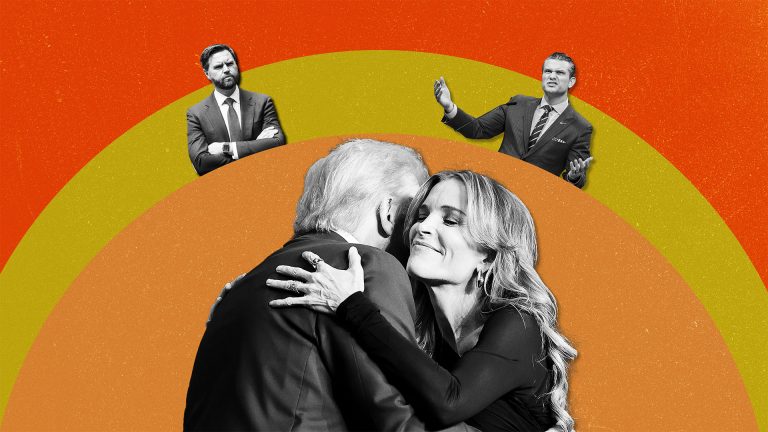
Could Megyn Kelly become president?
Nobody who promotes stuff like that could ever be president – right? Well, not according to the old political orthodoxy. But it is wise to remember how often political orthodoxy was prayed in aid between Trump’s descent of the golden escalator in June 2015 and his first presidential victory in November 2016. After January 6, it was routinely insisted that he was politically finished and would die in jail. How are those assurances working out today?
Like Trump, Carlson knows that, in hypermodern politics, emotional resonance and dramatic energy count for as much as policy and planning. He has been an impressive debater since his schooldays. He wraps bigotry in amiability, supporting autocracy with a smile in his lumberjack flannel shirt.
According to a study published last June by the National Academy of Sciences, more than 78 per cent of Americans believe in at least one conspiratorial idea. As the digital revolution has melted the partition between mainstream and fringe, so the attention economy is all about escalation and finding the new political or cultural high. As he told one colleague when he was running the Daily Caller: “There is no line. The line is fake… They impose the line to put you in place. The sooner you stop believing in the line, the better off you’ll be.”
With his arms folded and his brow furrowed, Carlson now repeats in the mid-mannered tones of the concerned citizen precisely what Alex Jones has long bellowed to camera on his demented Infowars channel. As Zengerle notes, he possesses “a certain trustworthiness, even gravitas, making him much more persuasive – and dangerous.”
It is a mistake, too, to think that the electoral coalitions of the future will be underpinned by splitting the difference and technocratic compromise. As Quentin Crisp said, charisma is “the ability to influence without logic”; and the two most compelling officeholders in the US by far -Trump and Zohran Mamdani – are, in different ways, powerhouses of charisma. So is Carlson.
What sort of platform might he run on? You do not have to look far to see the broad character of the offer he could make. First, his virulent opposition to Israel is to many an antisemitic dog-whistle but to others the mark of a man who, when he says “America First”, really means it. In his podcast on Friday with Cenk Uygur, the left wing host of The Young Turks, he denounced Israelis urging American politicians to intervene in the Middle East: “That’s your battle. Why don’t you keep it in the Levant?”
This is a position that draws support from right and left alike (Uygur talked in mafia language of the “heads of the families getting together”). So too does the economic populism that Carlson so strongly supports.
When he is not talking to opponents of immigration on his show, he is bemoaning the corporations that have driven up veterinary bills. He frequently attacks the worst aspects of consumer capitalism and the rigging of the system against ordinary Americans. He has praised Mamdani’s focus upon the cost of living and Democratic senator Elizabeth Warren’s “economic patriotism”. He taps into the “wellness” culture and hostility to Big Pharma mined by his friend Robert F Kennedy.
Above all – and to an underreported extent – he has placed a bet on automation and artificial intelligence becoming a huge issue in the years ahead. As long ago as 2018, Carlson told Shapiro (they were still talking back then) that “if I were president [I] would… say to DOT – the Department of Transportation: ‘We’re not letting driverless trucks on the road, period.’ Why? Really simple. Driving for a living is the single most common job for high-school-educated men in this country – in all 50 states. By the way, that’s the same group whose wages have gone down by 11 percent over the past 30 years.”
More recently, he has denounced the supine acceptance of AI and argued that its conquest of the job market, culture and everything else is a choice rather than an inevitability. “Is it good for people or not?” he says. “If it’s bad for people, then we should strangle it in its crib right now and…blow up the data centres.”
For now, this may sound like the doomed howl of neo-Luddism, as almost all politicians – including Trump – embrace AI as a transformative generator of growth and enhancer of productivity. No prominent office-holder on the US right dares to challenge the tech oligarchs, least of all Vance’s principal patron, Peter Thiel.
But wait a few years, as human beings start to lose their jobs en masse to robots – white-collar, as well as blue-collar. As Brian Merchant argues in his authoritative history Blood in the Machine: The Origins of the Rebellion Against Big Tech (2023): “It may only be a matter of time before the rebel workers of this new machine age see the injustices of the algorithmic platforms as too much to bear, the surveillance apparatus of Big Tech too intrusive, the robotic pace of work too ruthlessly body-breaking.”
Amid such social turmoil, the friendliness of ChatGPT will start to sound like a trap for the soul and voices such Carlson’s may resonate suddenly and broadly. In his own book Ship of Fools (2018), he foresaw a time when voters would rise up in anger at the pincer effect of immigration and automation: “It won’t take much to convince them to vote for radical populists who will make Donald Trump look restrained.” Who could he possibly have had in mind?
Put it this way: someone is going to run, and run hard, on this form of economic populism. Why not a man who everyone already refers to by his first name? Who comedians already compete to impersonate (Alex DeWitt is the best, if you’re interested)? Who is already steeped in politics yet postures as an outsider?
So think again of the first podcaster president, standing in the freezing cold and taking the oath of office to become the most powerful man in the world.
It probably won’t happen, of course. What’s beyond surreal is that it might.