“If you don’t get out of Port Said tomorrow, I’ll cause a run on the pound and drive it down to zero.” So said Dwight D Eisenhower to Anthony Eden in November 1956, at the height of the Suez crisis, the lowest point in the post-war relationship between the US and the UK – until now, that is.
Seventy years on, the symmetries between that geopolitical stand-off and the present fracture in the Western alliance are uncanny. Once again, the US president is threatening Britain – as well as, in this case, Denmark, Norway, Sweden, France, Germany, the Netherlands and Finland – with economic sanctions until he gets his way.
In 1956, Eisenhower demanded that Israel, France and Britain cease their military campaign to wrest back control of the Suez Canal, which had been nationalised in July by the Egyptian president, Gamal Abdel Nasser. Today, it is Trump who wants to seize Greenland, presently an autonomous territory of the Kingdom of Denmark, which is, in turn, a valued member of Nato.
Though Eisenhower had forged a warm friendship with Eden during the second world war, he did not hesitate to apply pressure to the prime minister, pausing plans to supply Western Europe with oil in the event that supplies from the Middle East were cut off, and blocking requests by the British government to the International Monetary Fund to make available its deposited dollar funds. So grave was the UK’s monetary predicament that Harold Macmillan, Eden’s chancellor and successor in No 10, told the Cabinet that he could “not any more be responsible for Her Majesty’s exchequer” unless a ceasefire was declared.
On Saturday, Trump posted a deranged and rambling screed on Truth Social – 172 words longer than Lincoln’s Gettysburg Address but rather more demotic in style. “World Peace is at stake!” he said. “China and Russia want Greenland, and there is not a thing that Denmark can do about it. They currently have two dogsleds as protection, one added recently. Only the United States of America, under PRESIDENT DONALD J. TRUMP, can play in this game, and very successfully, at that!”
The European nations who last week sent a few dozen military personnel to Greenland were, he continued, playing a “very dangerous game”, and, as punishment, would face a 10 per cent tariff on all goods entering the US from February 1, rising to 25 per cent on June 1- unless “a Deal is reached for the Complete and Total purchase of Greenland”.
Then, as now, Israeli government policy under prime minister David Ben-Gurion was globally controversial. Then, as now, an oppressed people rose up against their totalitarian masters. In Hungary, the Soviet Union sent 200,000 troops and 4,000 tanks to suppress the fledgling democracy, at a cost of at least 2,500 lives. Many more Iranians have died at the hands of the Islamofascist regime in Tehran.
As in 1956, the British prime minister is politically weak, a year and a half after a decisive general election victory. Keir Starmer, at least, is in good health. Eden was in a desperate physiological state, doped with opiates and amphetamines, and in chronic pain after a botched gall bladder operation.
So bad was his condition that he and his wife retreated to Ian Fleming’s Goldeneye estate in Jamaica, leaving his de facto deputy Rab Butler and Macmillan to run the shop in his absence. All the same: Starmer, like Eden, suffers grievously from the assumption in the political class, at home and abroad, that he will soon be forced from No 10.
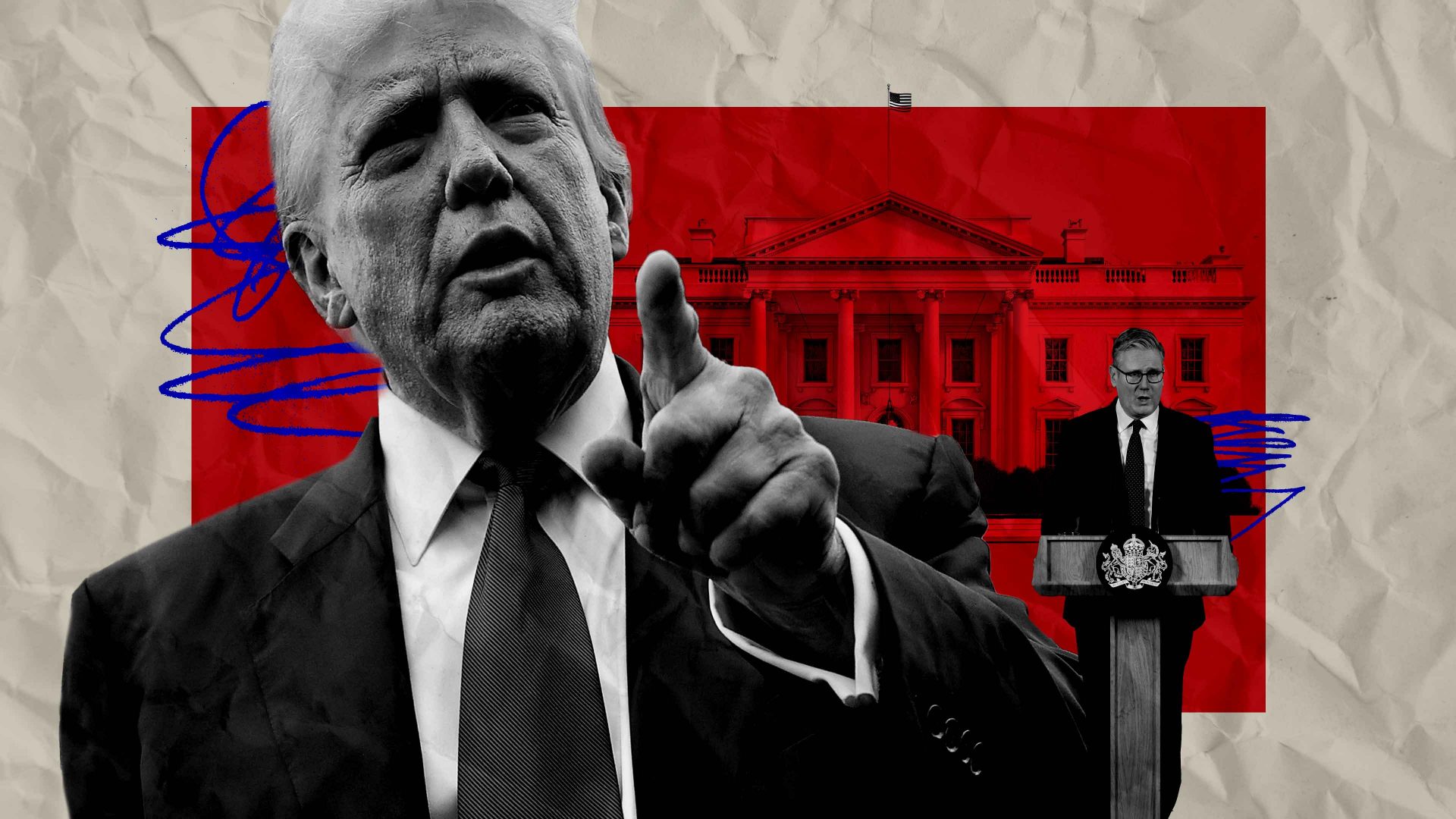
As was clear from his deluded performance in Downing Street on Monday, the PM has yet to confront fully the grim reality that a notional friendship with a maniac will deliver, at best, diminishing returns. He conspicuously failed to address the point made to him by Robert Peston of ITV News: that Trump is not behaving like a man who is amenable to reason or respects the rule of law.
The Suez crisis was a hugely consequential moment in geopolitical history – ending, once and for all, the pretensions of Britain and France as colonial powers and entrenching the role of the US as the lead Western power in maintaining stability in the Middle East.
Suggested Reading
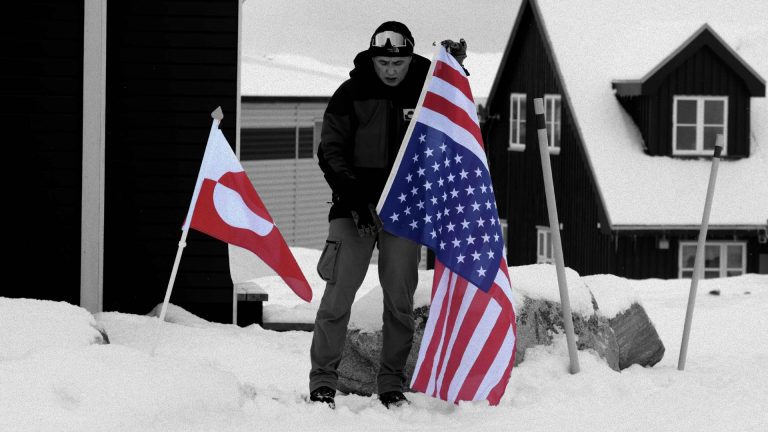
In Greenland, the threat of Trump hangs over us like Covid
This so-called “Eisenhower Doctrine” was spelt out to Congress on January 5, 1957. As for Eden, his Times obituary in 1977 observed correctly that he was “the last prime minister to believe Britain was a great power and the first to confront a crisis which proved she was not.”
Yet, as suggestive as these historical parallels are, what the free world faces now is much worse than its great wake-up call seventy years ago. First of all, the breach between White House and Downing Street in 1956 reflected a clash of two perfectly legitimate positions about the correct response to Nasser’s aggression.
Eden was haunted by appeasement in the 1930s and saw the Egyptian revolutionary nationalist as an Arab counterpart to Hitler. Eisenhower, on the other hand, considered the secret military pact reached between Britain, France and Israel at Sèvres on October 24, 1956, to be seriously reckless; precisely the kind of side-deal that had the potential to wreck the international order and turn the Cold War hot.
In a speech at Convention Hall, Philadelphia, on November 1 – five days before his re-election– he spelt out his principled position: “we cannot and we will not condone armed aggression – no matter who the attacker, and no matter who the victim. We cannot – in the world, any more than in our own nation – subscribe to one law for the weak, another law for the strong.”
There is simply no connective tissue – politically, morally or psychologically – between this form of argument and Trump’s emotive insistence that his raw power entitles him to annex Greenland. “I would like to make a deal the easy way,” he said on January 9, “but if we don’t do it the easy way, we’re going to do it the hard way.”
There is also no strategic case whatsoever for this demand: since 1951, Greenland has been fully available to the US in its defence of national and international security.
Unlike Eisenhower, who was reacting unhappily to a crisis not of his making, Trump has entirely manufactured the present geopolitical stand-off between Europe and the US. It is a transatlantic emergency that reflects nothing more elevated than the capricious demands of a giant orange man-baby. Which is why Starmer’s enduring faith in “calm discussion” with him is touching but misplaced.
Trump isn’t interested in “calm discussion”. He wants his own version of Thomas Jefferson’s Louisiana Purchase in 1803, or the Mexican Cession of 1848 under President James K Polk. An even better model – because it is defined by the humiliation of an entire people – would be the notorious acquisition of Manhattan Island in 1626 by the Dutch colonial governor Peter Minuit from the Native American Lenape for goods worth a mere $24.
Disdain is at the heart of all this, as America goads its own allies to respond to its insolent provocation. Last Wednesday, the foreign ministers of Greenland and Denmark, Vivian Motzfeldt and Lars Løkke Rasmussen, were at the White House for what was clearly a nerve-shredding encounter with vice-president, JD Vance, and secretary of state Marco Rubio.
On Sunday, the eight countries threatened by Trump’s tariffs warned that his plan risked a “dangerous, downward spiral”, reaffirming their “full solidarity with the Kingdom of Denmark and the people of Greenland”. Emmanuel Macron proposed that the EU deploy its “anti-coercion instrument” or “trade bazooka” which would (after consultation) enable coordinated counter-tariffs, import and export restrictions, exclusion from public procurement foreign investment limits, and even restricted access to financial markets and intellectual property rights.
In sharp contrast, Starmer declined on Monday even to hint at counter-measures. “A tariff war is in nobody’s interests,” he said – though, in case he hasn’t noticed, that war has already been declared. He would defend “our principles and our values”, he insisted, but dismissed as “performative” any practical suggestions as to how this might be accomplished.
Suggested Reading

Trump’s dark age of spectacle and power
All this will be music to the ears of the Trump administration, for which the herbivorous passivity of nations on this side of the Atlantic is taken as read. On Friday, Stephen Miller, White House deputy chief of staff and (increasingly) Trump’s grand vizier, was especially contemptuous of the Danish position.
“To control a territory, you have to be able to defend a territory, improve a territory, inhabit a territory,” he said. “Denmark has failed at every single one of these tests.”
On Sunday, Treasury Secretary Scott Bessent told NBC’s Meet the Press that only the US was a worthy custodian of Greenland. “There will not be a conflict, because the United States, right now, we are the hottest country in the world,” Bessent said. “Europeans project weakness.”
Why add insult to injury? Because the insult is the point. Trump thrives on cruelty, embarrassment and derision. Though I am sure he has never heard of Carl Schmitt, the Nazi jurist now fashionable among global far Right and reactionary thinkers, his behaviour cleaves to Schmitt’s core principle, expressed in The Concept of the Political (1932): namely, that “the specific political distinction to which political actions and motives can be reduced is that between friend and enemy”.
In Trump’s case, the boundary between the two is mobile and arbitrary. One minute, a Latino citizen in Minneapolis or Los Angeles believes that the president is on his side; the next a Border Patrol officer is harassing him “because of your accent”.
On the one hand, Trump tells America’s European allies to contribute more to Nato; on the other he suggests that they are weak and obsolete. The uncertainty itself is a weapon, intended to paralyse, confuse and demoralise the world into subjugation.
Back to Suez: for all its tension, the crisis played out under the canopy of the United Nations and international law. Seventy years ago, it really mattered that Britain and France (for the first time) used their veto on the UN Security Council to thwart a motion introduced by US ambassador Henry Cabot Lodge demanding an immediate ceasefire and the withdrawal of Israeli forces. And it mattered no less that, very unusually, the resolution went to the general assembly and was carried.
One of the fruits of the Suez Crisis was the UN Emergency Force, its first multinational military and peacekeeping operation. In contrast, the present cluster of geopolitical pressures are pushing the UN ever further to the margins.
Trump’s Gaza Board of Peace, whose first seven members were named last week, was endorsed by the UN Security Council in November. But the president clearly intends it to be a rival top table of international power, answerable to him personally. It is also striking that Trump has offered a permanent membership deal to participating states, at $1 billion a pop. He no longer bothers to conceal the grift or the privatisation of the global order.
Those who imagine fondly that the election of a Democratic president in November 2028 would straightforwardly repair all the damage being done to the geopolitical system are kidding themselves. For a start, Trump has three more years to wreak havoc.
Think how long ago the abduction of Nicolás Maduro now seems – since then we have witnessed the US come close to military intervention in Iran; the horrific execution of Renee Good by ICE in Minneapolis; the Pentagon’s preparation to send 1,500 soldiers to Minnesota; and the threatened criminal indictment of Federal Reserve chairman Jerome Powell. Now imagine all that – times 50.
International alliances are hard to create and easy to destroy, because they depend upon trust, mutual respect and, above all, continuity between administrations. Nato has endured precisely because it was unthinkable that a US president would behave as Trump has.
Even if his successor in the Oval Office is the most honourable devotee of internationalism and the rules-based order, who is to say how MAGA might metastasise if it lost the presidency? What kind of candidate would the Republicans nominate in 2032? The most important lesson of Trump’s return is that absolutely nothing can be taken for granted and that the old rules, still observed by Starmer, no longer apply.
This is how the world ends: not with a bang but a Truth post. Or, more accurately, this is how the postwar idea of the world, its organisation and system of rules is swept away. What replaces it is now the most pressing question facing Europe and its allies.
One of the many functions of history is to tell us when change is fundamental. Beneath the echoes of Suez lies a more unsettling beat, a warning that this is much worse. “America First” never meant US isolationism; in Trump’s eyes, it is the slogan of personal empire, kleptocracy and extortion, enforced by the most powerful military ever to exist. How the rest of the West responds will do much to define the second quarter of this pulverising century – and beyond.