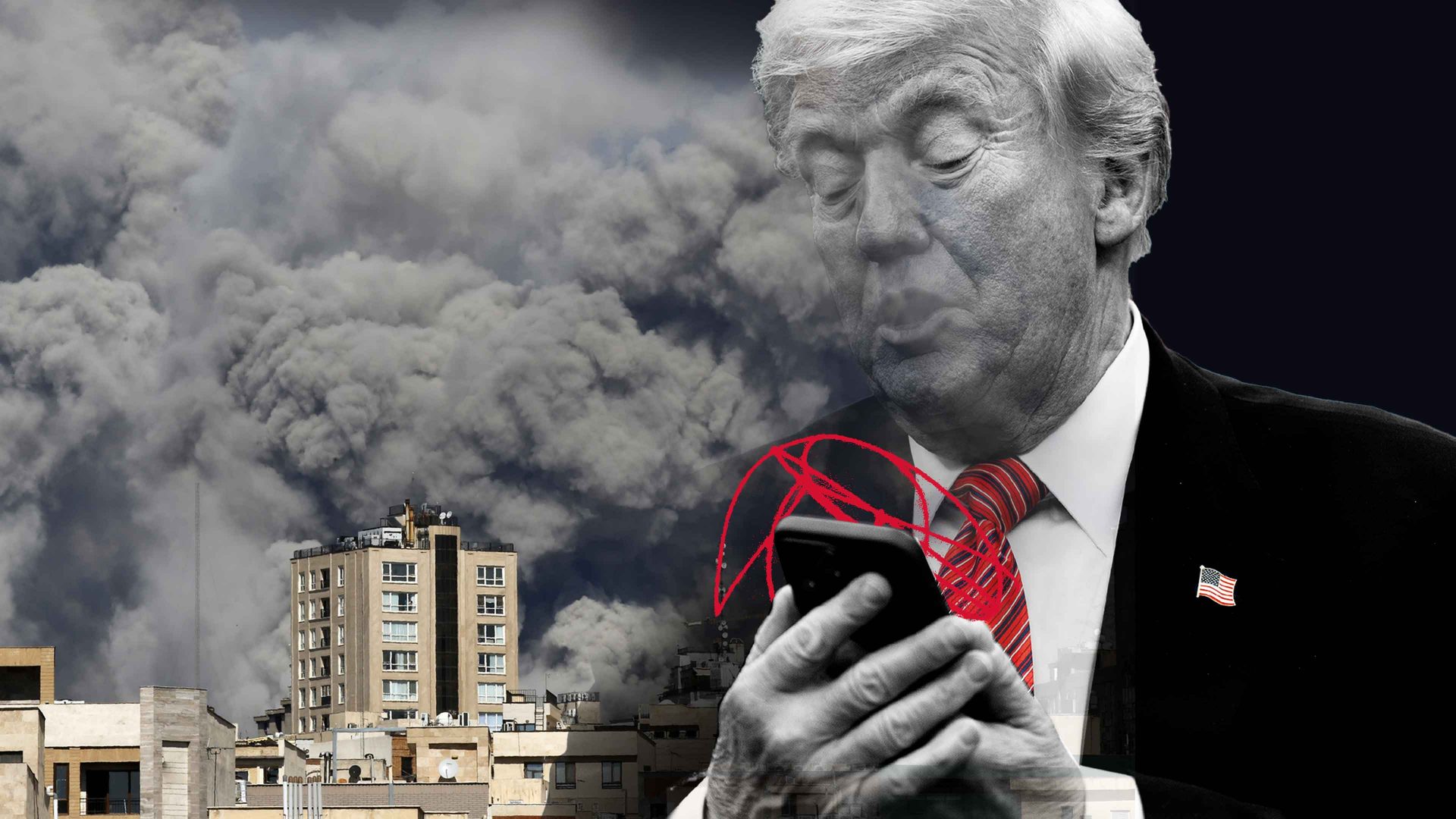
“I may have a plan, or I may not”: no kidding, Mr President. At the heart of the extraordinary, mind-bending Iran conflict has stood the pathological unpredictability of one man, who also happens to be the most powerful on Earth.
It is true that Donald Trump’s war aims have changed constantly, sometimes by the hour. Regime change, a popular uprising, the seizure of Iran’s enriched uranium, the destruction of its navy and ballistic missile system, the final obliteration of its terrorist proxy network.
At the time of writing, he has announced in a Truth Social post – all uppercase – that talks with Tehran are now proceeding and that he has postponed his threatened strikes on Iranian power plants. All now hinges upon the durable success of these negotiations.
A healthy dose of caution is essential because of the terrifyingly erratic way in which the president has conducted himself since announcing Operation Epic Fury. The warm glow may deepen – or vanish in an instant. This, after all, has been war as improv.
Indeed, the ever-changing list of war-aims has reminded me of Jake Blues (John Belushi) in The Blues Brothers (1980), apologising to his former fiancee (Carrie Fisher) for leaving her at the altar: “I ran outta gas! I had a flat tire! I didn’t have enough money for cab fare! My tux didn’t come back from the cleaners! An old friend came in from outta town! Someone stole my car! There was an earthquake, a terrible flood, locusts!”
And this brings us to what has been the much greater problem. Opaque war aims are one thing. It is quite another when the man with his finger – literally – on the button suffers from emotional lability that would make you hesitate to entrust him with the packed lunches on a school trip.
Never forget: this is the president who wanted to nuke hurricanes; to treat Covid by injecting bleach; to build a moat with alligators along the border with Mexico. He is beyond mercurial. He simply says whatever amuses him and – above all – keeps the spotlight firmly fixed upon his orange features.
Since the war began, this self-indulgence has so far included making a joke about Pearl Harbor in front of the Japanese prime minister Sanae Takaichi and reposting a sketch from Saturday Night Live UK’s debut show about the terror he inspires in Keir Starmer.
Which is why the raging argument in the US about Trump’s supposed betrayal of his “America First” credentials misses the point. He has never been a Robert A Taft or Patrick Buchanan or JD Vance: doctrinally hostile to foreign entanglements in the spirit of George Washington’s farewell address of 1796.
True, he thought that the Iraq war was a waste of time and money. But, as long ago as 1980, during the Iranian hostage crisis, he said that “we should have gone in there with troops” to make America “an oil-rich nation.” It’s not that he has been quietly planning this conflict for 46 years, or that he was a covert hawk all along; simply that he says whatever comes into his head and meshes with his mood.
So the civil war into which the current crisis has undoubtedly plunged the MAGA movement strikes him as a category mistake. As he told Rachael Bade of The Inner Circle newsletter in an interview published on March 3: “MAGA is Trump… MAGA wants to see our country thrive and be safe. And MAGA loves what I’m doing – every aspect of it.”
For Trump, the charge that he has broken his promise to his voters not to embroil America in warfare is not so much unfair as meaningless. There are no U-turns in a world that you define as capriciously as you please. To adapt Louis XIV: MAGA, c’est moi.
In a sense, the true mystery is that it took so long for the lovechild of Mussolini and Mr Toad to open the biggest box of toy soldiers in the world and really get stuck in. What, frankly, did we expect? Thoughtful restraint?
Suggested Reading
Trump’s Iran war is becoming a fundamentalist Christian crusade
I remain unpersuaded by those who confidently assert that they know precisely what this conflict has signified and portends. There are so many comfort zones on offer: it’s all Israel’s fault (in some cases, a disgraceful variant of the Nazi Dolchstoßlegende stab-in-the-back myth that Germany lost the first world war because of Jewish treachery); it’s all a matter of international law (yes, but the war also demonstrates the weakness of that law); it’s all about economic power and the price of energy (yes, but it’s also about the resilience of Islamist ideology and its confrontation with US populist nationalism).
None of these catch-all explanations comes close to capturing the sheer scale, risk and alarming novelty of what has unfolded in the Middle East. In search of clues, I went back to Jean Baudrillard’s The Gulf War Did Not Take Place (1991), a collection of highly provocative articles by the French post-modern theorist that scrutinised the dramatically evolving relationship between modern media, combat and geopolitics.
In his writings on the US coalition’s expulsion of Saddam Hussein from Kuwait, Baudrillard’s objective was never, as is often claimed, to deny its horror or bloodshed. His point, instead, was that the war was not real to those who consumed it on CNN; that the carnage of the battlefield had been obscured by sanitised satellite-feeds, by hyperreality, by simulacra.
“We are all accomplices in these fantasmagoria, it must be said, as we are in any publicity campaign,” he wrote. “[T]oday, in our enslavement to information, we constitute the reserve army of all planetary mystifications.”
More than three decades later, his dark warning still feels vividly contemporary. Yet, if anything, it did not go far enough. Baudrillard believed that “the charnel house of news signs” and occasional war as “preventative electroshock” would become the control mechanisms of the post-cold war “new world order.”
In practice, that supposed “order” was tested by the violent collapse of Yugoslavia and destroyed by 9/11, the rise of China and the end of America’s brief unipolar rule. Baudrillard died in March 2007 – just two months after Steve Jobs unveiled the iPhone, only three years after Mark Zuckerberg founded Facebook and a year after the launch of Twitter.
Sadly, therefore, the great theorist did not live to comment upon the tumultuous disruption of our political, democratic and social lives by social media and always-on digital devices: the truest manifestation of what Wyndham Lewis famously called the “moronic inferno”.
It is intriguing to know what Baudrillard would have made of Trump’s grotesque online war; his administration’s use of memes, mashed-up clips of combat footage, Hollywood movies, video games, and AI-generated images of cartoon destruction. What would he have to say about montages of US missile strikes to the strains of Macarena?
If the Arab Spring of 2010-11 was the first social media revolution, then this has been the first TikTok war. As a White House official told Politico in a story posted on March 18: “We’re over here just grinding away on banger memes, dude. There’s an entertainment factor to what we do.”
When Ben Stiller objected to the use in one of these blood-lust videos of a clip from his 2008 movie Tropic Thunder, Kaelan Dorr, White House deputy communications director, replied on X: “Still better than Zoolander 2”.
All wars, just or not, are about blood, steel, deprivation and misery. Yet it is entirely consistent with Trump’s love of WWE “kayfabe” – the core principle in big-money wrestling that everything is staged, and nothing is real – to pursue the sick idea that conflict is just another form of showbusiness. As the president said to Jonathan Karl of ABC News on March 5: “How do you like the performance?”
In time of war, US commanders-in-chief tend to exercise greater discipline than usual in their dealings with the press. During the Cuban Missile Crisis, for example, John F Kennedy spoke only to a tiny circle of trusted journalists, notably Charles Bartlett and Joseph Alsop. In complete contrast, Trump has been chatting away to just about anyone who has his mobile number (which is most of the Washington press corps).
This, remember, is the man who is in charge of the most powerful and deadly military machine in history, and has been overseeing a campaign of daunting complexity and consequence. More than 1,300 civilians have already been killed; at the time of writing, 14 US service personnel have died; the UN reports that up to 3.2 million Iranians have been displaced; shockwaves have coursed through the global economy; it will take a generation to repair the damage already inflicted upon infrastructure in the region.
And yet – let us say it how it is – Trump has been having the time of his life. Yes, his chief of staff, Susie Wiles and a few other advisers will have told him, with varying degrees of candour, of the dire political problems now facing Republican candidates in the November mid-terms.
But in his second term, as if keeping the contagion of reality at bay for as long as he can, he has stuffed his administration with sycophants such as his deputy chief of staff Stephen Miller, press secretary Karoline Leavitt and defense secretary Pete Hegseth (memorably described by the journalist Andrew Sullivan as “Rumsfeld-On-Meth”). They and others like them are the enablers, cheering him on as he romps in his bubble bath of post-truth and lies.
On March 9 – in a speech which the White House proudly uploaded to YouTube and its official website – the president gleefully described his alleged conversation with military commanders after the sinking of 46 Iranian ships: “I said, ‘Why don’t we just capture the ship? We could have used it. Why did we sink them?’ They said, ‘It’s more fun to sink them.’”
After the bombing of Kharg Island on March 13, Trump suggested in a phone interview with NBC News that “we may hit it a few more times just for fun.” The war has been like a geopolitical theme park for the president; one fantastic ride after another, with no queues.
In this respect, Trump has been entirely honest – if utterly deranged – in describing the huge US military operation as a “little excursion”. He is no longer on the ballot (if he clings on to power after January 20, 2029, it will not be by traditional electoral means). In July 2024, the Supreme Court granted sweeping rights of immunity to his office. Yes, he may be impeached a third time – but, having beaten the rap twice, he knows that the present system makes conviction almost impossible.
Suggested Reading
Trump’s war will encourage Iran to develop the bomb
So why worry? Why let America’s allies, the media and the polls kill your buzz? For Trump, this has been the equivalent of a mini-break with the US military-industrial complex as travel agents.
On Friday, he posted on Truth Social that he was considering “winding down our great Military efforts.” Yet he had only just told reporters outside the White House that “I don’t want to do a ceasefire. You know, you don’t do a ceasefire when you’re literally obliterating the other side.” Now, he is hailing “very good and constructive conversations” with Iran.
So which is it? Does he even know? He has, after all, been declaring victory since the first hours of the war and now seems to be edging towards a settlement. But, still, two Marine Expeditionary Units – the 31st and the 11th – are surging towards the Gulf.
For the president, the fun of what Theodore Roosevelt called the “bully pulpit” is to keep the world guessing, to keep the audience tuned in, to ensure that, figuratively speaking, the studio renews The Trump Show for another season; and perhaps, after the White House, a spin-off series or two.
Since the war began on February 28, frequent (and justified) reference has been made to the words of David Petraeus, then commanding the 101st airborne division, to the journalist and author Rick Atkinson, during the invasion of Iraq: “Tell me how this ends.” Perhaps it is ending now.
But I very much doubt that this, or much else, keeps Trump awake at night. His objectives are dynastic power, grift on an unprecedented scale, and – above all – the attention of absolutely everybody. The wellbeing of the world is below his pay grade.
Meanwhile, he is already and quite openly preparing for the next stop on his global tour. As he said on March 16: “Taking Cuba in some form? Yeah.” You can already envisage the merch: “Venezuela, Greenland, Iran… No sleep ’til Havana!”
This is a form of hyper-reality that not even Baudrillard could have predicted. It is global war as monodrama: a conflict of historic importance, mediated through a single, prodigiously powerful personality – a personality disfigured by zero conscientiousness, manic impulsivity, and hypomania.
And we are all contaminated. It would be gratifying to pretend otherwise, but also delusional. All we can be sure of is that, in the long and grim reckoning ahead, it will not be Trump who pays the price.
 Most popular

Screen scandal: How Ofcom lets GB News get away with it
GB News Scandal: The presenters
GB News Scandal: Read our dossier of their flagrant Ofcom breaches
Do your duty! Watch an hour of GB News