Since he descended the golden escalator to announce his presidential candidacy in June 2015, the pledge to end America’s “forever wars” overseas has been at the heart of Donald Trump’s political promise. What he did not mention a decade ago was his intention to declare a new “forever war” – at home.
The shooting of two members of the West Virginian National Guard in Washington DC on November 26 has become a tragic parable of the violent peril now faced by the republic and its people.
On Thursday, Army Specialist Sarah Beckstrom died of her injuries, aged only 20. At the time of writing, Air Force Staff Sgt Andrew Wolfe, 24, remains in critical condition. Once again, the American psyche has been traumatised by a terrible act of violence that, political or not, has been instantly politicised.
The alleged shooter, 29-year-old Rahmanullah Lakanwal, is an Afghan refugee who fought the Taliban alongside US forces until the ignominious retreat from Kabul in August 2021. He was embedded with a so-called “Zero Unit” in Kandahar province, a CIA-backed partner force engaged in covert paramilitary operations. No alleged motive for the attack has yet been publicly suggested.
What is known is that Lakanwal drove with his .357 Smith and Wesson across country from Bellingham, Washington, to carry out the ambush; and that in April, four years after their evacuation to the US, he and his family were granted asylum – that is, by the Trump administration.
Not that the president is taking any responsibility for that. At a press conference at Mar-a-Lago last week, he lashed out at CBS correspondent Nancy Cordes who had the temerity to ask an entirely reasonable question after Trump had raged against the incompetence of Joe Biden.
“Actually,” she said, “your DOJ IG [Department of Justice inspector general] just reported this year that there was thorough vetting by DHS [Department of Homeland Security] and by the FBI of these Afghans who were brought into the US. So why do you blame the Biden administration for what this man did?”
To which the leader of the free world replied: “Because they let them in. Are you stupid? Are you a stupid person? Because they came in on a plane, along with thousands of other people that shouldn’t be here, and you’re just asking questions because you’re a stupid person.”
In the Trump playbook, the tragedy also represents an appetising political opportunity. After months of tanking poll numbers, rising public anger over the cost of living, and the fracturing of MAGA over the Epstein saga and the president’s support for Israel, he has exploited the attack to force the national conversation back to his autocratic comfort zone: the maintenance of order on the streets of American cities by any means necessary and the relentless pursuit and deportation of migrants.
Hence, quite illogically, he immediately froze all immigration from Afghanistan; announced on Truth Social that he would turn away arrivals from “all Third World Countries” to enable “the US system to fully recover”; would denaturalise all “who undermine domestic tranquillity” and deport those who were “non-compatible with Western Civilization”. More “negative factors” will now apply to “green card” applicants seeking the permanent right to work in the US from 19 countries including Myanmar, Chad, the Republic of Congo and Libya.
Suggested Reading
Trump goes to war
Even by Trump’s standards, this is a brazen ploy to extract tactical advantage from bloodshed and to realign the nation’s political priorities with his approved narrative. In his deranged imagination, America’s greatest battle is against “the enemy within”.
In which context: it is important to recall quite how aggressively autocratic his first year back in office has been. In March, more than 260 Venezuelan and Salvadoran nationals were deported to President Nayib Bukele’s horrific Centro de Confinamiento del Terrorismo (CECOT) in Tecoluca, El Salvador, without even the pretence of due process.
On Meet the Press in May, Trump was pressed on this explicit infringement of the Fifth Amendment. “I don’t know,” he said. “It seems – it might say that, but if you’re talking about that, then we’d have to have a million, or two million, or three million trials.” In other words: who cares?
The president’s determination to tear up what James Madison called the “parchment barriers” of the US constitution became even clearer in June when he deployed 2,000 National Guard troops to Los Angeles, notionally to quell violent protests and to enable ICE agents to round up undocumented migrants.
In September, he announced the despatch of troops to Memphis, Tennessee – though no more than 180 reached the streets of the city before the operation was stalled on November 18 by state judge Patricia Head Moskal. The courts have also blocked the attempted deployment of the National Guard to Portland, Oregon.
But Trump is undeterred: he loves nothing more than legal confrontations, the primary stage on which he fought to win back the presidency. In these battles with the judiciary, he has postured as the defender of urban order against the liberal elite and its supposed indifference to imported savagery. He has even suggested that “we should use some of these dangerous cities as training grounds for our military”.
In October, the Great Autocracy Tour reached Chicago with “Operation Midway Blitz”, engaging 500 National Guard troops from Illinois and Texas. Again, a federal judge blocked the operation. Again, Trump was unfazed: by then he had already bypassed city leaders in Washington DC and deployed 800 troops to the nation’s capital, quickly rising to 2,000 (“We’re going to take our capital back”). After the attack last week, Pete Hegseth, the self-styled “secretary of war”, announced that he would send in 500 more National Guardsmen.
To do what? Because the collapse of order in DC and elsewhere exists only in Trump’s propaganda, these troops have been grotesquely reduced to raking leaves, removing graffiti and clearing up litter. These are important public services, but in no way part of the military’s remit.
What matters to the president, however, is not what the soldiers do but where they are. He wants to normalise the spectacle of federalised troops on American streets. He is introducing martial law not suddenly, but gradually.
Liberal democracy buckles when soldiers are deployed in this way, as the traditional relationship between civilians and military is vandalised. Norman Mailer captured this tragic disruption in The Armies of the Night (1968), his classic account of the suppression in October 1967 of the anti-Vietnam war march on the Pentagon. “There are negative rites of passage as well,” Mailer wrote. “Men learn in a negative rite to give up the best things they were born with, and forever.”
More recently, it is surely no accident that Paul Thomas Anderson’s masterly movie One Battle After Another has been his most commercially successful to date. In its tale of a white supremacist, Col Steven Lockjaw (Sean Penn) on the trail of Bob Ferguson (Leonardo DiCaprio), former member of the “French 75” militant group, and his daughter Willa (Chase Infiniti), Anderson’s film is rich in troubling contemporary resonance, portraying modern US fascism in epic VistaVision.
But the nuances of the social fabric – the subtleties that hold together a nation governed by laws, not men – are of no interest to Trump. Indeed, his administration is on a declared path towards the invocation of the 1807 Insurrection Act, which enables the president to deploy troops to suppress civil disorder, violent uprisings and sedition – thus suspending the all-important doctrine of posse comitatus, according to which federal military forces are prevented from engaging in domestic law enforcement except with explicit legal authorisation.
“We have an Insurrection Act for a reason,” he said in October. “If people were being killed and courts were holding us up, or governors or mayors were holding us up, sure, I’d do that.”
The act has been used 30 times, most recently in 1992 when Pete Wilson, the governor of California, requested military aid from President George HW Bush to quell the Rodney King race riots. In June 2020, Trump himself had a proclamation drafted to invoke the act in response to the unrest that followed the murder of George Floyd. He was talked out of it by defense secretary Mark Esper, attorney general Bill Barr and chairman of the Joint Chiefs of staff, General Mark A Milley.
The crucial difference is that those offices are now occupied by Trump sycophants: respectively, Hegseth; Pam Bondi; and General Dan “Raizin” Caine who first met the president in Iraq in 2019 (according to Trump, Caine said on that occasion: “I love you, sir. I think you’re great, sir. I’ll kill for you, sir”). If and when Trump decides to use the act, he will be egged on by all three.
The probability that he will do so sooner rather than later was greatly increased by the assassination of Charlie Kirk in September, after which the president repeatedly promised to hunt down “each and every one of those who contributed to this atrocity and to other political violence.”
Suggested Reading
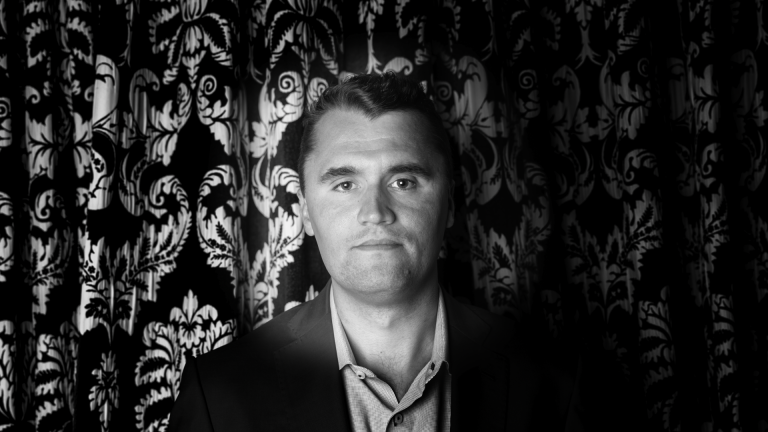

The civil legacy of Charlie Kirk
At the memorial to Kirk held at State Farm Stadium in Glendale, Arizona, Stephen Miller, White House deputy chief of staff and architect of Trump’s nascent autocratic regime, grafted this secular project to enforce order on to the religious crusade of the Christian nationalist. “The day that Charlie died the angels wept,” he said. “But those tears had been turned into fire in our hearts! And that fire burns with a righteous fury that our enemies cannot comprehend or understand!”
This vengeful spirit now burns deep in the administration. On November 20, Trump accused six Democratic members of Congress who had urged military and intelligence personnel to resist unlawful orders, of “SEDITIOUS BEHAVIOR, punishable by DEATH!” – an outburst as frightening as it was absurd. The FBI has now launched an investigation into the six lawmakers.
Violence is never merely instrumental; it sprays psychological shrapnel everywhere and long outlasts the narrow perimeters of the news cycle. Over time, it desensitises and barbarises civilised people. It is also the dark core of Trump’s governing ethos: civil strife, real or fictitious, is his stock in trade. He seeks it out, to justify his repressive ambition. He insists it is there, even when it isn’t.
It is awkward, of course, that, in recent years, the far right has been responsible for much more political violence than the radical left. So awkward in fact, that in September, the Department of Justice simply erased from its website a National Institute of Justice study demonstrating precisely this point, on the basis of decades of research.
Instead, the administration has amplified analysis by the Center for Strategic and International Studies indicating that incidents of left wing terrorism are on course to outnumber comparable right wing attacks this year (anomalously, in fact).
Certainly, there is a tradition of revolutionary underground violence in America; brilliantly described in Bryan Burrough’s Days of Rage (2015) which chronicles the sometimes-lethal activities in the 1960s and 70s of groups such as the Weather Underground; the Black Liberation Army (BLA); and the Symbionese Liberation Army.
In his epilogue, Burrough quotes the late Sekou Odinga of the BLA, who served 33 years in maximum-security prisons: “America has only gotten worse. It has. At some point it’s gonna fall, because all empires fall. It’s on its way right now. There’s not going to be any America in 50 years.”
It is precisely this sense of futility and unstoppable decline that Trump seeks to exploit. The first anniversary of the murder of Brian Thompson, CEO of UnitedHealthcare, in Manhattan falls on Thursday, December 4. Also this week, Simon & Schuster publishes the first mainstream biography of his alleged killer, Luigi Mangione, by John H Richardson.
It is a disturbing book, portraying the deranged mind of a clever young man, now 27, who lived in a digital world unmoored from grounding principle; who read the writings of the Unabomber, Ted Kaczynski, much too closely; and who, obscenely, became a hero to many as part of “the hyperreality of media events, in which everything is real and nothing is real”.
Trump and his troops; Luigi and his adoring fans: two faces of an end-stage democracy on the brink of something very much worse. Yes, the Democrats may yet revive, may yet win back the presidency in 2028. But this is only one of many potential outcomes of the political battlefield as presently configured; and not all of them involve conventionally functioning democracy.
On January 20, it will be nine years since the president, in his first inaugural address, pledged to bring an end to “American carnage”. Yet the carnage, like the cruelty, was always going to be the point. His promise to end it, was, in fact, a wicked incantation, willing it into being.
It is what Trump feeds on, what he nurtures, the irrigation of his proto-authoritarian rule. Without disorder and violence – or their apparition, on a billion social media feeds – he is nothing. And so, we must assume, there is nothing he will stop at.