PICK OF THE WEEK
The Secret Agent (selected cinemas)
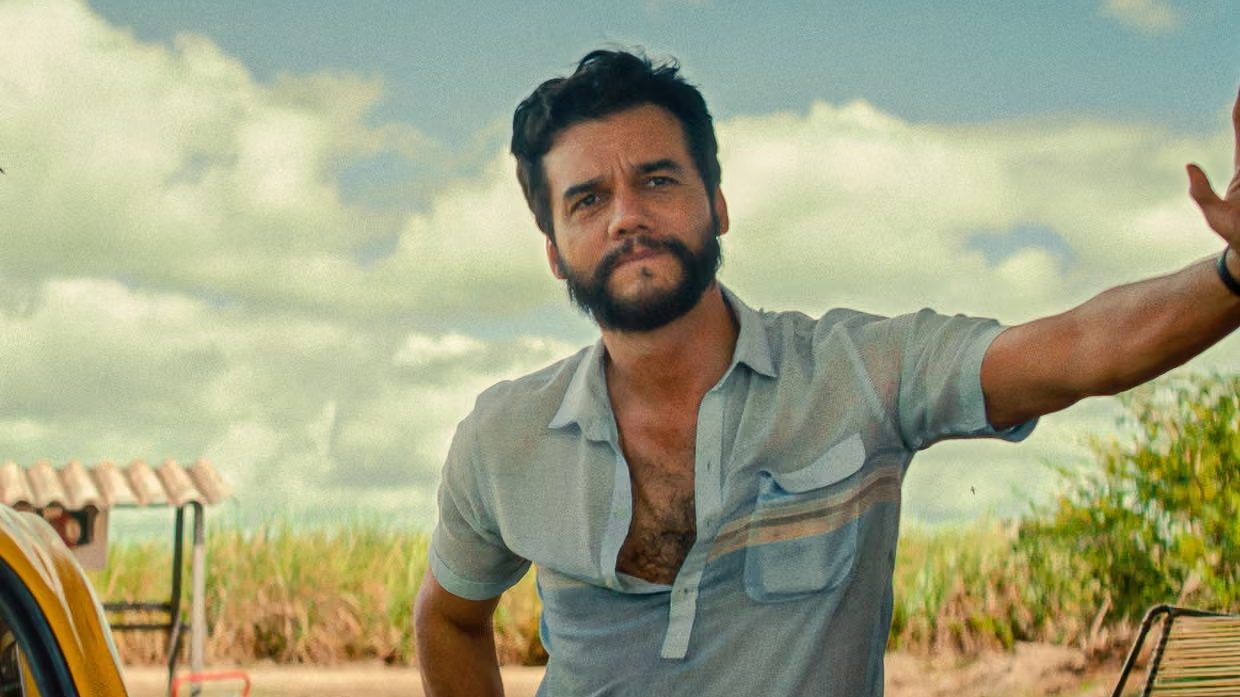
Brazil, 1977: a yellow VW Beetle pulls up in the shabby forecourt of a rural gas station. Attracting a swarm of flies, a corpse rots in the sun under a makeshift cardboard covering. When the cops arrive, they are indifferent to the dead body but try to shake down the driver, Marcelo (Wagner Moura), demanding a cash donation to the “Policeman’s Carnival Fund”. Since he has no money, they make do with his remaining cigarettes, and drive off. Cue Chicago’s If You Leave Me Now.
Kleber Mendonça Filho’s fourth dramatic feature film is an extraordinary portrait of his native country’s suffering during the dictatorship that stretched from 1964 to 1985: “a period of great mischief”. But it is so much more: playing with time frames, tone, genre and the prism of personal testimony to tell the story of one man snagged by the thorns of history.
Arriving in Recife – the coastal city in northern Brazil where the director was born – the fugitive Marcelo seeks sanctuary in a safe house run by Dona Sebastiana (Tânia Maria). He hopes to collect his young son Fernando (Enzo Nunes), who is being cared for by his maternal grandparents Lenira (Aline Marta Maia) and Alexandre (Carlos Francisco), and to escape the country. Meanwhile, the community of self-styled “refugees” arranges temporary work for him in a government department responsible for issuing ID cards – where he also intends to track down his mother’s records.
In one of many sharp ironies, Marcelo befriends the corrupt chief of police, Euclides (Robério Diógenes) who, with his officers Arlindo (Ítalo Martins) and Sérgio (Igor de Araújo), exploits the mayhem of the Carnival to kill off those he regards as undesirable. When two hitmen Augusto (Roney Villela) and Bobbi (Gabriel Leone) arrive on his patch – with his tacit blessing – he does not realise that their target is none other than Marcelo.
Quite rightly nominated for the best actor Oscar, Moura delivers a magnificent performance that merges deep melancholy – he is mourning his wife and fearful for his son – with fury at the arbitrariness of his predicament. His real name, it transpires, is Armando and he is the former head of a university engineering department in São Paulo who became embroiled in a row with a minister seeking to embezzle its funds. It is the minister that has ordered his assassination.
Though The Secret Agent is primarily a superb political thriller, its ambitions do not stop there. Entangled with Marcelo’s story is a truly surreal subplot about the discovery of a human leg in the belly of a shark – linked to Fernando’s obsession with Jaws. Like the ear in David Lynch’s Blue Velvet (1986), the leg is a weird MacGuffin: in this case, acquiring a dream-logic life of its own, and, in one stop-motion sequence, terrorising gay men cruising in a park.
What is Mendonça Filho up to? The movie is not only an exploration of injustice; it also unpicks the threads of memory and the complex relationship between past and present. I would not dream of spoiling the startling final chapter which demands one further flex of Moura and puts everything else in a deeply moving perspective. A stone-cold masterpiece.
FILM
Wasteman (general release)
When Taylor (David Jonsson) is told that, after 13 years in prison for manslaughter, he is eligible for early release, he plans to keep his head down, work in the kitchen, cut his fellow inmates’ hair and make amends to his 14-year-old son Adam (Cole Martin) on the outside. “Fill out the worksheet and stay out of trouble,” he is told.
So it’s seriously bad news when the brash and unpredictable Dee (Tom Blyth) arrives as his new cellmate, singing The Good Life – an ominous nod to Paul McGuigan’s brutally violent crime classic, Gangster No. 1 (2000). “Gonna boss it like I bossed Aylesbury,” he promises Taylor, and quickly furnishes him with all manner of perks including sweets, a phone and the Subutex heroin substitute to which he is addicted.
Soon drones carrying drugs start to arrive at their cell window and Dee sets out to take over D wing. What follows in Cal McMau’s accomplished feature debut is a storm of brutality, often captured on social media. In a world of nightmarish claustrophobia, the risk of a shanking or worse is ever-present. When an inmate is put into a tumble dryer, it is the cause of great mirth, recorded for repeat viewing. Imagine Alan Clarke’s great borstal movie Scum (1979), but for the digital age.
Jonsson, so good in Alien: Romulus (2024) and The Long Walk (2025), takes another step towards superstardom as a young man with the stoop and slow weariness of someone who has aged far too quickly. Torn between his growing fear of Dee – “I’m going to end all of them!” – and his determination to see his son, he shuffles towards a reckoning, the nature of which is uncertain until the final scenes.
Having delivered the best British prison movie since Steve McQueen’s Hunger (2008), McMau is a talent to watch, and Blyth is terrific – and frightening – as Dee, an IED made flesh. But it is Jonsson’s film. Watch out for his forthcoming lead role as Sammy Davis Jr in Colman Domingo’s directorial debut, Scandalous!
Suggested Reading

“Wuthering Heights” is a camp triumph
BOOK
Vigil, by George Saunders (Bloomsbury)
Not since Gibreel Farishta and Saladin Chamcha fell like “bundles dropped by some carelessly open-beaked stork” from Flight AI-420 in the opening pages of Salman Rushdie’s The Satanic Verses (1988) has a work of fine literature begun with a character making such a dramatic entrance. “What a lovely home I found myself plummeting toward,” says our narrator, Jill “Doll” Blaine, “acquiring, as I fell, arms, hands, legs, feet, all of which, as usual, became more substantial with each passing second.”
The mansion in Dallas belongs to 87-year-old oil magnate KJ Boone, who is dying from cancer; and Jill, who was killed in 1976 by a car bomb intended for her police officer husband Lloyd, is making her 343rd visit back to the world of the living to shepherd the old tycoon – “my present charge” – to the land of the dead. To her surprise, another “of our ilk”, a Frenchman, is already there, furiously holding Boone to account for the damage he has inflicted upon humanity and the environment.
No less than in his Booker Prize-winning Lincoln in the Bardo (2017), Saunders is very much at home in the marchlands between life and death. As a student of Buddhism, he inclines towards a metaphysics defined by gentleness and compassion rather than straightforward enthusiasm for infernal punishment. “Comfort, for all else is futility,” is the “unyielding directive” Jill has been given by “a vast, beneficent God.”
Some have been disappointed that Vigil does not observe the ideological conventions of cli-fi – by, so to speak, its insufficiency of virtue-signalling. But this subtlety is a strength, rather than a weakness. There is plenty of rage in these pages: Boone’s sins are great, and the cost of his “long service to his colossal ego” almost incalculable. He credits himself with keeping the US out of the Kyoto Protocol. His championship of climate change denial is despicable.
Yet, as Jill observes, he personifies something much deeper and more terrible. In the decades since her own death “[s]ome tendency suppressed and kept within decent bounds…had been unleashed and any shame about it so intensely rationalized that it no longer occurred to anyone that swollen ugliness everywhere was a direct result of the heedless indulgence of some pervasive acquisitive hunger.”
In this respect, Vigil could hardly be more contemporary. That the possibility of consolation and redemption is offered to a man who has fallen so far is characteristic of Saunders and his philosophy (see his famous 2013 commencement speech at Syracuse University); it also makes for a novel that is witty, mystical and profoundly affecting.
STREAMING
Lonesome Dove (YouTube)
In 1989, the work of two titans of American culture converged in a landmark television miniseries that rejuvenated the Western genre. Larry McMurtry’s best-selling novel, Lonesome Dove (1985) had already won the Pulitzer Prize. Now, in a four-part CBS drama, starring Robert Duvall – who died on February 15, aged 95 – it became a small-screen smash hit, watched by 44 million people.
In the 1870s, retired Texas rangers Gus McCrae (Duvall) and Woodrow Call (Tommy Lee Jones) seek a final adventure on a cattle drive from the edge of the Rio Grande River to Montana. The supporting cast is extraordinary (Danny Glover, Diane Lane, Frederic Forrest, Anjelica Huston, Steve Buscemi, Robert Urich), the pace of the four episodes daringly measured and the dialogue whip smart. This is prestige television before the term was invented.
The success of Lonesome Dove paved the way for a golden age of gritty “revisionist” Westerns: notably Clint Eastwood’s Oscar-winning Unforgiven (1992) and David Milch’s Deadwood (2004-06). Taylor Sheridan, perhaps the most powerful showrunner in streaming today, has often cited McMurtry as the inspiration of Yellowstone (2018-24) and its growing suite of spin-offs.
Though he will probably be remembered most fondly as Tom Hagen in the first two Godfather movies (1972 and 1974) and the surfing Lieutenant Colonel Bill Kilgore in Apocalypse Now (1979) – with perhaps a nod to his Oscar-winning performance as former country music star Mac Sledge in Tender Mercies (1983) – Duvall treasured the role of McCrae above all others. “If you want only one thing too badly, it’s likely to turn out a disappointment,” says the weathered old ranger. “The only healthy way to live as I see it, is to learn to like all the little everyday things like a sip of good whiskey in the evening, a soft bed, a glass of buttermilk – or a feisty gentleman like myself.” RIP.