Not long after his arrival in No 10, Gordon Brown was kind enough to invite me to collaborate with him in editing a volume of essays on Britishness. The subject was among the new prime minister’s main preoccupations; one which he connected to “the long retreat from worldwide power”, the pressures of globalisation, new security threats, and – prophetically – to our relationship with Europe.
We commissioned a wide range of public figures to offer their thoughts on the essence of national identity, including Ian Rankin, George Martin, June Sarpong, Jonathan Sacks, Tanya Byron, Muhammad Abdul Bari, Piers Morgan, Douglas Murray, Rowan Williams, Stephen Fry, and Libby Purves.
As you might imagine, the collection, published in 2009, embraced many different ideas and emphases, from Purves’s view that Britishness reflected “a mishmash of more or less inaccurate but immensely nourishing daydreams”; to Sacks’s warning that “we will have to engage, consciously and actively in society building”.
Trevor Phillips wrote that Britishness was “malleable and modern”, but foresaw a time when the Equality and Human Rights Commission, which he chaired at the time, “will have to stand up and say, for example, that you cannot both uphold your desire to force your daughter to marry a man against her will and still claim allegiance to a British identity”.
Seventeen years ago, the question of British identity seemed important. In 2026, it feels existential. On Sunday, another Labour prime minister – Keir Starmer – told the BBC’s Laura Kuenssberg that “the next election is going to be about a question of ‘what is it to be British?’ And I believe to be British is to be compassionate, reasonable, live-and-let-live and diverse, and I am proud to serve our diverse country… It is British to be diverse and that is the essence of Britishness.”
Starmer is right about what is on the line in Labour’s coming battle with Reform UK, and correct that diversity is, and has long been, an important component of Britishness. But is it, as he claims, the essence of our national identity?
In this context, the PM had a dismal start to the year with the fiasco of Alaa Abd el-Fattah’s return to this country as a British citizen; celebrated effusively by Starmer in a tweet on Boxing Day that declared that “Alaa’s case has been a top priority for my government since we came to office”. After six years imprisoned in Egypt – one of many periods he has spent behind bars – the activist was released in September but not permitted to travel to the UK by Abdel Fattah el-Sisi’s government until last month.
Yet, in a spectacular failure of due diligence, Starmer was not aware, when he welcomed el-Fattah to these shores, of his poisonous record on social media. For example: “Dear Zionists, please don’t ever talk to me, I’m a violent person who advocated the killing of all Zionists including civilians, so fuck off”. Or: “I’m telling you that I hate white people”. Or: “Now all I can think of is joining Bin Laden and killing a few Americans.” Or: “Police are not human — they don’t have rights, we should just kill them all.” Or: “I am a racist, I don’t like white people.” Or, at the height of the riots in England in 2011: “Now my real criticism of these post-police murder riots is the wrong focus, go burn the City or Downing Street, or hunt police fools.”
Predictably, this set off tripwires on right and left. Even though it was Boris Johnson’s government that granted el-Fattah citizenship in 2021, Robert Jenrick, the shadow justice secretary, said that he should now “be made to live in Egypt or frankly anywhere else in the world”.
Chris Philp, the shadow home secretary, demonstrated his rhetorical sophistication by calling el-Fattah a “despicable scumbag”. On December 28, Nigel Farage wrote to Shabana Mahmood, the home secretary, demanding that she “revoke his citizenship and order his deportation”.
On the left, meanwhile, there was a New Year fireworks display of virtue signalling: outrage at the suggestion that el-Fattah’s citizenship should even be challenged; emphasis upon the “historic” nature of his posts; and scolding of all those who had “weaponised” the case.
To be fair: it is correct that the legal basis for deporting him is negligible to non-existent. Having secured citizenship by registration – which is to say, as of right, because his mother is British – rather than by naturalisation, el-Fattah did not have to pass a discretionary “good character” test. He was, in other words, asserting an existing statutory entitlement, rather than seeking a new status.
To revoke citizenship established by this route would require Mahmood to clear a very high legal bar indeed: providing evidence, for example, that el-Fattah is a clear and present danger to national security or that he had acted fraudulently during the registration process. Since neither would appear to be the case, the legal scope for revocation is vanishingly small – and that’s before you get the question of refoulement, the illegal act of sending a person back to a place where they are likely to face persecution (in this case, Egypt).
Fifteen years ago, this would probably have been an end to the matter. But these are not ordinary times, and it is idle to deny that a case such as el-Fattah’s now exacerbates resentments that are already raw and livid and (unfortunately) absolutely central to mainstream political debate.
Some of the outrage at his case and Starmer’s welcome may indeed reflect nothing more than bigotry and prejudice. But, in 2026, the most powerful engine of public anger is something different: a curdling sense that the whole system is absurd, detached from public priorities, deaf to the concerns of those it is meant to serve.
Suggested Reading

Nigel Farage, the man who broke Britain
In fact, absurdity is as lethal to a government’s prospects as incompetence (though the two are often intimately entangled). It is insulting that Starmer so heedlessly offered a digital embrace to el-Fattah (“Of course I regret that,” he told Kuenssberg on Sunday). It is ridiculous that it did not occur to him, as a matter of basic prudence, that an activist embroiled for many years in the ferocious politics of the Middle East might have said some incendiary things in his time. It is infuriating, in short, that the PM should so lazily combine moral certainty with epic naivety.
I would go further: absurdity is radicalising. If people feel mocked or taken for granted by elites, they will embrace toxic alternatives. Yes, Farage and Jenrick are “weaponising” this resentment. But the problem is that the resentment is there to be weaponised in the first place – and the el-Fattah case is only the latest iteration of a narrative that stretches from the rape gang saga via the asylum hotel riots to the deadly Islamist attack in Heaton Park in October.
Starmer’s greatest political failure is an inability – so to speak – to tell the political time. It is so much later than he thinks. He talks of 2026 as the year of delivery, of the UK economy’s terrific statistical performance in comparison with other G7 countries, of his confidence that he will still be in No 10 in 12 months’ time. Yet he communicates no sense of kineticism, urgency or even empathy for those who feel terribly let down by his bland, technocratic style.
To return to the question of Britishness: yes, diversity is an important part of it. And yes, values, rather than ethnicity, are the basis of our national identity. But, according to a YouGov poll published last month, 36% now believe that a person must be born in this country to be truly British, sharply up from 19% in 2023.
Among Reform supporters, 59% say that the nation is an ethnic rather than a civic community. Ethnonationalism, in other words, is no longer confined to marchers at Tommy Robinson rallies. It is putting down noxious roots much further afield.
To respond to this challenge with the language of tolerance – as Starmer does – is necessary, but not remotely sufficient. I increasingly think of him as a time-traveller, stranded in our era but belonging to a political world that is long gone.
In this respect, he is merely the most senior exemplar of a profoundly worrying failure of understanding and imagination in the political class. They do not see how seriously diminished the immune system of our liberal democracy truly is in the face of the populist right wing virus.
In the 1930s, Oswald Mosley failed because the existing party system was so resilient and resisted jackbooted disruption by the British Union of Fascists with relative ease. But the old party structure is now disintegrating, as was clear from the desperate performance of Labour and Conservatives alike in last May’s elections.
In 1968, Enoch Powell was summarily sacked from the shadow cabinet by Edward Heath after his notorious “rivers of blood” speech in Birmingham. Though Powell undoubtedly touched a public nerve, his inflammatory rhetoric also helped to establish a boundary beyond which no mainstream politician could stray and remain respectable.
In the modern world of digital media and decentralised information, no such crash barriers exist. Today, Powell would be touring podcast studios in the UK and America, raising money for a new party. He would be baffling Donald Trump with ancient Greek quotations over dinner at Mar-a-Lago.
The bitter twist is that we have lost the talent of pluralism precisely when we need it most. This is partly a reflection of intellectual laziness and a decrepit sense of history; but it is also the upshot of a political culture in which the highest priority, in practice if not officially, is not to cause offence.
The most important feature of pluralism is that it is emphatically not the same as relativism. As Isaiah Berlin wrote in The Pursuit of the Ideal (1988): “The world that we encounter in ordinary experience is one in which we are faced with choices between ends equally ultimate, and claims equally absolute, the realisation of some of which must inevitably involve the sacrifice of others.”
Crucially, the constant task of choice between values and claims in a diverse nation does not mean that anything goes. In the same essay, Berlin wrote that “There is a minimum without which societies can scarcely survive”. The more complex a society becomes, the more important it is that this core of non-negotiable norms be protected with vigour.
For instance: if we assume that el-Fattah has the right to remain in this country, should his case not also prompt some fresh thought on the rule that excuses a person registering for citizenship via parenthood from passing a “good character” test, especially if the individual in question has hitherto mostly lived abroad?
Imagine, for instance, a grown man living in France who has been heavily involved in the racist activism of Generation Identity and has posted frequently that he hates Muslims and Jews. He has a British father and seeks a UK passport. Should his right to citizenship simply be rubber-stamped?
The defence of pluralism, in other words, involves hard decisions that will infuriate extremists. But so what? Why, for instance, is a teacher from Batley Grammar School in West Yorkshire still in hiding, five years after his lessons upset a group of Muslim parents? I asked this question last January. It remains conspicuously unanswered, as if posing it were poor form and letting the progressive side down.
This moral cowardice strikes me as disastrous. If liberals continue to seek out parapets beneath which to hide, bad actors will simply sweep them aside. In many places, they already have.
Suggested Reading
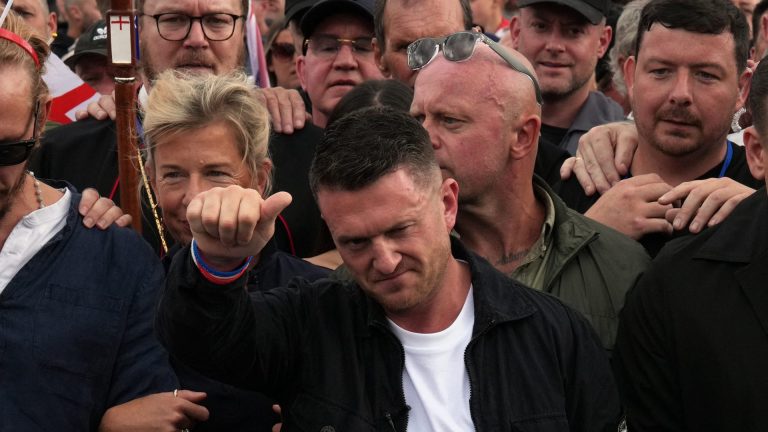
We’re paving the road to power for Tommy Robinson
The battle globally is no longer between left and right, but between liberal democracy and authoritarianism. The former is much more fragile than we once imagined, and it is failing: first, because it is no longer regarded as dependably effective; and second, because the social contract upon which it depends is close to collapse.
If that contract is not revitalised without fear or favour, populists will replace it with something much worse. In December 2016, Louise Casey delivered a fine 200-page report on integration, full of solid suggestions: the improvement of English language teaching, the provision of digital literacy in multi-racial areas, the boosting of school mixing (through sports and other activities), an emphasis on British values and history in the curriculum. But the report was shelved.
The key to the debate on Britishness that Starmer (rightly) proposes is that citizenship must amount to more than obeying the law and paying taxes. It is an emotional identity and an allegiance to a shared way of life as much as it is an administrative and legal status.
All successful pluralist societies accept this – and always have. Only recently, and with terrible consequences, have we chosen cantonisation, relativism and the avoidance at all costs of difficult debates. It is not racist to insist upon a core of social norms – quite the opposite. It is the only dependable bulwark against prejudice and fundamentalism.
So much more is at stake in 2026 than the fate of the prime minister. Happy new year.