One of Donald Trump’s most notorious claims was made on January 23, 2016. “I could stand in the middle of Fifth Avenue and shoot somebody, and I wouldn’t lose any voters, OK?” he said. “It’s, like, incredible.”
What few now remember is where this declaration was made. Nine days before the Republican presidential caucuses in Iowa – in which Trump finished second, behind Ted Cruz – he was addressing an audience of pious evangelicals, at Dordt University in Sioux Center. To press home the point: the famously sinful contender was positively flaunting his supposed impunity in front of 1,500 devout Christians whose worldview was defined by the conviction that holy scripture is literal truth and that its commandments are unambiguous and binding.
The setting foreshadowed an alliance of great consequence. For this was the year in which the mighty evangelical coalition – representing at least 53 million Americans – decided to throw in its political lot with a shameless libertine who, the movement’s leaders concluded, would nonetheless get things done. The biblical analogue was the Persian emperor Cyrus, a heathen guided by God to free the Jews from Babylon.
And how well this pact has worked – until now. In 2018, Trump delighted Christian Zionists by moving the US embassy from Tel Aviv to Jerusalem. By appointing three conservative justices to the supreme court (Neil Gorsuch, Brett Kavanaugh and Amy Coney Barrett), he set the stage for the overturning of Roe v Wade in June 2022, ending a woman’s constitutional right to an abortion.
Exemptions for Christians from practices they consider irreligious have been embedded in law. In his second term, he has created a task force to eradicate anti-Christian bias, and re-established the White House Faith Office under his spiritual adviser, the charismatic televangelist Paula White-Cain – who believes that “to say no to President Trump would be saying no to God.”
Only against this backdrop is it possible to understand the religious controversies in which he has been recently embroiled. Since his descent of the golden escalator 11 years ago, he has, of course, gorged himself electorally (and hypocritically) on popular grievance, resentment and disenfranchisement. But there have been two additional narrative through-lines to his political saga.
First, Trump’s colossal, megalomaniacal and apparently indestructible ego: the primal force that drove him through 91 indictments, 34 felony convictions, two impeachments, two attempted assassinations and the ostensible absurdity of the idea that he might win back the White House.
Second, and to an extent that is very difficult for the secular British political mind to grasp fully, there has been the ideologically dynamic and mobilising power of religion. More than has been appreciated, the insurrection of January 6, preceded by the so-called Joshua marches, was underpinned by Christian apocalypticism, MAGA’s very specific reading of the Book of Revelation and a belief that the supposedly stolen 2020 election was an End-Times struggle between good and evil.
It was no accident, furthermore, that, in March 2023, Trump launched his third presidential campaign at Waco, Texas, where in 1993, 86 died in the federal siege of David Koresh’s Branch Davidian compound. This choice of location sealed the city’s status as the most significant pilgrimage site of modern American millenarianism, and burnished Trump’s credentials as the champion of evangelicals and fundamentalists.
Historians will, I think, recall that he was never more powerful than between his brush with death at Butler, Pennsylvania, in July 2024, and the Charlie Kirk memorial service in September at State Farm Stadium in Glendale, Arizona: an overtly theocratic rally that sought to turn the 31-year-old activist’s martyrdom into the basis of a Christian national crusade. How long ago that moment now seems.
On a dime, Trump has taken the unifying force of religion and made it schismatic. Witness, for a start, the idiotic campaign he and JD Vance have waged against Leo XIV. On Easter Sunday, the pope said: “Let those who have the power to unleash wars choose peace!”; posting on X on April 10 that “God does not bless any conflict. Anyone who is a disciple of Christ, the Prince of Peace, is never on the side of those who once wielded the sword and today drop bombs.”
No more than a glancing knowledge of Catholic “just war” theory is needed to see that the pope’s statements represented absolutely mainstream theology. As the great systematiser of the bellum iustum, St Augustine of Hippo (AD354-430) was responding to the needs of a new era in which, since the conversion of Constantine the Great, Christians were no longer a persecuted sect but often in positions of power, seeking to reconcile military imperatives with moral responsibility.
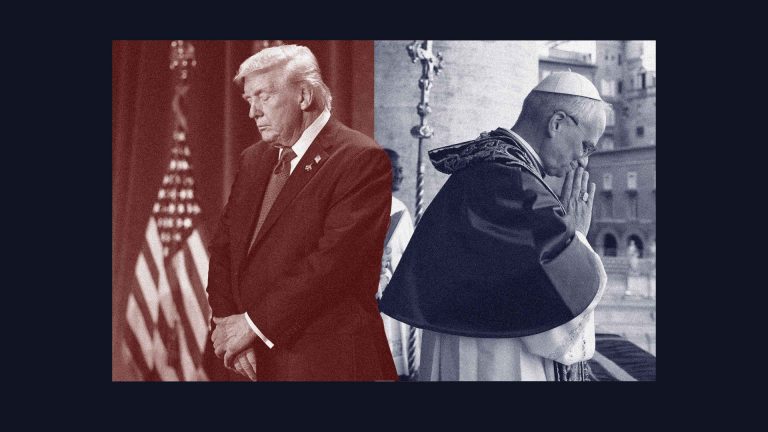
Ever since, and especially in modern times, the strong inclination of Catholic prelates and theologians has been to insist that a very high doctrinal threshold is met before a war can be considered consistent with the Church’s teaching – notably, it must be an absolute last resort with which to address an imminent threat (tests which Trump’s “little excursion” in Iran self-evidently fail). It is worth noting, in this context, that John Paul II, scarcely a tofu-eating hippy, strongly opposed the Gulf war of 1990-91 as well as the invasion of Iraq in 2003. The prevention and curtailment of conflict is high on the list of papal priorities.
You might think that, as an Augustinian friar and former prior general of the Order of St Augustine, Leo probably knows his stuff in this respect (he does). But Trump and Vance aren’t buying it. On April 12, the president posted on Truth Social that the pontiff was “WEAK on Crime, and terrible for Foreign Policy” – as if deriding a Democratic state governor who had upset him.
According to the commander-in-chief, the pope was only elected “because he was an American, and they [the cardinals] thought that would be the best way to deal with President Donald J Trump.” This was surely news to the 133 members of last year’s papal conclave.
Even worse, Vance, who converted to Catholicism only seven years ago, decided it was time to give the Vicar of Christ, successor to St Peter and wearer of the Fisherman’s Ring, a lesson in how to do his job. “I think it’s very, very important for the pope to be careful when he talks about matters of theology,” the vice-president said on April 14. “If you’re going to opine on matters of theology, you’ve got to be careful.”
Where to begin with this? On the whole, I’d say that, when it comes to theological credentials, the pope, who has a master’s degree in divinity and a doctorate in canon law, not to mention his official infallibility on doctrinal matters when speaking ex cathedra (that is, with the full authority of his office), probably has the edge on everyone’s favourite hillbilly venture capitalist.
And that’s before we get to the raw politics of the showdown. Leo is an English-speaking pope who is quickly learning how to engage with the media and on social media. When he told NBC News on April 13 that he had “no fear of the Trump administration”, he must have known that this would send the president into orbit.
For Trump expects everyone to fear him. He clearly regards the Holy See as the United Nations with added incense – or as the conservative nationalist commentator Rod Dreher, who attended Vance’s baptism, put it astutely last week: “Trump seems to think that the pope is nothing more than Keir Starmer in a white cassock.”
But Leo is no such thing. He comes from the south side of Chicago, after all. Though his sacred office requires him to speak in a conciliatory register, he is not remotely intimidated by Trump’s nonsense. Witness his quip that Truth Social was an “ironic” name.
He is also the spiritual leader of 1.4 billion people – some of whom form a swing demographic that is very important in US elections. For perspective: had 300,000 Catholics in Pennsylvania, Michigan, and Wisconsin flipped their vote in November 2024, Kamala Harris would be in the White House today.
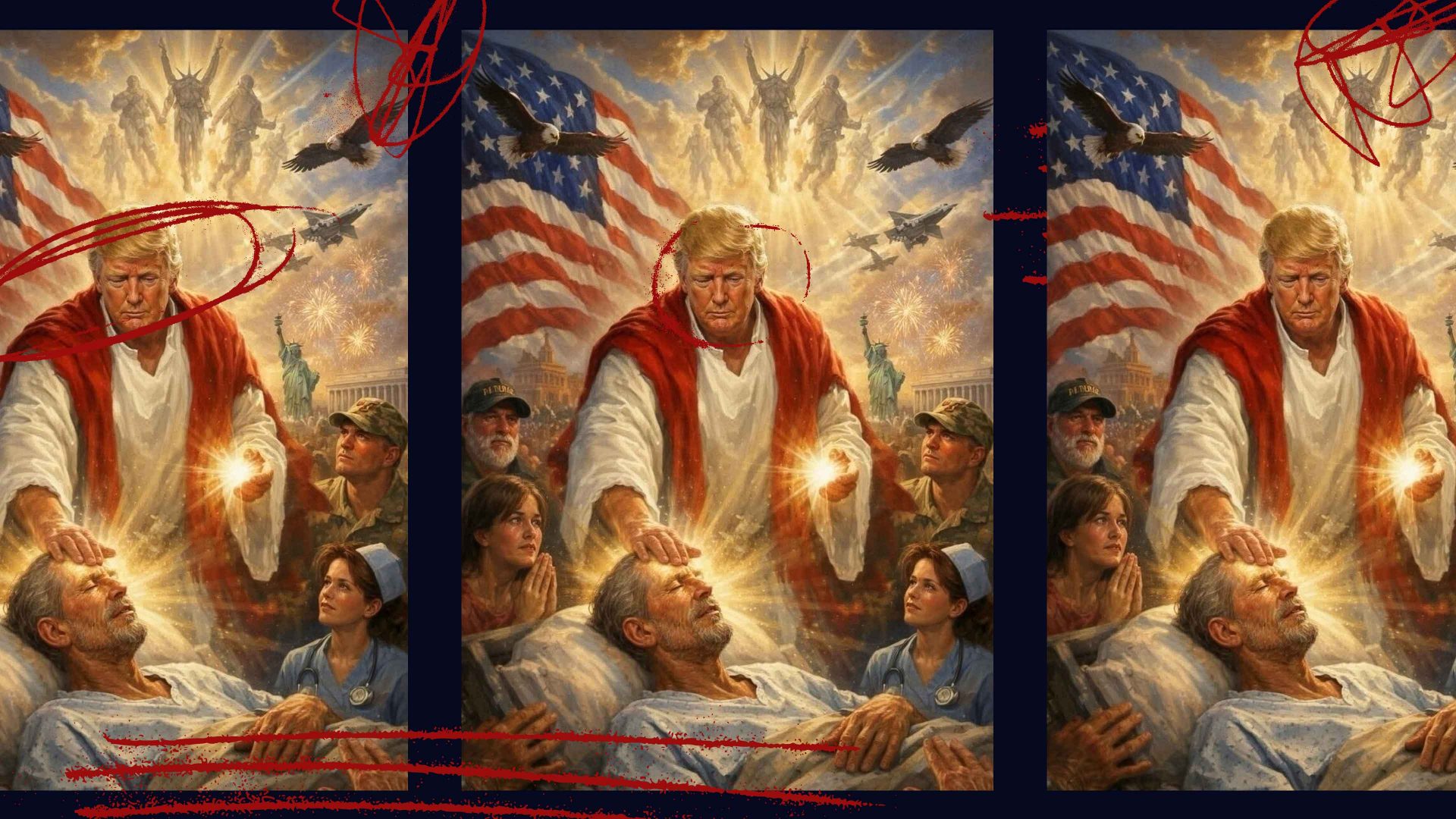
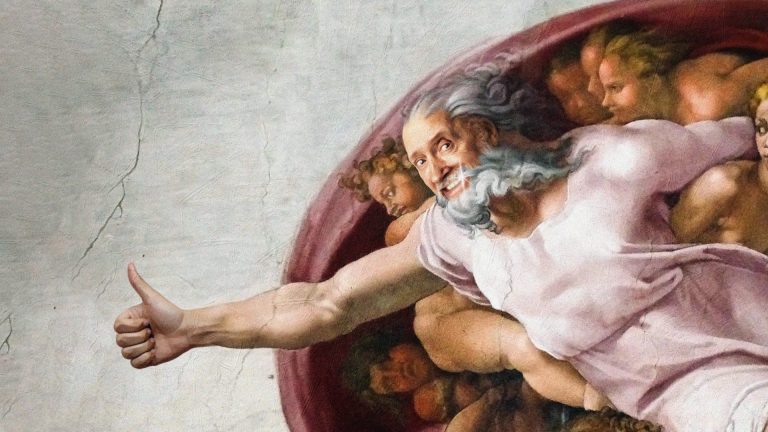
As foolhardy as the rift with the pope has been, Trump’s posting on April 12 of an AI image of himself as Jesus healing the sick was even more damaging to his already splintering coalition. Again, it is easy for British observers to underestimate quite how staggeringly offensive and sacrilegious such a hijacking of Christ’s persona is to the evangelical sensibility (and to many American Christians of other denominations).
As I wrote last week, when a president warns that “a whole civilization will die tonight”, it really won’t do to shrug and say that this is just “Trump being Trump”. In similar spirit: for American Bible folk, the heresy of posing as a pseudo-Christ or pseudochristos is an unspeakable sin against God (one cited explicitly in Mark 13:22 and Matthew 24:24).
‘As his power ebbs, Trump is falling prey to the very forces, emotions and apocalyptic folklore that he for so long mobilised to his great advantage’
Which is why MAGA loyalists like Doug Wilson, Pete Hegseth’s spiritual mentor, denounced it as “blasphemy”. The Reverend Tony Suarez, a longtime adviser to the president, said of the image that it “needs to be taken down immediately” and that it was “an offense to allude or depict that a human can compare to our Lord and Savior Jesus Christ.”
Sean Feucht, a conservative Christian activist long active in MAGA-world, added that “[t]here’s no context where this is acceptable”.
And it gets worse. For millennia, the pseudo-Christ has often been identified in eschatological tracts as the antichrist – and, in recent days, there has been no shortage of Christian public figures willing to make this leap.
On April 13, the evangelist Clint Russell, host of the conservative Liberty Lockdown podcast, posted on X that: “In 18 months I went from hesitantly voting for Trump to thinking there’s a decent chance he’s the antichrist.”
On the same day, the online pastor Joel Webbon – one of the leading “TheoBros” – posted that “I genuinely believe Trump is currently demon-possessed”, and went on to host a livestream chat titled “Is Donald Trump the Anti-Christ?” The evangelical influencer Mandy Arthur chipped in, too: “God, we might have made a mistake and [accidentally] elected the Antichrist. Send help.”
Suggested Reading
God is back… and He’s trending
The more cerebral Dreher told the Wall Street Journal that Trump was “radiating the spirit of Antichrist, no question”. In a majestic essay for The Lamp, Matthew Walther explored the question at length, with detailed reference to John Henry Newman’s series of lectures in 1838, The Patristical Idea of Antichrist.
Whether you believe a word of such metaphysical speculation, it is remarkable that, in 2026, serious religious thinkers should be asking if the most powerful person in the world is none other than the Beast; whose coming, according to Revelation, heralds the tribulation and the apocalypse itself.
And remember: for huge numbers of Americans this is not a matter of metaphor or myth. According to research by the Pew Research Center in 2022, 39% of adults in the US believe, quite literally, that “we are living in the end times”.
For 11 years, Trump has relied upon the conviction of these particular Christians and their faith that, in the final conflict, he would be emphatically on the side of the just. So it is nothing like good news for the president that a great many MAGA diehards are now starting to wonder if he is, after all, an orange demon; the “father of lies” of John 8:44.
In such a febrile context, his transparently ridiculous claim that he thought the AI image (which he had by then deleted) portrayed him as “a doctor making people better” has only compounded the sin. If you are trying to persuade your base that you are not the antichrist, then flagrant falsehoods are probably not the best place to start.
Populist politics meets at the junction between emotion and economic grievance, where fiery belief and material hardship converge. In improving times, strongman leaders can get away with plenty of hypocrisy, perhaps even the gold-leaf idolatry to which Trump is addicted. But when gas is $6 a gallon, unemployment has reached 4.3%, the president and his family are brazenly touring the world enriching themselves, and the slogan “America First” seems now to mean “a new war every month” – well then, voters start to get tetchy.
As his power ebbs, Trump is falling prey to the very forces, emotions and apocalyptic folklore that he for so long mobilised to his great advantage. Some of the faithful will stick with him, of course. It is always so when cults decay.
But MAGA’s immune system is failing catastrophically and the light in which the president is now bathed is very far from divine. It is the light of angry scrutiny.
The crowd looks on, a mass of slow-burning wrath, gradually realising that it has been played; awoken to the dismal truth, after all these years, that the man it chose – twice – is nothing like Jesus at all, but was Barabbas the thief all along.