The contrast could scarcely be more distasteful: as the US has waged a historic war against Iran, with truly global consequences and terrible bloodshed, the world of MAGA influencers has descended into playground politics, name-calling and narcissistic spite.
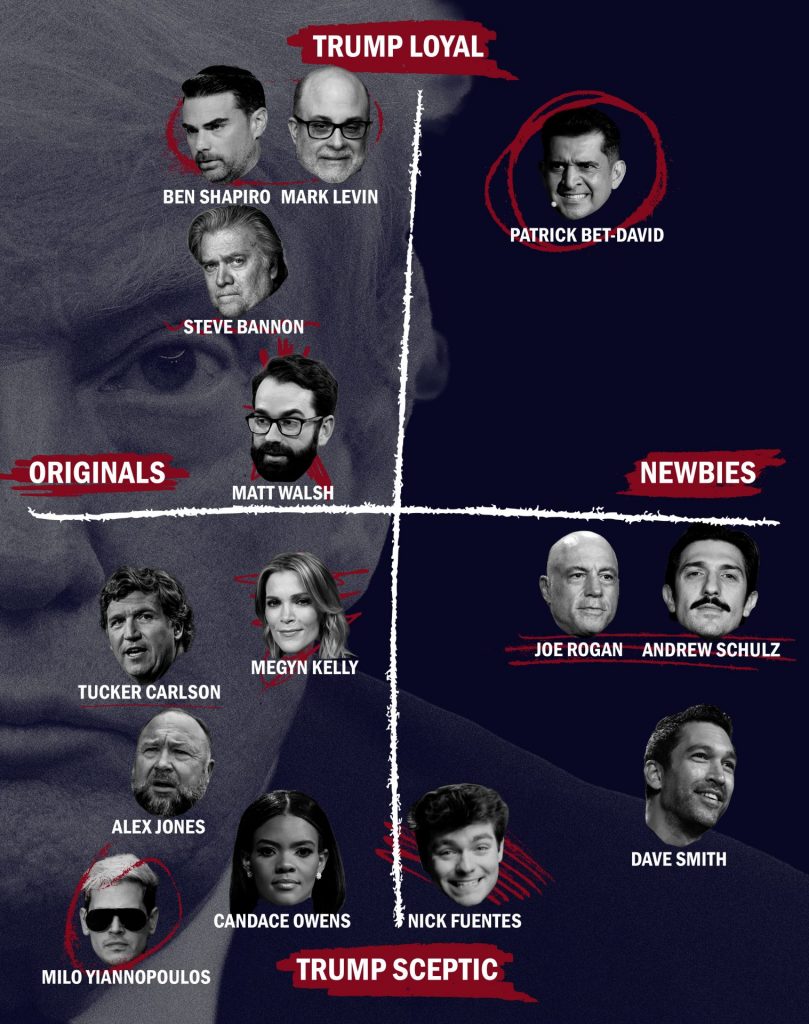
To take a particularly egregious example: the pro-war Fox News and podcast host, Mark Levin, has engaged in a battle of staggering infantilism with Megyn Kelly, who is normally supportive of Donald Trump but, like many of her fellow right wing online personalities, is opposed to the president’s “little excursion” in the Middle East.
This tawdry squabble has played out on X, where Levin has 5m followers and Kelly 3.6m, and kicked off properly on March 15 when she posted: “I’m sorry you have a micro penis but don’t drag the rest of us into your drama.”
Well: that was enough to prompt an intervention on Truth Social from the commander-in-chief himself who declared that Levin, “a truly Great American Patriot, is somewhat under siege by other people with far less Intellect, Capability, and Love for our Country.”
Undeterred, Kelly doubled down, dismissing Levin as “such a SMALL MAN he had to go beg the president for a pat on the head (in the middle of a war!).” And on it went.
On March 27, Kelly wrote: “Look at Micro. So drunk on his teeny tiny temporary power he wants the VP [JD Vance] out for the sin of challenging Netanyahu.” Summoning the rhetorical powers of Cicero, Levin countered: “Look at Deep Throat. Oh the stories I hear. Filthy mouth.” To which Kelly replied: “It’s okay Micro! I’m sure your disability makes it really tough to look at more successful women!”
Meanwhile, Tucker Carlson, the big beast of the anti-war, anti-Israel, “America First” faction, has been devoting almost every episode of his hugely influential podcast to the evils of the Jewish state. According to the former Fox News presenter, the war is being covertly stage-managed by the Chabad movement – a missionary Hasidic group that operates synagogues, schools and charitable services around the world – and its true objective is to destroy the Al-Aqsa mosque in Jerusalem, from which Muhammad is said to have risen to heaven, and to build the Third Temple on the razed site.
Over at The Daily Wire, Ben Shapiro, who strongly support’s Trump’s war, has branded Kelly an “unbelievable coward, adding: “Tucker and Megyn both – unbelievable cowardice.” But his former employee Candace Owens, who now hosts her own very successful podcast, is having none of it. When Carlson claimed that the CIA was reading his texts, she posted on X: “If they come for Tucker, we ride at dawn.” No, I don’t know what that means, either.
Taunts about genitalia, antisemitic conspiracy theories and opaque threats: if all this strikes you as disgracefully entitled bickering among right wing millionaire influencers, at a time when thousands are dying in the warzone, up to 3.2 million Iranians have already been displaced, and the global economy is reeling – well, that’s because it is.
Though the opinion polls indicate a high level of residual personal loyalty to Trump among MAGA voters, the movement itself is now rent asunder by factionalism. And there is no obvious off-ramp, either. One side must win, and the other lose, especially as the Republican Party braces itself for terrible results in the November mid-terms and starts to think seriously about its presidential candidate in 2028 (assuming that Steve Bannon, another war-sceptic podcaster, is wrong when he insists that “on the afternoon of January 20th, 2029, Donald Trump, is going to be president for his third term”.)
How did the MAGA army of online influencers – such a force in the 2024 presidential election – descend into mutiny and petty infighting? In search of answers, we have to go back to the very beginning of the story: a tale which is far from linear, has a rolling cast of characters (some now forgotten), and is as unpredictable in its twists and turns as the Big Orange himself.
On June 16, 2015, Milo Yiannopoulos, working at the time for Bannon at the far-right platform Breitbart News, headed to Trump Tower in New York to attend an event that, he had been tipped off, would intrigue him. The ambitious young activist and prankster watched Trump descend the golden escalator and listened to him rant about Mexican “rapists” and drug dealers, promise to build a “Great Wall” and swear “to make our country great again.” His interest was indeed piqued.
At the time, Trump was covered by the mainstream media only as a grotesque novelty act; a freakish warm-up act before the Republicans selected a respectable nominee like Jeb Bush or Scott Walker. But – galvanised by the sheer brazen novelty of the maverick contender – Yiannopoulos and others in the loose-knit “alt-right” network saw a tectonic change ahead in conservative politics and quickly became the spear’s tip, the digital guerrillas of the fledgling MAGA movement.
Among those so-called “OGs” – original gangstas – were Richard B Spencer, Lauren Southern, Gavin McInnes and Mike Cernovich. Along for the ride, if erratically, was the veteran Texas-based host of Infowars.com and arch-conspiracy theorist, Alex Jones. In a campaign appearance on his show, Trump described Jones’s reputation as “amazing” – which was true, just not in the way he meant it.
As an overt ethno-nationalist, Spencer believed that “America was, until this past generation, a white country. It is our creation. It is our inheritance and it belongs to us.” At a meeting of his National Policy Institute 11 days after the 2016 presidential election, he notoriously proclaimed: “Hail Trump, hail our people, hail victory!” In the audience, young white men gave the Nazi salute.
Southern, in contrast, was a young telegenic Canadian, who specialised in YouTube clips attacking feminism, Islam and immigration. In Daniel Lambroso’s excellent documentary White Noise (2020), she is shown writing the words “Fuck Islam” on her face in lipstick; she turned up at women’s marches with placards declaring “There Is No Rape Culture In The West”; and her personal motto was: “It’s okay to be white”.
Along with Gavin McInnes, co-founder of Vice magazine, she was hired by Ezra Levant’s Rebel Media to produce provocative, offensive and potentially viral YouTube content. A self-professed champion of the West and of the writings of paleoconservative Patrick Buchanan, McInnes was proudly sexist and hostile to Islam.
He was often very funny, too. More than any of the OGs, he understood that humour is a much more powerful force in political persuasion than a barrage of facts and earnest talking points. In some of his segments, he would pretend to be his (non-existent) “Social Justice Warrior” brother Miles McInnes, in Che cap, keffiyeh, and combat jacket, claiming to be a “Gaysian Albino”, “on about a billion Facebook pages” and longing for the extinction of white people “because we suck”.
He also founded a ludicrous drinking group of “Western chauvinists” calling themselves the Proud Boys, after the song “Proud of Your Boy” from Disney’s Aladdin (1992). Their (meaningless) slogan was “Uhuru!” These sub-frat inadequates met in dive bars, drank Budweiser, sang Disney songs, and practised an initiation rite in which recruits were punched (not very hard) until they could name five breakfast cereals. In those days, the Proud Boys were more sad than bad.
As Angela Nagle writes in Kill All Normies: The online culture wars from Tumblr and 4chan to the alt-right and Trump (2017), the insurgent energy of the alt-Right drew upon the dark subculture of gaming, imageboard websites, and the online fixation with movies such as The Matrix (1999), Fight Club (1999) and American Psycho (2000).
The OG influencers grasped completely that appointment broadcasting was dying; that the partition between fringe and mainstream had been breached; and that the rise of Trump was a symptom of a colossal cultural upheaval.
“What seemed to hold them all together in their obscurity,” writes Nagle, “was a love of mocking the earnestness and moral self-flattery of what felt like a tired liberal intellectual conformity running right through from establishment liberal politics to the more militant enforcers of new sensitivities from the wackiest corners of Tumblr [the progressive social networking platform] to campus politics.”
Suggested Reading
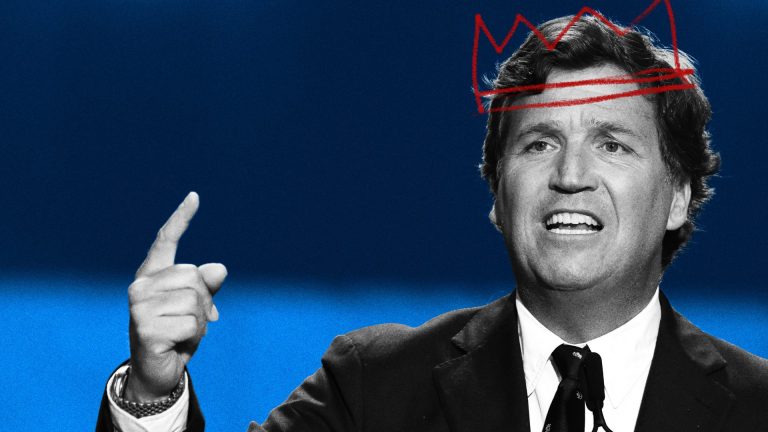

Tucker Carlson, podcaster president?
For the first cohort of pro-Trump influencers, anarchy was more important than ideology. In this respect, Yiannopoulos, who took to referring to Trump as “Daddy”, was right that the early MAGA movement was the “new punk”. In 2017, he himself was hailed by the talk show host Bill Maher (absurdly) as a successor to Christopher Hitchens. I remember the editor of a big UK newspaper complaining that its proprietor was desperate to hire this peroxide-blond bigot as a columnist.
As shiny and new as the alt right contrived briefly to appear, the movement was as breakable as balsa – and was shattered by the horror of the Charlottesville race riots in August 2017, during which the 32-year-old paralegal Heather Heyer was killed by a car rammed by the white nationalist James Alex Fields Jr. into a crowd of counter-protestors. Neo-Nazis marched with tiki torches chanting “Jews will not replace us!” (a reference to the “Great Replacement” theory, according to which a Jewish conspiracy is seeking to outnumber white people in the West with ethnic minority immigrants).
These scenes and Trump’s shocking response – that there were “very fine people” on both sides of the disorder – plunged the OGs into disarray. Spencer withdrew to his mother’s home in Whitefish, Montana, claiming that “I am an artist before I am a politician” (remind you of anyone?).
In March 2018, Southern was barred from Britain under Schedule 7 of the Terrorism Act after handing out leaflets in Luton saying “Allah is gay”. Her credibility in the alt-right movement collapsed when she married an Australian “fed” (to this day, a term of abuse in the MAGA lexicon) who also happened to be part-Asian. This reflected a pattern of hypocrisy: as much as the OGs presented themselves as the defenders of “European” (which is to say, white) culture, their own life choices infringed the very purity tests their movement supposedly stood for.
McInnes is married to a woman of Native American heritage; Yiannopoulos, before his professed turn away from the gay “lifestyle”, preferred Black boyfriends; Cernovich’s wife comes from an Iranian Muslim family. By definition, viral memes and YouTube clips lack nuance. Real life isn’t like that.
In November 2018, McInnes quit the leadership of the Proud Boys which, spinning out of control, had hardened from a slobbish drinking club into a militia with chapters all over the US. Yiannopoulos was ostracised and lost a $250,000 book contract with Simon & Schuster, when an interview resurfaced in which he defended sex between men and under-age boys.
As the impact and reach of podcasting surged, Steve Bannon, Kelly and Charlie Kirk, co-founder of Turning Point USA, all launched their own shows. Other MAGA presenters such as Jack Posobiec and Steven Crowder weathered the storm.
But the overall pattern of retreat descended into outright disaster on January 6, 2021, as pro-Trump insurrectionists invaded the Capitol, protesting Joe Biden’s victory and declaring themselves ready to hang vice-president Mike Pence and speaker of the House Nancy Pelosi.
Having incited the uprising, Trump himself was suspended from Twitter, along with 70,000 associated users.
It looked like the party was over. But it wasn’t.
The second wave of MAGA influencers – quite different to the first – arose in an extraordinary context. First, Covid completely disrupted the cultural landscape to an extent that, even now, has not yet been fully acknowledged.
Without the pandemic, Elon Musk would not have become so obsessed by the “woke mind-virus” that he bought Twitter in October 2022, renamed it as X and restored many of the banned accounts. In the US, lockdown, masks and the vaccine were much more polarising than on this side of the Atlantic. Online contrarians and anti-authoritarians joined forces in rebellion, exploiting the paranoia of millions stuck in their homes to turbo-charge old conspiracy theories and the new wellness-meets-QAnon cult of “conspirituality”. All this was grist to the mill of MAGA, as it sought urgently to rebrand itself.
The second defining feature of the period 2020-24 was Trump’s early insight that the 91 felony charges against him were not a distraction from his third presidential campaign; they were the campaign. However ludicrously, they enabled him to posture as a victim of the “Biden crime family” and its retribution, and, more significantly, as the human shield between woke tyranny and ordinary Americans. In the first six hours after he was convicted of all 34 felony charges in the New York hush-money case in May 2024, his campaign raised $34 million.
The paradoxical power of this new narrative helped to explain the growing success of The Daily Wire, where Owens’ show Candace was a hit and the plaid-shirted, self-described “theocratic fascist” Matt Walsh developed a mighty online fanbase, including 4m followers on X. With TDW’s cash, he also made two successful and highly controversial documentary features, What is a Woman? (2022) and Am I Racist? (2024).
Initially, both Shapiro and Walsh inclined towards Florida governor Ron DeSantis (remember him?) for the 2024 nomination – but soon reverted to Trump when it became clear where the primary race was heading.
Carlson, for his part, founded the Tucker Carlson Network in December 2023, eight months after he was sacked by Fox News (apparently as part of a $787.5 million settlement with Dominion Voting Systems over its coverage of the 2020 election). More than ever, he was on the phone to Trump or a guest at Mar-a-Lago – and has been credited with persuading the nominee to pick JD Vance as his running mate.
What tipped the balance, however, was the energy with which this new variant of MAGA spread into parts of “Podcastistan” where it had rarely been a significant force. As Trump has often said, it was his youngest son, Barron (now 20), who convinced him to spend precious campaign hours appearing on the bro-friendly shows of stand-up comedians such as Andrew Schulz, Theo Von and – the prime quarry – Joe Rogan, the world’s biggest podcaster, previously a supporter of Bernie Sanders, whose top-performing episodes achieved as many as 60 million views.
Late to the game the comedian-influencers might be, but their electoral impact was palpable. On November 5, 2024, Trump was supported by 56 per cent of men aged 18-29: a demographic group that had backed Biden in 2020. The Republic nominee might be 78 years old on polling day – the oldest person to be elected president – but the sheer kinetic energy of the influencers had done much to cast him, ludicrously but effectively, as the changemaker, the indicted outsider fighting on behalf of the guy on the barstool against the imperious liberal elite.
On January 20, 2025, Rogan, Von, Kelly and Carlson were all guests at Trump’s second inauguration. So was the professional wrestler and podcaster Logan Paul, on whose show Impaulsive Trump had appeared in June 2024, with his boxer brother Jake. There they all were, suited and booted, alongside the tech giants such as Mark Zuckerberg, Jeff Bezos, Tim Cook, Sam Altman and Sundar Pichai.
It looked as much like the anointment of a new American establishment as the commencement of a presidency; a new Gilded Age. And therein lay the seeds of the next, greater disaster.
For the first months of Trump’s second term, the pure oxygen of victory, the lamentable state of the Democratic Party, and the incoming administration’s sheer urgency held the movement together – mostly.
The new director and deputy director of the FBI – Kash Patel and Dan Bongino – were both former podcasters. Carlson was a member of the administration in all but name. Bannon was often phoned by Trump for advice.
Yet both Carlson and Bannon were jealous guardians of the “America First” principle: the doctrine, long predating Trump, that the US should not waste blood and treasure on foreign entanglements and what had become known as “forever wars”. Both men were opposed to Trump’s decision to deploy 125 American aircraft to the 12-day war in June, as Israel bombarded Iran’s nuclear facilities (they should have remembered his words way back in June 2015: “I will stop Iran from getting nuclear weapons.”)
Indeed, on an episode of Bannon’s War Room, the two veteran populists burrowed so deep into the conspiracist rabbit hole that they concluded that Operation Midnight Hammer was only the latest ploy by the Deep State to maximise US military activity overseas; a conspiracy that, they believed, could be traced back to the assassination of John F Kennedy.
As an economic populist, Bannon was deeply concerned that Trump would be distracted from the core mission of serving the “deplorables” and the disenfranchised of the flyover states. But Carlson’s motivations were deeper and darker.
Since October 7 and the terrible bombardment of Gaza, he had become increasingly convinced that the US government was in thrall to Israel and the “Israeli lobby”. Though he insisted that he could not be an antisemite – axiomatically so, because his Christian faith forbade it – he seemed to be talking about Jews an awful lot. And he was fixated upon the Epstein files, repeatedly insinuating that the late sex-trafficker and pedophile had been an agent of the Mossad and might have gathered devastating kompromat on Trump.
The assassination of Charlie Kirk, aged only 31, at Utah Valley University on September 10 sent shock waves through the ranks of MAGA, and much further afield. No murder in history has been seen by so many, so immediately, with such graphic brutality. In the movement he had done so much to build since co-founding TPUSA at the age of 18, there was a rush to pull together and exhibit solidarity.
Five days after his death, Vance hosted The Charlie Kirk Show, with guest appearances by White House deputy chief of staff Stephen Miller, Robert F Kennedy Jr, White House press secretary Karoline Leavitt, and Carlson.
On September 21, 71,000 mourners filled State Farm Stadium in Glendale, Arizona – with an additional 19,000 in the nearby overflow arena – for a painstakingly choreographed memorial service. Carlson spoke, as did podcaster Benny Johnson. So did Trump, Vance, Pete Hegseth, Marco Rubio, Tulsi Gabbard, Miller, chief of staff Susie Wiles, Donald Trump Jr, and Kirk’s widow, Erika.
As Bannon put it, this was a “MAGA state funeral”. In the decade since Trump announced his first candidacy, the movement had never appeared more united.
But that appearance was wholly deceptive.
Two podcasts signalled the coming of the MAGA civil war. The first, back in April 2025, was an unexpectedly fractious episode of The Joe Rogan Experience, featuring the conservative author and journalist Douglas Murray, and the libertarian anti-Zionist comedian Dave Smith.
Murray, who almost uniquely in the right wing ecosphere does not have a podcast of his own, took Rogan to task for hosting the Holocaust revisionist Darryl Cooper, who has called Winston Churchill “the chief villain of the second world war” and the conspiracist Ian Carroll who claimed that a “giant group of Jewish billionaires is running a sex-trafficking operation targeting American politicians and businesspeople.”
Murray also questioned the presence of Smith – who has never been to the Middle East – on an episode billed as a discussion of October 7 and its aftermath. Smith protested that this was irrelevant.
Murray insisted that a measure of expertise and reporting experience was essential for anyone addressing the complex history of Israel’s relationship with the Palestinians. Smith demurred – and the show became, by Rogan’s standards, unusually rancorous.
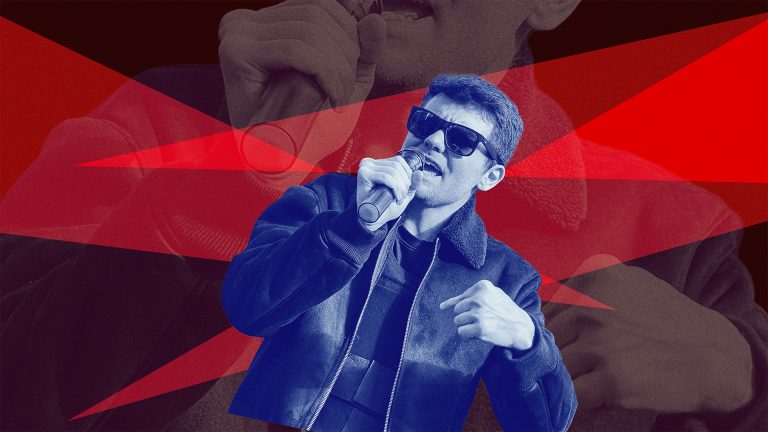
This moment of turbulence revealed the tensions lurking in the air and foreshadowed a much more consequential podcast in October. Carlson’s decision to grant Nick Fuentes, the 27-year-old neo-Nazi, unabashed racist, and leader of the online “Groyper” movement, a two-hour softball interview was a pivotal moment in the history of MAGA.
The inventory of appalling statements by Fuentes has grown familiar: “I don’t care about Auschwitz”; “I don’t want to live around black people. I just don’t”; “Jews are running society, women need to shut the fuck up, Blacks need to be imprisoned for the most part, and we would live in paradise”; and Hitler was “really fucking cool.”
None of this was, in itself, new: for years, Fuentes and his acolytes had tormented Kirk and sought to infiltrate TPUSA. What was new was Carlson’s calculated bid to help usher the young far right activist into the mainstream. As Fuentes attacked “organised Jewry” and American Jews who were “putting the interests of themselves before the interests of their home country”, his host gave him free rein.
Why? Because Kirk’s assassination had generated a moment of harmony. But it had also created a vacancy. Carlson wanted to be the one to consecrate MAGA’s new young prince.
“The engine of influencers that propelled Trump to a second term is now melting down: live by podcast, die by podcast. MAGA has hit the buff ers of an age-old predicament; of an insurgency that calcifies into an establishment”
All hell broke loose. Shapiro condemned Carlson for his “ideological laundering” of extremists. Murray accused him of trying to give Fuentes “a veneer of reasonableness and respectability.” The Florida congressman Randy Fine brandished a red “TUCKER IS NOT MAGA” sign.
But – crucially – the denunciations were far from universal within the movement. Shapiro’s Daily Wire colleague Walsh refused to join him in seeking Carlson’s banishment. Kelly responded by inviting her former Fox News colleague on to her show for a friendly discussion.
What was at stake? Carlson nailed it in his monologue on November 6: “This war is actually about what comes after Donald Trump.” The internal arguments over Gaza, the June attacks on Iran and now the moral status of Fuentes were all proxy battles in a larger (and inevitable) conflict over the future of MAGA.
In November, the temperature rose once more at TPUSA’s conference in Phoenix, Arizona, where Shapiro took aim again at Carlson and Owens – whom he had fired in 2024 over her increasingly antisemitic and conspiracist opinions. “The conservative movement is in serious danger,” he said, “from charlatans who claim to speak in the name of principle but actually traffic in conspiracism and dishonesty.”
Carlson and Kelly brushed this off in their own on-stage conversation and – in a clear indication of which side he was backing – Vance said pointedly that “President Trump did not build the greatest coalition in politics by running his supporters through endless self-defeating purity tests.” The French Revolution had the principle pas d’ennemis à gauche. The vice-president’s version was, in effect, “no enemies to the right”.
Suggested Reading
Nick Fuentes, American Nazi
Which brings us back to the present day and the ideological bedlam into which the war in Iran has plunged MAGA. For now at least, Shapiro and Levin have prevailed: the president is following the military strategy they support. But if that strategy fails, so will they in the eyes of the movement and the world.
With every episode, Carlson grows more incandescent, disgusted by his failure to dissuade Trump from the attack on February 28. Owens posts daily about “Zionist false flags” and claims that Jews worship the demon “Baal”. Fuentes just looks for clicks, even suggesting that he misses Barack Obama. They – and other influencers like them – wait to seize control of the movement in this defining hour.
Outside the inner MAGA circle, the stand-up stars – Rogan, Von, Schulz – are drifting away with a collective shrug of bafflement. When Rogan complained on March 10 that “a lot of people feel betrayed” by the war, the story made the homepage of the New York Times.
Even Yiannopoulos rose like a political zombie on March 16 to declare on X: “Every OG—and I do mean all of us—is off the fucking train, Trump.” On the same day, Cernovich posted more elegiacally: “A generational coalition, squandered.”
The engine of influencers that propelled Trump to a second term is now melting down: live by podcast, die by podcast. Political hegemony, to adapt Rick James, is a hell of a drug. It turns hunger into decadence, vigilance into preening rivalry. MAGA has hit the buffers of an age-old predicament; of an insurgency that calcifies into an establishment. In the words attributed to Georges Danton: “The revolution devours its own.”
The rag-tag army of punks and white nationalist subversives of 2015 has been supplanted by an oligarchy of digital grandees, presently forming a circular firing squad. And, after all: don’t stars always fall out? If your trade is spectacle and your objective is attention, you will naturally snipe at your competitors.
This lot don’t model themselves upon great US conservative intellectuals like Henry Kissinger, William F Buckley or Irving Kristol. They look instead for showbusiness beef: Bette Davis versus Joan Crawford, Biggie versus Tupac, Dwayne Johnson versus Vin Diesel. It is as pitiful as it is alarming.
Looking back on it all in her 2025 memoir – after mental collapse, drug abuse, sexual assault, and career oblivion – Lauren Southern reflects: “I don’t see heroes, just theatre… the direction of power itself is what’s most worrisome. An era of technofascism, algorithmic control, data and digital systems.” There is, she writes, a “cost to pretending you’re God.”
How can such a bunch of megalomaniacs possibly be entrusted with the trajectory of the mightiest nation on earth? The founding fathers, especially James Madison, warned of the pulverising power of “faction” and, in the 250th anniversary year of the republic, precisely what they feared has come to pass, in a form they could not have imagined.
These MAGA big shots, these little people posing as giants: they promised to drain the swamp but ended up creating a brand new one. Who gets out alive? Which of them wins? In the end, even as the world burns, that’s all they really care about.