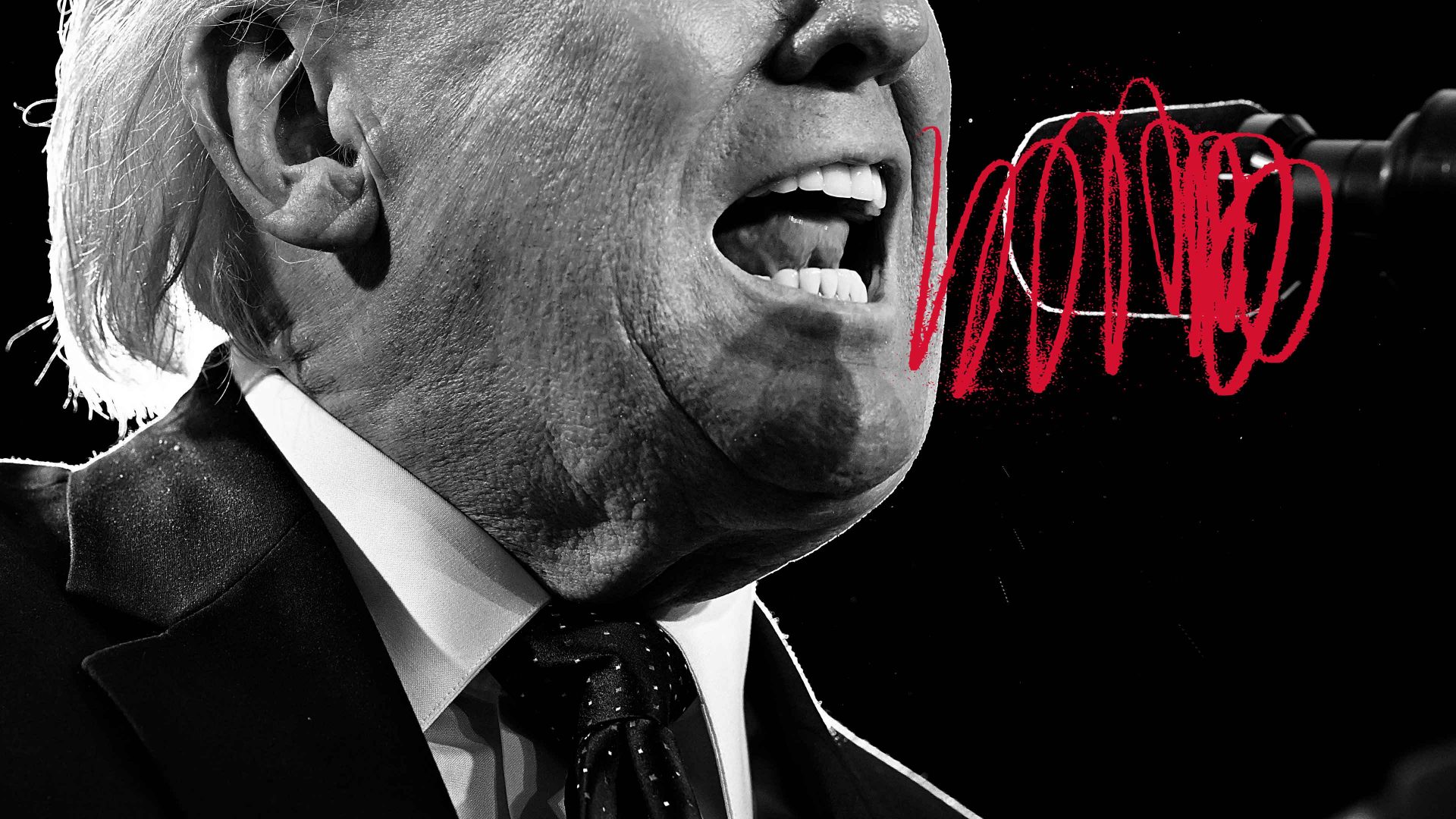
Never forget the night of Tuesday April 7, 2026. Even for seasoned observers of Donald Trump, it was different.
The president had, quite explicitly, promised that, unless the Iranian leadership acceded to his demands, “a whole civilization will die tonight”. Not until 11.32pm British time did he suspend that threat and announce a two-week truce.
This time, none of the usual excuses wheeled out by MAGA’s champions cut any ice. An apocalyptic ultimatum of this character, following his pledge on April 1 to bomb Iranians “back to the Stone Age, where they belong” and his enraged instruction on Easter Sunday to “Open the Fuckin’ Strait [of Hormuz], you crazy bastards, or you’ll be living in Hell”, simply couldn’t be waved aside as “Trump being Trump”; “trash talk”; or (a distinction that has aged woefully) words to be taken “seriously but not literally”.
And so what if he was “bluffing”? The most powerful person on earth cannot “bluff” with such psychopathic abandon and be regarded as anything but a clear and present menace to the world.
For the 10 hours and 26 minutes between the original Truth Social post and the second announcing the suspension of bombing, the tendrils of fear crept over the planet. I heard of friends panic buying petrol, groceries and medicine; an echo of “Black Saturday” – October 27, 1962 – the darkest night of the Cuban Missile Crisis.
True, the world was not, on this occasion, facing a thermonuclear exchange between two superpowers. But what unimaginable geopolitical horrors might a genocidal onslaught by the US upon Iran have unleashed? How quickly would the stitches of global order – already so badly frayed – have been entirely unpicked? There were, at least, protocols and conventions during the cold war. Trump’s threat promised only cataclysmic uncertainty, displacement, terror.
As TNW’s Paul Mason has written so compellingly, this conflict has turbocharged the case for a stronger European defence and economic identity, with the UK at its heart. I think it also presents the American people, in the 250th anniversary year of their independence, with a profound structural and cultural challenge; one that has been revealed by Trump but will outlast him. Its urgency cannot be overstated.
The founding principle of the US was opposition to monarchy. In Common Sense (1776), the most influential pamphlet in American history, Thomas Paine denied the scriptural basis of the institution and identified it with “idolatrous homage”.
In their construction of the constitution, the founding fathers sought to immunise the republic against the return of monarchy. When it was suggested to George Washington that he should become a king, he was outraged: “You could not have found a person to whom your schemes are more disagreeable.”
Yet the finest orator among the American revolutionaries, Patrick Henry, warned at the Virginia Ratifying Convention in 1788 that the constitution, in granting such great power to the presidency, left the republic vulnerable to a criminal occupant of that office who sought “to make one bold push for the American throne”.
The era of Trump has shown how prescient were Henry’s fears of a proto-despot on the rampage. As long ago as September 2017, he declared to the UN that the US might have “no choice but to totally destroy North Korea”.
Naturally, this unhinged language occasioned great alarm – what sort of president was this? But Trump was not already deep in a shooting war with Kim Jong Un, as he was with Iran when he unambiguously threatened it with annihilation.
Was it plausible that this most impulsive and disinhibited commander-in-chief might unleash Armageddon upon 93 million Iranians? Plausible enough that the White House felt obliged to deny that anything he or JD Vance had said “implied” that the US might use nuclear weapons. In context, this was not especially reassuring.
The most comforting – and the worst – response to what happened last week is to categorise Trump as a complete aberration, wait out the storm until January 2029, and depend upon the corrective power of democracy to restore normality (as if that still exists).
Among the champions of this approach, the most egregious is the frontrunner for the Democratic presidential nomination in 2028, Gavin Newsom. In Davos in February, he said: “I hope if there is nothing else I communicate today: Donald Trump is temporary. He’ll be gone in three years.”
Suggested Reading

How MAGA ate itself
This is reckless complacency. It is very likely that the Republicans will be badly beaten in the November mid-terms and entirely possible that they will lose the White House two years thereafter. But such electoral prospects offer impermanent political respite rather than structural repair.
It is madness to assume that Trump (re-elected in 2024 in spite of everything) is historically unique and that the new tech-entertainment-industrial complex will not spawn other populist presidents who share some or all of his pathologies. The extent to which his successors will be constrained by international alliances or law will be a matter of personal inclination rather than dependable geostrategic continuity.
The framers of the constitution were part of a civic elite steeped in the writings of Aristotle, Polybius, Cicero, Plutarch and Tacitus. Trump is the first president of the post-literate age, but he will not be the last. His lack of erudition is not simply a question of ignorance. It is about how he perceives time and consequence; his indifference to the lessons of the past, his callous disregard for the future (aside from his vulgarian obsession with monuments to himself).
Though an obsessive consumer of television, he is the first occupant of the Oval Office to be a captive of the digital instant: of social media posts, memes, and viral clips. He has reduced Theodore Roosevelt’s “bully pulpit” to deranged screeds on Truth Social.
To protect the republic against such a figure – and there will be others – requires more than a couple of Democratic victories and a collective sigh of global relief. What is needed now is systemic constitutional change: difficult, technical, facing long odds at every turn – but absolutely imperative.
As Jill Lepore writes in her magisterial We the People: A History of the US Constitution (2025), the original text was meant to be changed: this is the explicit purpose of the constitution’s fifth article. As Thomas Jefferson wrote to James Madison in September 1789: “no society can make a perpetual constitution, or even a perpetual law. The earth belongs always to the living generation.”
And yes, it is difficult, by design, to secure amendments: in most cases, the support of two-thirds of each house of Congress and the assent of three-quarters of state legislatures is required. But, as Lepore puts it, “the philosophy of amendment” has often flourished.
Madison himself was the shepherd of the first ten such revisions in the Bill of Rights (1791). Between 1865 and 1868, the Pennsylvania congressman Thaddeus Stevens was the driving force behind the 13th, 14th and 15th amendments, abolishing slavery, establishing birthright citizenship and enshrining Black suffrage.
As chairman of the Senate subcommittee on constitutional amendments between 1963 and 1981, Birch Bayh of Indiana oversaw four modifications in the 1960s alone, including the 25th amendment which defines the rules governing presidential succession and disability.
It is the invocation of this provision that, at the time of writing, more than 70 Democratic lawmakers have demanded in response to Trump’s conduct during the war. They will not succeed, because section 4 of that amendment – the passage addressing the removal of a president – is so heavily weighted in favour of the executive; which is one of many reasons why it has never been used.
First, the vice-president and half of the cabinet or “such other body as Congress may by law provide” must declare that the president is unable to discharge his duties – at which point the vice-president becomes acting president. If the removed commander-in-chief resists, both houses of Congress must, within 21 days, and by a two-thirds vote, ratify the original decision, or allow him to resume office.
“The most comforting – and the worst – response is to categorise Trump as a complete aberration, wait out the storm and depend on democracy to restore normality”
Clearly, there is not a chance in hell that Vance would take such a risk, or that Trump’s team of stooges would support him, or that either house would vote by such a margin to depose the president. In 2017, his second chief of staff, John F Kelly, reportedly took a straw poll to see if the cabinet might back such a perilous initiative – and found that most of them would not.
But the office of the commander-in-chief was very different 59 years ago, when the 25th amendment was ratified. The foundations of the imperial presidency had, it is true, already been laid by Franklin D Roosevelt. After Watergate, some powers were clawed back from the executive, notably by the 1978 Ethics in Government Act, which authorised the appointment of special prosecutors.
But the overall pattern thereafter was a radical accrual of power in the White House – most notably during George W Bush’s presidency, when his vice-president Dick Cheney capitalised upon the aftermath of 9/11 to implement the so-called “unitary executive theory” and maximise the authority of the federal government. None of Bush’s successors has significantly reversed this trend.
The dramatic change in the might of the presidency and the potential character of its future occupants of the office make an overwhelming case for constitutional amendment and a recalibration of the balance of power: especially on the most sensitive question of all, which is the right to remove the incumbent in times of extreme crisis.
It is a matter of record that the framers of the 25th amendment chose quite deliberately not to define presidential “inability” or the nature of the “other body” that Congress might appoint to assess such incapacity. Yes, they were thinking primarily of psychiatric or medical collapse (which is how Joe Biden could have been removed from office).
But “inability” can have many meanings when the person in question has immediate command and control over more than 5,000 nuclear warheads. The endless fixation with Trump’s sanity and age misses the point, because it focuses upon an individual rather than a systemic weakness.
Suggested Reading

He might hate Trump now, but Tucker Carlson is not your friend
Last week’s nerve-shredding brinkmanship should prompt a much greater degree of political imagination. An amended system needs to make provision for a president in good physical health who is not clinically insane but nonetheless announces – for example – that an entire civilisation should die.
If you think this is inconceivable, you have not been paying attention. Stephen Miller, the poisonous White House deputy chief of staff, is only 40. Do you think he, if elected to the presidency, would hesitate to push the button?
Again, the core rules of impeachment – under which a president may be deposed by the legislature for “treason, bribery, or other high crimes and misdemeanors” – have not changed since 1787. Congress brings charges by a simple majority but the Senate requires a two-thirds vote to convict. Only three presidents have been impeached – Andrew Johnson in 1868, Bill Clinton in 1998 and Trump in 2019 and 2021 – and none successfully.
The separation of powers has always been a sacred principle in the affairs of the US republic. The president is emphatically not a prime minister, removable by a vote of no confidence, as in a parliamentary system. But, as the political scientist Philip A Wallach argues in his bracing polemic Why Congress (2023), the legislature is “on its way to obsolescence”: at risk of becoming “little more than a venue for a partisan death match”, composed of tribal loyalists who spend much of their time confirming executive appointees and fund-raising. This decline is as dangerous as the relentless enhancement of presidential power and impunity.
The 120th Congress elected in November needs to look far beyond the immediate business of thwarting Trump in his last two years in office and going for the hat-trick of failed impeachments. It must begin the nightmarishly heavy lifting of radical amendment. In fact, its likely members should start planning that work now, looking at the 1973 War Powers Resolution, the proliferation of presidential executive orders, term limits in the supreme court, and much else besides. Their objective should be no less daunting and noble than to stop the next Trump – for there will be one; not from being elected, for that is impossible, but from leading the world to perdition.
For most of its first 250 years, the republic has depended upon norms as much as rules. We now live in an age that is shredding norms like old paper. It follows that the rules must be strengthened and the balance between institutions revised, however painful and time-consuming that task might be.
The framers of the constitution intended it to be a living document – and it is time to honour that commitment. Politics may be the art of the possible. But statesmanship is the clear-eyed recognition of the necessary.
The most important and unwelcome thing to understand about Trump is that he is only the start. For the republic to endure, it must now confront and embrace the difficulty of what is required.