

As so often, Jürgen Habermas foresaw what has come to pass. The great German philosopher, who died on Saturday aged 96, warned repeatedly that the orthodoxies of the post-cold war era would be overturned and that new strategies and ideas were urgently needed.
In a recently published collection of interviews, Things Needed to Get Better: Conversations with Stefan Müller-Doohm and Roman Yos, he spoke of “a rather disoriented West that refuses to acknowledge its own weakness… the West is still taking a casual political approach and doesn’t seem to realize that the undisputed superpower of the twentieth century has used up most of its moral credit”.
In a speech in Munich in November, Habermas also declared categorically – though with tempered confidence – that the European Union must “assert itself in world politics and world society independently of the USA and independently of system-incompatible compromises with the USA or other authoritarian states as an autonomous player.”
How resonant those words are today as the world is convulsed, perplexed and tested by the Iranian conflict. I don’t know when the war will be over, and neither do you. As AJP Taylor wrote in How Wars End (1985), they tend to conclude “raggedly”; it is often “very difficult to define the moment” when hostilities truly cease.
What I do know is that warfare, especially on this scale, is invariably consequential. It clarifies, reveals, and transforms, accelerating change and mutating all in its path. In any conflict, the battle of ideas is an all-important front.
Here are two conspicuous examples. In her classic work, Britons: Forging the Nation 1707-1837 (1992), Linda Colley shows that the modern concept of British nationhood was forged in the crucible of conflict and especially the Napoleonic wars of 1793-1815. As she writes: war with Catholic France forced Britons “into confrontation with an obviously hostile Other… They came to define themselves as a single people not because of any political or cultural consensus at home, but rather in reaction to the Other beyond their shores.”
Second, consider the extent to which the second world war entrenched and dramatically magnified the principles of Franklin D Roosevelt’s New Deal. In Total Defense: The New Deal and the Invention of National Security (2025), Andrew Preston shows how the 32nd president extended the ethos of his landmark social and economic reforms into a doctrine of global security overseen by the US.
The cold war, Preston writes, “didn’t result from departing from Roosevelt’s principles, but from applying them”. Donald Trump now commands the most ferocious military machine in the history of the world – one which, ironically, was built by a collectivist Democrat and his immediate successor, Harry Truman, who signed the formative National Security Act of 1947.
The examples multiply. Nye Bevan was explicit that the second world war had revealed “the shape of a national health service”. Widely regarded as an act of post-imperial hubris at the time, Margaret Thatcher’s decision in April 1982 to despatch a naval task force to the Falklands proved to be the defining moment of her premiership. In different eras and in different ways, the Vietnam and Iraq wars pulverised trust in public institutions.
For now, and understandably, the primary issues in this war are the capricious vagueness of Trump’s objectives, the human toll in the region (the UN estimates that up to 3.2 million Iranians have already been displaced), and the mounting economic price. But we should also be looking at a much broader canvas and asking difficult questions about what this conflict means and what it mandates.
On March 23, six years will have passed since Boris Johnson announced the first Covid lockdown. If you recall, the pandemic was supposed to encourage a grand embrace of long-termism; a fresh attention to resilience in all its forms; a shift from “just-in-time” to “just-in-case” supply chains; and a collective commitment to be “good ancestors”. None of this has happened.
Once again, we are witnessing the speed with which global commerce can be plunged into turmoil by an act of economic acupuncture – in this case, the blockade of the Strait of Hormuz, through which 20% of the world’s oil normally flows. Having insulted Keir Starmer as an unworthy successor to Churchill, Trump is now asking for the help of the UK in liberating this trade route – a request that, at the time of writing, the PM is reportedly resisting.
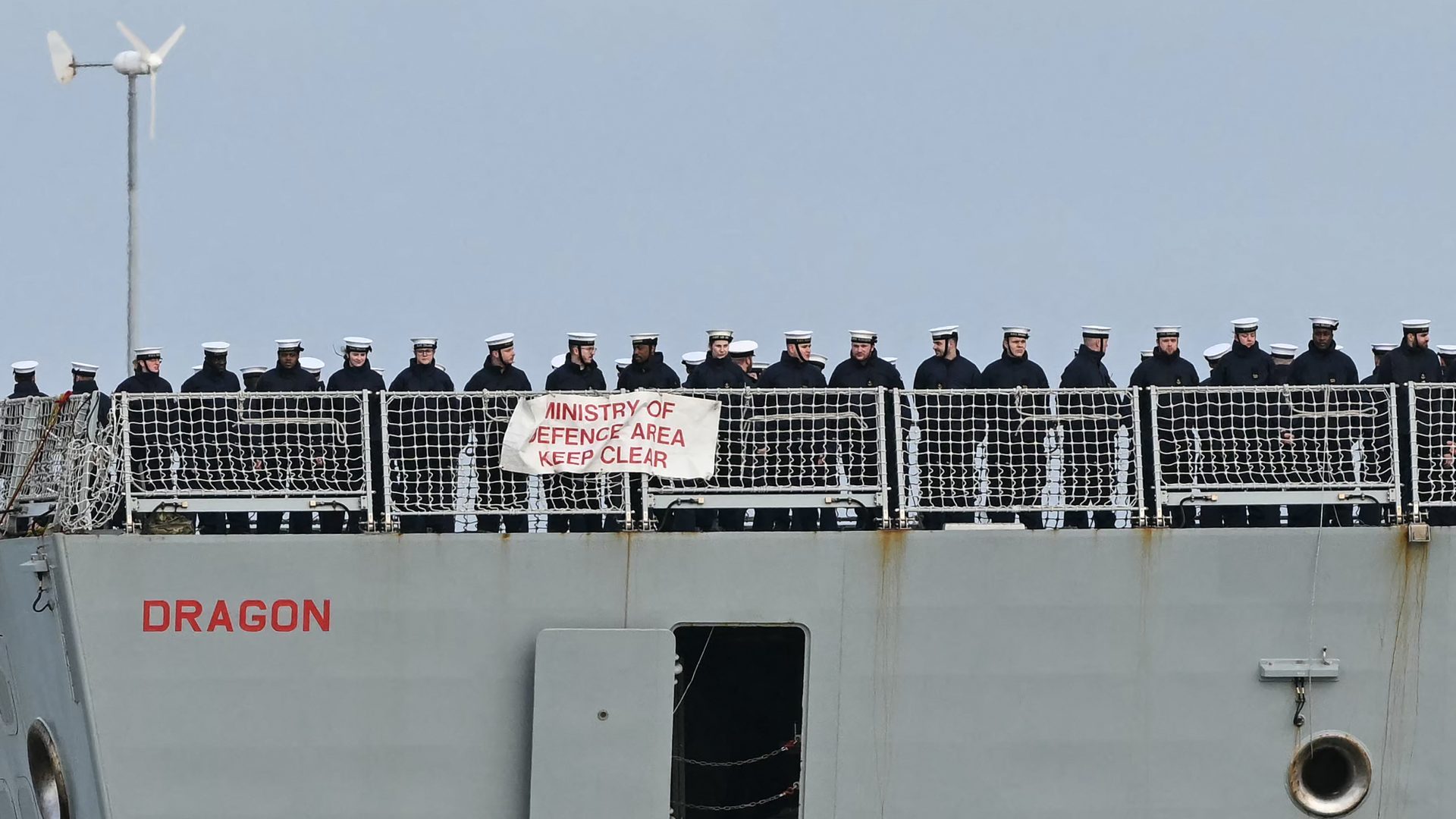
As the sad, postponed passage of HMS Dragon to Cyprus shows, there is only so much that Britain can do to help the US. Given the pathetically depleted state of our defensive capability – for which the Conservatives bear most of the blame – even a hawkish prime minister like Margaret Thatcher or Tony Blair would have struggled to add much beyond public solidarity to the US-Israeli operation.
This is why the Jesuitical argument about Starmer’s position on the war and his appeal to international law is mostly academic. If you can only bring a peashooter to a gun fight, it doesn’t really matter if you stay at home or not. You don’t have to be familiar with Clausewitz or Sun Tzu to know that feeling virtuous is not a strategy.
In 2026, of all years, we should be ready to think big again. A decade has passed since Trump’s first election and the Brexit referendum. What have we really learned? How rigorously have those of us who oppose populist nationalism scrutinised our own mistakes?
The most depressing response to the war has been an ill-disguised relish in some quarters at the failure of the US-Israeli campaign to yield instant success. Yes, it is of the highest importance to hold Trump and Benjamin Netanyahu to account for what they are doing.
But public discourse on the conflict has also been contaminated by a dismal quest among some politicians, podcasters and journalists – on both sides of the Atlantic – for personal vindication. Again, “I told you so” is not a strategy. We play Trump’s game if we resort to the same debased name-calling and self-congratulation that are his stock in trade.
Suggested Reading

Trump’s Iran war is a family business
This war is not an ideological triumph for anyone. It is possible both to deplore Trump’s grotesque bellicosity – his readiness to strike Kharg Island again “for fun” –and to recognise that the Iranian regime would represent a profound geopolitical threat even if Kamala Harris were in the Oval Office today.
Never forget that Barack Obama’s nuclear deal, from which Trump withdrew in May 2018, released at least $50bn in frozen assets and gave Tehran access to the international banking system, enabling it to build up the terrorist proxy forces that attacked Israel on October 7.
To understand the implacable character of Iranian theocracy, bear in mind the warning of Ken McCallum, director-general of MI5, in October that the security service had tracked “more than 20 potentially lethal Iran-backed plots in just the one year since I last stood at this podium [my italics].” His threat update was delivered more than four months before Operation Epic Fury.
I emphasise this because these are precisely the sort of thorny and nuanced questions that those who still believe in internationalism, democracy and pluralism should be addressing, whatever their opinions on the US-Israeli campaign. To state it more generally, we need to look beyond the war and hug the cactus of difficulty: one of the traps set by this conflict is to see it primarily as confirmation of all that we already think.
It is no longer sufficient to be anti-Trump and anti-Brexit. The second quarter of the century requires us to fashion a world that is post-Trump and post-Brexit. In 2016, we left an EU defined by a broad faith in social democracy, regulation, and population mobility. The Europe that I hope we shall join – and the sooner the better – will be shaped by hard power, radically enhanced defence and a readiness to tackle the grave geopolitical challenges that we have hitherto preferred to delegate to the American hegemon (while reserving the right to complain when this delegation goes sideways).
As things stand, the liberal order is in rapid decline. It may bounce along for a while: there will always be individual local and national election results and opinion polls that give hope to the relatives around the bed. But an unfiltered snapshot of the world today would acknowledge that we are fast heading towards an unstable multipolar system in which autocratic regimes (of varying ferocity) govern in restless coalition with a tiny number of mega-corporations; a world in which Elon Musk, Palantir’s Alex Karp, Sam Altman of OpenAI, and Nvidia’s Jensen Huang are much more powerful than most nations.
As we argue laboriously about access to social media for under-16s, these tech oligarchs are feasting upon our very souls, in what is only the first phase of the AI revolution. Indeed, it is terrifying how far most governments are lagging behind this technology’s warp-speed disruption of absolutely everything.
Some – like Trump’s – don’t care what AI does to disfigure the human experience. If, in the spirit of George Orwell’s O’Brien, you want a picture of the future, listen to Karp’s ill-concealed glee as he discusses his company’s role in this conflict. “What makes America special right now is our lethal capabilities, our ability to fight war,” he told CNBC last Thursday, adding that “the AI revolution is uniquely American”. Please note: Palantir’s share price has soared by almost 15% in the past month.
What is to be done? In this country, the progressive cause has been greatly endangered by the listless technocracy of Starmer’s premiership, and the drainage of Labour support to the Greens, now offering a bold (if impulsive) left wing populism of huge appeal to the young, to those excluded from economic opportunity and to many ethnic minority voters. This prime minister’s caution, style and demeanour are a perfect fit for the age; the problem is that the age in question is the 1950s.
None of which is to say that the situation is entirely hopeless. In a Wall Street Journal piece posted on Friday, Rahm Emanuel, a contender for the Democratic presidential nomination in 2028, warned his fellow US liberals not to “view this as some pop quiz about whether the Trump administration is heeding the Constitution. They need to realize that foreign policy demands results, not merely rules… What the American people need to hear from Democrats isn’t arguments about the process but a clear articulation of the strategy we would pursue.”
Suggested Reading

Trump’s dark legacy: The world now sees America as worse than China
Meanwhile, on March 9, at the EU ambassadors’ conference in Brussels, Ursula von der Leyen delivered one of the most perceptive and clear-sighted speeches of recent years – and one that should have been much more widely reported.
“You will hear different views about whether the conflict in Iran is a war of choice or a war of necessity,” the president of the European Commission said. “But I believe this debate partly misses the point. Because Europe must focus on the reality of the situation, to see the world as it actually is today… the idea that we can simply retrench and withdraw from this chaotic world is simply a fallacy.”
She continued: “Europe can no longer be a custodian for the old world order, for a world that has gone and will not return. We will always defend and uphold the rules-based system that we helped to build with our allies, but we can no longer rely on it as the only way to defend our interests or assume its rules will shelter us from the complex threats that we face.”
In her call for rapid diversification of supply chains, a much more muscular European defence project and a recognition that trade is an instrument of hard power, von der Leyen offered her fellow western leaders a provisional route-map for the future.
They will need it. Though this war may ruin Trump’s legacy and has seriously discombobulated Reform UK, its aftermath will almost certainly offer rich pickings for the populist right. High energy prices, potential stagflation, a refugee crisis that could dwarf the influx of Syrians to Europe in 2015: this is precisely the context in which angry nationalism prospers. Progressives need to prepare for that now.
The checklist should be familiar: wealth taxes; a huge hike in defence spending; a housing revolution; a new intergenerational contract; an honest recognition that globalisation has failed millions of people; a fair and firm debate about immigration and (especially) integration; net zero as a pillar of national security; a real-time approach to tech regulation.
All of this is possible and much of it is obvious. What is lacking? Candour, audacity, the courage to lead: qualities that war sometimes nurtures in what Habermas described as the “public sphere”.
He also called for “constitutional patriotism”: an urgent sense of civic idealism and a commitment to change; a sense of ourselves not only as impatient consumers and digital tribalists, but as citizens. That this seems such a revolutionary idea in 2026 is a reproach – but should also be an inspiration.
 Most popular
It’s official: Reform has slumped in the polls
Pedro Sánchez is outclassing Trump with the president’s own tactics
Trump’s dark legacy: The world now sees America as worse than China
The bombs and the bombshell: At home in Dubai with Isabel Oakeshott